EasyManua.ls Logo

Sony ICF-6800W - Circuit Description - PLL Synthesizer

Sony ICF-6800W
60 pages
Print Icon
To Next Page IconTo Next Page
To Previous Page IconTo Previous Page
Loading...
1-2,
CIRCUIT
DESCRIPTION
This
receiver has
a
high
degree
of
stability
which
is
achieved
by
replacing
the
first
local
oscillator
of
the
shortwave
double-super
heterodyne
circuitry
with
a
PLL
synthesizer.
The
following
is
a
brief
circuit
description.
1)
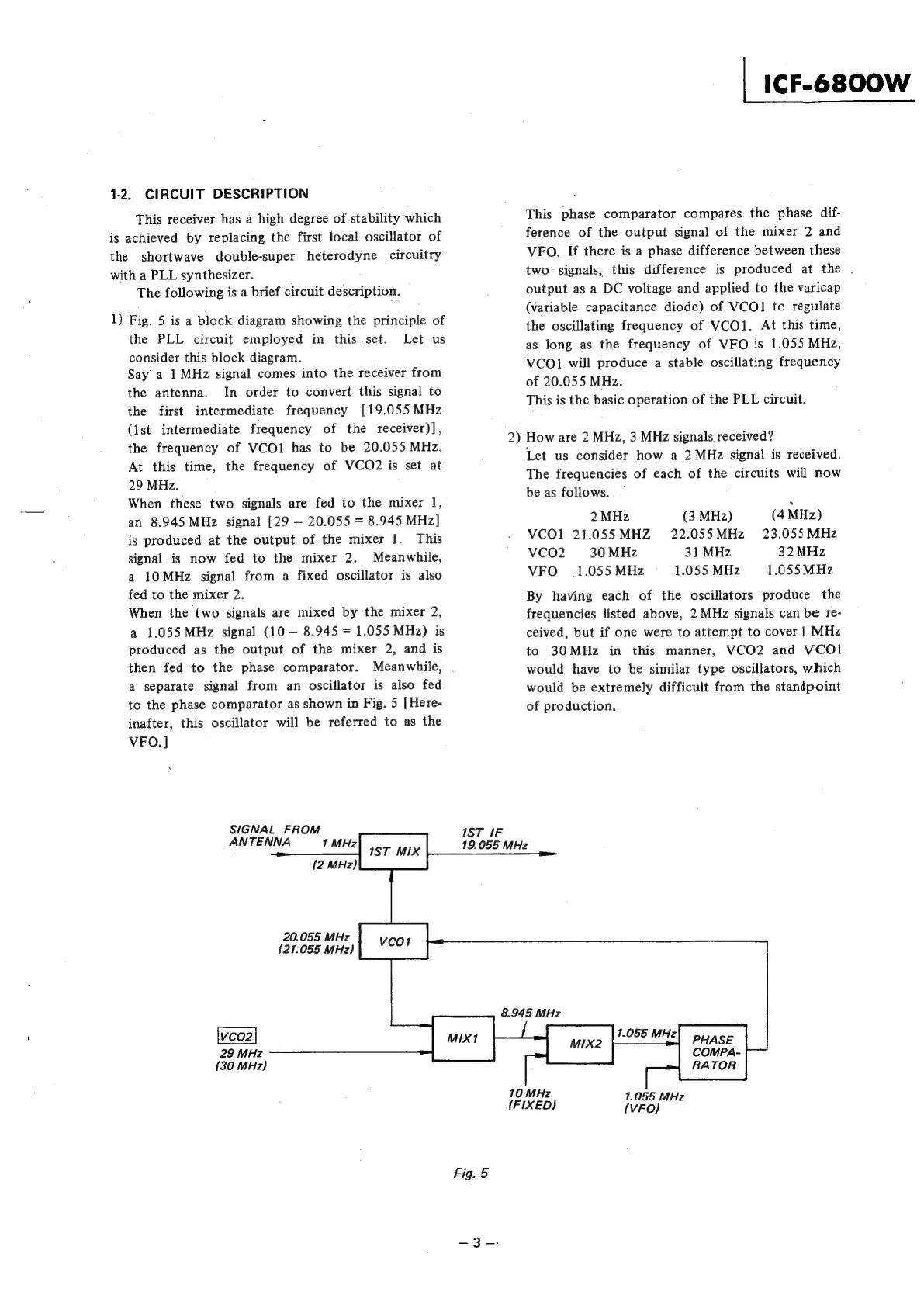
Fig.
5
is
a
block
diagram
showing
the
principle
of
the
PLL
circuit
employed
in
this
set.
Let
us
consider
this
block
diagram.
Say
a
1
MHz
signal
comes
into
the
receiver
from
the
antenna.
In
order
to
convert
this
signal
to
the
first
intermediate
frequency
[19.055
MHz
(ist
intermediate
frequency
of
the
receiver)],
the
frequency
of
VCO1
has
to
be
20.055
MHz.
At
this
time,
the
frequency
of
VCO2
is
set
at
29
MHz.
When
these
two
signals
are
fed
to
the
mixer
1,
an
8.945
MHz
signal
[29
20.055
=
8.945
MHz]
is
produced
at
the
output
of.
the
mixer
1.
This
signal
is
now
fed
to
the
mixer
2.
Meanwhile,
a
10MHz
signal
from
a
fixed
oscillator
is
also
fed
to
the
mixer
2.
When
the
two
signals
are
mixed
by
the
mixer
2,
a
1.055
MHz
signal
(10
8.945
=
1.055
MHz)
is
produced
as
the
output
of
the
mixer
2,
and
is
then
fed
to
the
phase
comparator.
Meanwhile,
a
separate
signal
from
an
oscillator
is
also
fed
to
the
phase
comparator
as
shown
in
Fig.
5
[Here-
inafter,
this
oscillator
will
be
referred
to
as
the
VFO.
]
SIGNAL
FROM
ANTENNA
1
MHz
1ST
MIX
20.055
MHz
(21.055
MHz)
29
MHz
(30
MHz}
19.055
MHz
8.945
MHz
ICF-6800W
This
phase
comparator
compares
the
phase
dif-
ference
of
the
output
signal
of
the
mixer
2
and
VFO.
If
there
is
a
phase
difference
between
these
two
signals,
this
difference
is
produced
at
the
.
output
as
a
DC
voltage
and
applied
to
the
varicap
(variable
capacitance
diode)
of
VCO1
to
regulate
the
oscillating
frequency
of
VCO1.
At
this
time,
as
long
as
the
frequency
of
VFO
is
1.055
MHz,
VCO1
will
produce
a
stable
oscillating
frequency
of
20.055
MHz.
This
is
the
basic
operation
of
the
PLL
circuit.
2)
How
are
2
MHz,
3
MHz
signals,
received?
Let
us
consider
how
a
2
MHz
signal
is
received.
The
frequencies
of
each
of
the
circuits
will
now
be
as
follows.
2
MHz
(3
MHz)
(4
MHz)
VCO1
21.055MHZ
22.055MHz
23.055MHz
vVCO2.
+30MHz
31
MHz
32
MHz
VFO
1.055
MHz
1.055
MHz
1.055MHz
By
having
each
of
the
oscillators
produce
the
frequencies
listed
above,
2
MHz
signals
can
be
re-
ceived,
but
if
one
were
to
attempt
to
cover
|
MHz
to
30MHz
in
this
manner,
VCO2
and
VCO1
would
have
to
be
similar
type
oscillators,
which
would
be
extremely
difficult
from
the
standpoint
of
production.
10
MHz
1
(FIXED)
He
on

Other manuals for Sony ICF-6800W

Related product manuals