EasyManua.ls Logo

Sony ICF-6800W - VCO2 Operation and Frequency Control

Sony ICF-6800W
60 pages
Print Icon
To Next Page IconTo Next Page
To Previous Page IconTo Previous Page
Loading...
ICF-6800W
|
3)
VCO2
of
ICF-6800W
Accordingly,
the
circuitry
of
the
ICF-6800W
is
put
together
as
shown
in
Fig.
6,
in
determining
the
oscillating
frequencies
of
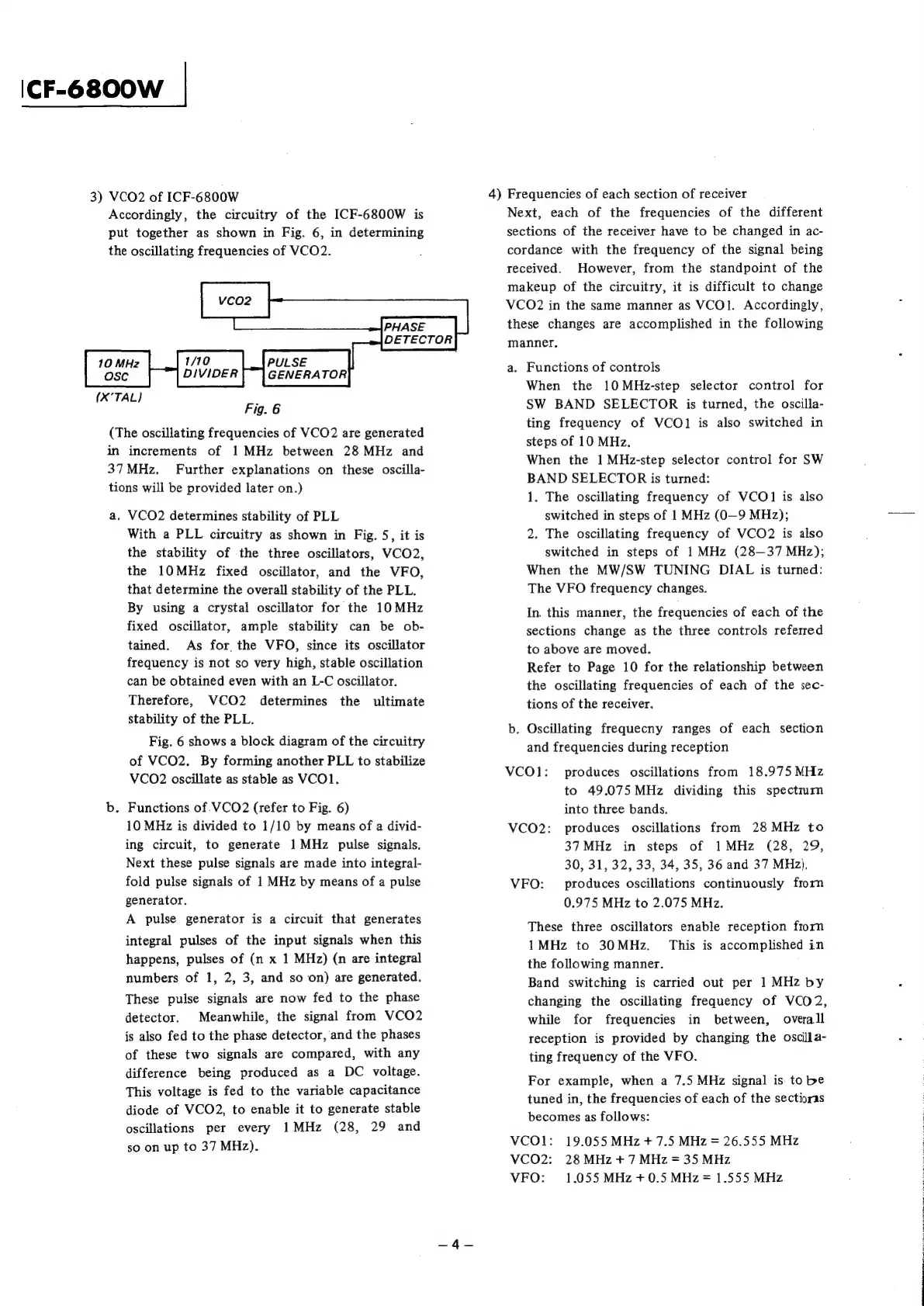
VCO2.
1/10
PULSE
DIVIDER
GENERATOR
(X’TAL}
Fig.
6
(The
oscillating
frequencies
of
VCO2
are
generated
in
increments
of
1
MHz
between
28
MHz
and
37MHz.
Further
explanations
on
these
oscilla-
tions
will
be
provided
later
on.)
a.
VCO2
determines
stability
of
PLL
With
a
PLL
circuitry
as
shown
in
Fig.
5,
it
is
the
stability
of
the
three
oscillators,
VCO2,
the
10MHz
fixed
oscillator,
and
the
VFO,
that
determine
the
overall
stability
of
the
PLL.
By
using
a
crystal
oscillator
for
the
10
MHz
fixed
oscillator,
ample
stability
can
be
ob-
tained.
As
for,
the
VFO,
since
its
oscillator
frequency
is
not
so
very
high,
stable
oscillation
can
be
obtained
even
with
an
L-C
oscillator.
Therefore,
VCO2
determines
the
ultimate
stability
of
the
PLL.
Fig.
6
shows
a
block
diagram
of
the
circuitry
of
VCO2.
By
forming
another
PLL
to
stabilize
VCO2
oscillate
as
stable
as
VCO1.
b.
Functions
of
VCO2
(refer
to
Fig.
6)
10
MHz
is
divided
to
1/10
by
means
of
a
divid-
ing
circuit,
to
generate
1
MHz
pulse
signals.
Next
these
pulse
signals
are
made
into
integral-
fold
pulse
signals
of
1
MHz
by
means
of
a
pulse
generator.
A
pulse
generator
is
a
circuit
that
generates
integral
pulses
of
the
input
signals
when
this
happens,
pulses
of
(n
x
1
MHz)
(n
are
integral
numbers
of
1,
2,
3,
and
so
on)
are
generated.
These
pulse
signals
are
now
fed
to
the
phase
detector.
Meanwhile,
the
signal
from
VCO2
is
also
fed
to
the
phase
detector,
and
the
phases
of
these
two
signals
are
compared,
with
any
difference
being
produced
as
a
DC
voltage.
This
voltage
is
fed
to
the
variable
capacitance
diode
of
VCO2,
to
enable
it
to
generate
stable
oscillations
per
every
1MHz
(28,
29
and
so
on
up
to
37
MHz).
vco2
PHASE
DETECTOR
4)
Frequencies
of
each
section
of
receiver
Next,
each
of
the
frequencies
of
the
different
sections
of
the
receiver
have
to
be
changed
in
ac-
cordance
with
the
frequency
of
the
signal
being
received.
However,
from
the
standpoint
of
the
makeup
of
the
circuitry,
it
is
difficult
to
change
VCO2
in
the
same
manner
as
VCO1.
Accordingly,
these
changes
are
accomplished
in
the
following
manner.
a.
Functions
of
controls
When
the
10MHz-step
selector
control
for
SW
BAND
SELECTOR
is
turned,
the
oscilla-
ting
frequency
of
VCO1
is
also
switched
in
steps
of
10
MHz.
When
the
1
MHz-step
selector
control
for
SW
BAND
SELECTOR
is
turned:
1.
The
oscillating
frequency
of
VCO1
is
also
switched
in
steps
of
1
MHz
(0O—9
MHz);
2.
The
oscillating
frequency
of
VCO2
is
also
switched
in
steps
of
1
MHz
(28—37
MHz);
When
the
MW/SW
TUNING
DIAL
is
turned:
The
VFO
frequency
changes.
In.
this
manner,
the
frequencies
of
each
of
the
sections
change
as
the
three
controls
referred
to
above
are
moved.
Refer
to
Page
10
for
the
relationship
between
the
oscillating
frequencies
of
each
of
the
sec-
tions
of
the
receiver,
b.
Oscillating
frequecny
ranges
of
each
section
and
frequencies
during
reception
VCO1:
produces
oscillations
from
18.975
MHz
to
49.075
MHz
dividing
this
spectrum
into
three
bands.
VCO2:
produces
oscillations
from
28
MHz
to
37
MHz
in
steps
of
1MHz
(28,
29,
30,
31,
32,
33,
34,
35,
36
and
37
MHz),
VFO:
produces
oscillations
continuously
from
0.975
MHz
to
2.075
MHz.
These
three
oscillators
enable
reception
fromm
1MHz
to
30MHz.
This
is
accomplished
in
the
following
manner.
Band
switching
is
carried
out
per
1
MHz
by
changing
the
oscillating
frequency
of
VCO2,
while
for
frequencies
in
between,
overall
reception
is
provided
by
changing
the
oscilla-
ting
frequency
of
the
VFO.
For
example,
when
a
7.5
MHz
signal
is:
to
be
tuned
in,
the
frequencies
of
each
of
the
sectioras
becomes
as
follows:
VCO1:
19.055
MHz
+
7.5
MHz
=
26.555
MHz
VCO2:
28
MHz
+7
MHz
=
35
MHz
VFO:
=
1.055
MHz
+
0.5
MHz
=
1.555
MHz

Other manuals for Sony ICF-6800W

Related product manuals