EasyManua.ls Logo

Sony ICF-7600DA - Page 16

Sony ICF-7600DA
56 pages
Print Icon
To Next Page IconTo Next Page
To Previous Page IconTo Previous Page
Loading...
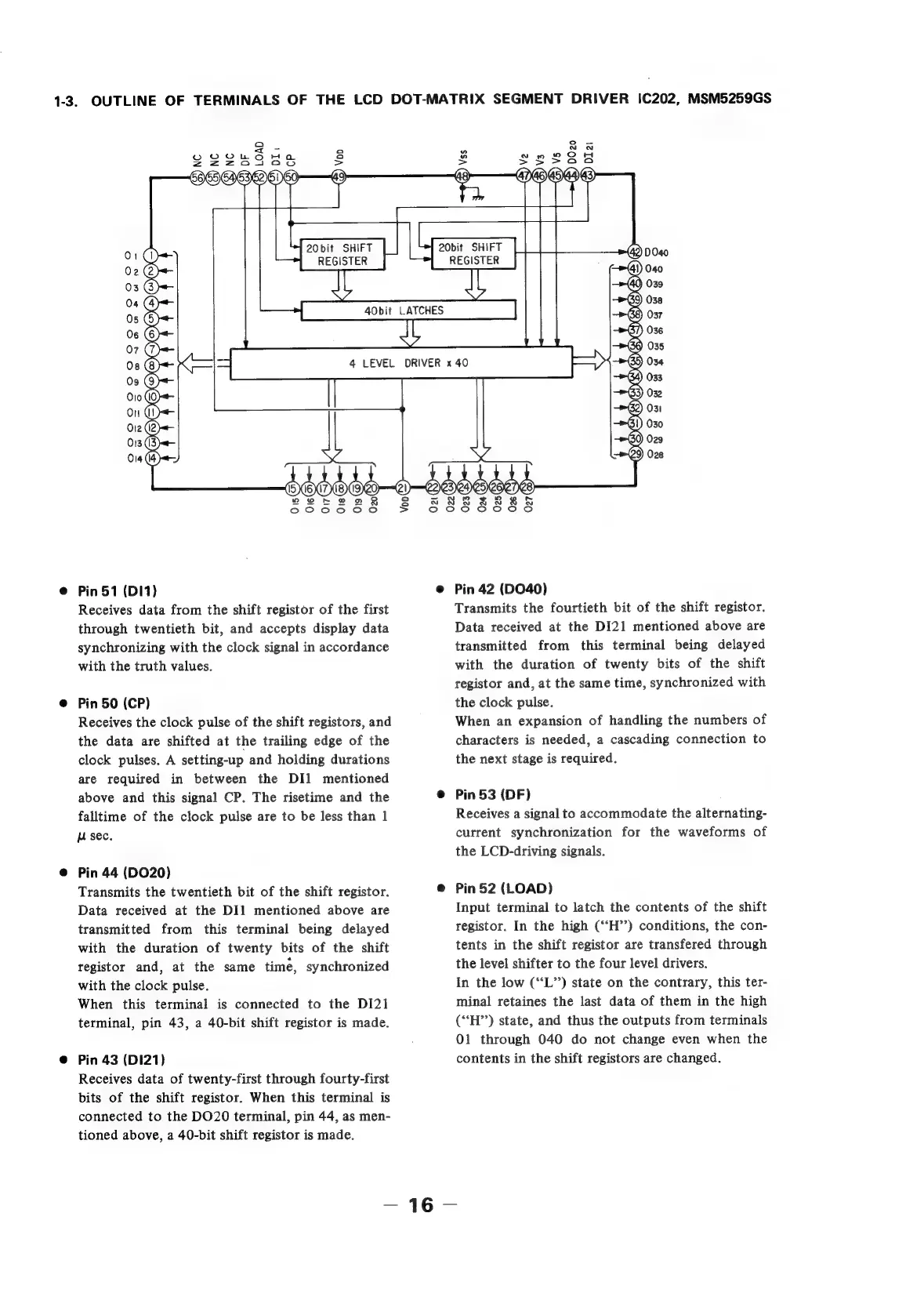
1-3.
OUTLINE
OF
TERMINALS
OF
THE
LCD
DOT-MATRIX
SEGMENT
DRIVER
IC202,
MSM5259GS
a
o
a
43)
&
:
>
@9)
01
(1)
2]
02
@)
03
G)
04
@)
0s
6)
06
6)
07
@)
08
(8)
03
Q)
O10 (0)
on
()
012
013
(3)
014
(4)
@
Pin
51
(DI1)
Receives
data
from
the
shift
registor
of
the
first
through
twentieth
bit,
and
accepts
display
data
synchronizing
with
the
clock
signal
in
accordance
with
the
truth
values.
Pin
50
(CP)
Receives
the
clock
pulse
of
the
shift
registors,
and
the
data
are
shifted
at
the
trailing
edge
of
the
clock
pulses.
A
setting-up
and
holding
durations
are
required
in
between
the
DI1
mentioned
above
and
this
signal
CP.
The
risetime
and
the
falltime
of
the
clock
pulse
are
to
be
less
than
1
sec.
Pin
44
(DO20)
Transmits
the
twentieth
bit
of
the
shift
registor.
Data
received
at
the
DI1
mentioned
above
are
transmitted
from
this
terminal
being
delayed
with
the
duration
of
twenty
bits
of
the
shift
registor
and,
at
the
same
time,
synchronized
with
the
clock
pulse.
When
this
terminal
is
connected
to
the
D121
terminal,
pin
43,
a
40-bit
shift
registor
is
made.
Pin
43
(DI21)
Receives
data
of
twenty-first
through
fourty-first
bits
of
the
shift
registor.
When
this
terminal
is
connected
to
the
DO20
terminal,
pin
44,
as
men-
tioned
above,
a
40-bit
shift
registor
is
made.
Ql)
oa
$s
@
Pin
42
(D040)
Transmits
the
fourtieth
bit
of
the
shift
registor.
Data
received
at
the
DI21
mentioned
above
are
transmitted
from
this
terminal
being
delayed
with
the
duration
of
twenty
bits
of
the
shift
registor
and,
at
the
same
time,
synchronized
with
the
clock
pulse.
When
an
expansion
of
handling
the
numbers
of
characters
is
needed,
a
cascading
connection
to
the
next
stage
is
required.
Pin
53
(DF)
Receives
a
signal
to
accommodate
the
alternating-
current
synchronization
for
the
waveforms
of
the
LCD-driving
signals.
Pin
52
(LOAD)
Input
terminal
to
latch
the
contents
of
the
shift
registor.
In
the
high
(‘‘H’’)
conditions,
the
con-
tents
in
the
shift
registor
are
transfered
through
the
level
shifter
to
the
four
level
drivers.
In
the
low
(‘“‘L”’)
state
on
the
contrary,
this
ter-
minal
retaines
the
last
data
of
them
in
the
high
(“‘H”’)
state,
and
thus
the
outputs
from
terminals
01
through
040
do
not
change
even
when
the
contents
in
the
shift
registors
are
changed.

Related product manuals