2
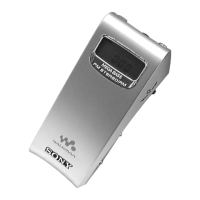
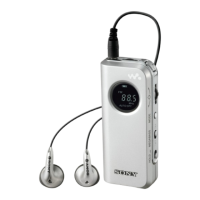
SRF-M97
TABLE OF CONTENTS
1. GENERAL ................................................................... 3
2. DISASSEMBLY
2-1. Disassembly Flow ........................................................... 4
2-2. MAIN Board, Cabinet (Front) Assy ................................ 4
2-3. Side Panel Section, Cabinet (Rear) Assy......................... 5
2-4. AMP Board...................................................................... 5
3. ELECTRICAL ADJUSTMENTS ......................... 6
4. DIAGRAMS ................................................................. 8
4-1. Schematic Diagram ......................................................... 9
4-2. Printed Wiring Board – MAIN Board – .......................... 10
4-3. Printed Wiring Board – AMP Board – ............................ 11
5. EXPLODED VIEWS
5-1. Cabinet (Front) Section ................................................... 14
5-2. Cabinet (Rear) Section .................................................... 15
6. ELECTRICAL PARTS LIST................................ 16
Notes on chip component replacement
• Never reuse a disconnected chip component.
• Notice that the minus side of a tantalum capacitor may be
damaged by heat.
Flexible Circuit Board Repairing
• Keep the temperature of the soldering iron around 270 ˚C
during repairing.
• Do not touch the soldering iron on the same conductor of the
circuit board (within 3 times).
• Be careful not to apply force on the conductor when soldering
or unsoldering.
UNLEADED SOLDER
Boards requiring use of unleaded solder are printed with the lead-
free mark (LF) indicating the solder contains no lead.
(Caution: Some printed circuit boards may not come printed with
the lead free mark due to their particular size)
: LEAD FREE MARK
Unleaded solder has the following characteristics.
• Unleaded solder melts at a temperature about 40 °C higher
than ordinary solder.
Ordinary soldering irons can be used but the iron tip has to be
applied to the solder joint for a slightly longer time.
Soldering irons using a temperature regulator should be set to
about 350 °C.
Caution: The printed pattern (copper foil) may peel away if
the heated tip is applied for too long, so be careful!
• Strong viscosity
Unleaded solder is more viscou-s (sticky, less prone to flow)
than ordinary solder so use caution not to let solder bridges
occur such as on IC pins, etc.
• Usable with ordinary solder
It is best to use only unleaded solder but unleaded solder may
also be added to ordinary solder.




 To Next Page