,8
MAITENANCE E CLEANING
BSS-134
CHAP.- 10
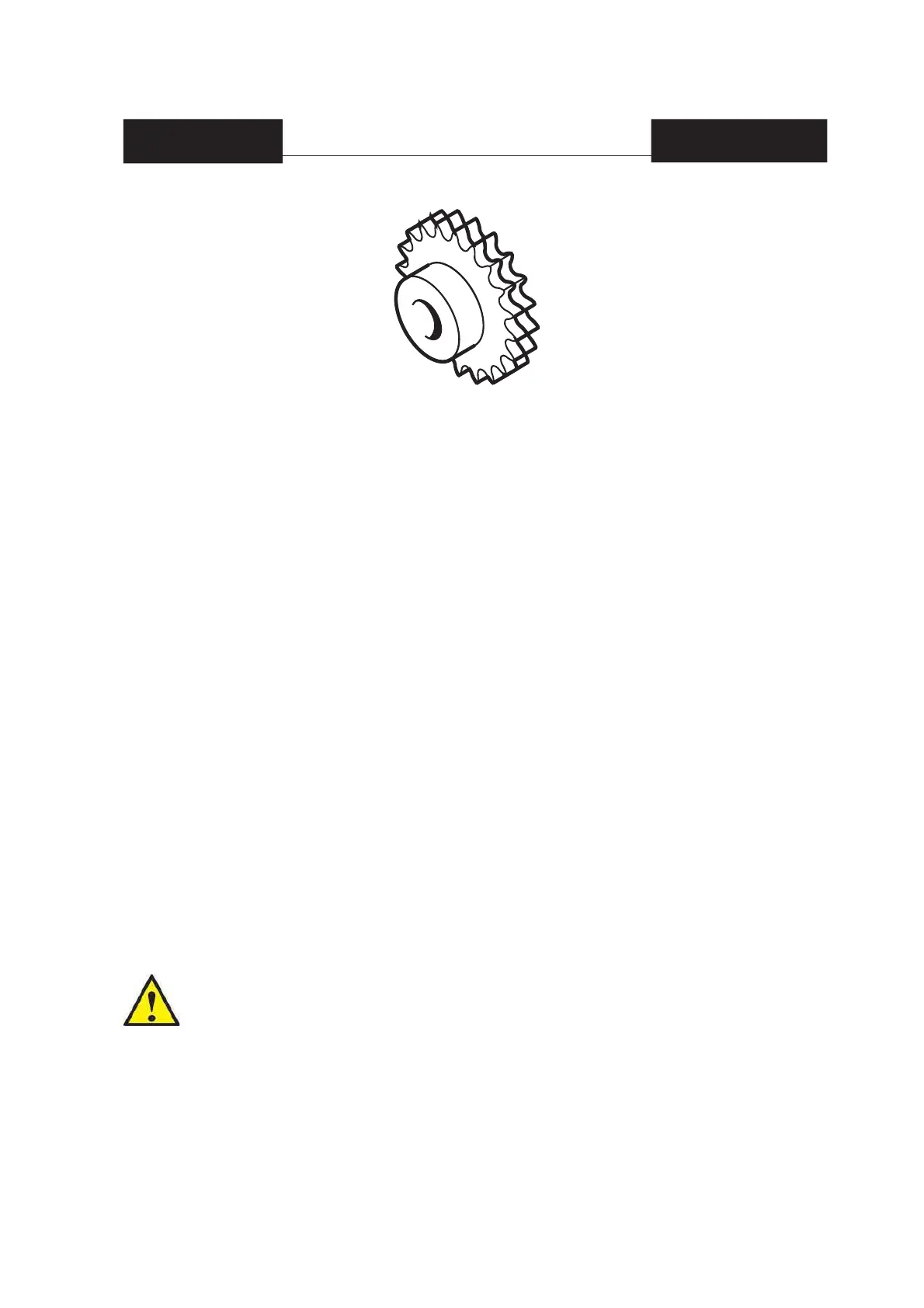
Pinions
The pinions are the toothed wheels on which the chains rotate, transmitting the movement. The life-span
of a pinion is limited, it is therefore some times necessary to replace it. A pinion can be idle or motor.
For the extraction of a pinion, the following must be taken into consideration:
Motor Pinions
Dismantle the stop device (Seeger, or head screw, etc.) and remove the pinion.
Idle Pinions
Dismantle the supports fi xing the shaft, by loosening the pins (built-in hexagon head-less screw).
Loosen the pins of the locking ring that hold the pinion on the shaft.
Supports for Bearings
The bodies of the supports are made of cast iron or printed steel sheet. The cast iron ones are
provided with greaser. The supports are suitable for working in places with variable temperatures
between -5° and +50°C.
Lubrication
Before starting lubrications, accurately clean the greaser. The grease must be introduced with pressure,
making the bearing rotate and continuing until the fresh grease leaks from the same bearing.
Avoid excessive pressure so as not to damage the seal gaskets.
The lubrication intervals depend on the working conditions and signifi cantly differ.
We recommend greasing at least every two weeks during the working seasons.
Assembly instructions
The shaft must be perfectly cylindrical, clean, with the ends rounded off to facilitate introduction in
the bearing’s hole. Never use the hammer as it may damage the bearing.
When assembly on the shaft is complete, make the shaft turn to verify its free and correct rotation.
When installing a support, the relative bearing must not be locked on the shaft until the body is securely
fastened to the machine. In this way, the bearing can assume its correct position on the same shaft
without damaging stresses arising.


 To Next Page