Freeze-Drying Concepts
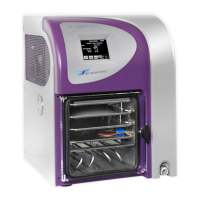
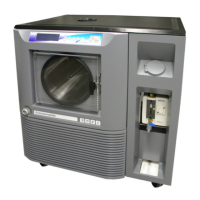
irTis BenchTop 2K, 4K and 6
8 Rev 007, 10/11
© SP Scientific 2011
Heat
Adding heat to the frozen product speeds the drying process. The BenchTop unit is
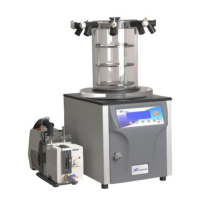
designed to be used as either a manifold freeze dryer or a tray dryer. Exposing
glassware containing frozen product to ambient room temperature helps drive the
drying process by adding heat. This causes the frozen solvents in the product to
sublimate and then migrate to the colder surface of the condenser wall.
Several heated and unheated racks and stoppering accessories are available for
freeze-drying in drum manifolds.
In its simplest configuration, a BenchTop unit will freeze-dry products on the partially
raised vacuum baffle in the center of the condenser. Heat will be added by radiation
through the acrylic cover.
Condenser
Trapping water vapor molecules in the form of ice on the condenser surface
effectively removes moisture from the product. The refrigeration system cools the
internal condenser at the bottom of the chamber to attract and trap vapors migrating
off the product.
The condenser is located under the manifold to provide the shortest vapor path to
achieve the maximum drying rate. The condenser capacity ranges from 3 to 9 liters,
which indicates the maximum volume that can be condensed from the product before
defrosting is necessary.
Product Dependencies
The freeze-drying process is completely dependent upon, and will therefore change
with, each specific product. In all cases, the condenser temperature must be cold
enough to trap the vapors migrating from the product effectively. If the condenser is
not cold enough,
excess vapors may be pulled into the vacuum pump inadvertently.
To compensate for this issue, SP Scientific offers optional filter and liquid nitrogen
(N
2(liq)
) traps.


 To Next Page