EasyManua.ls Logo

ST STM32F072 - User Manual

ST STM32F072
27 pages
Print Icon
To Next Page IconTo Next Page
Loading...
March 2020 UM1690 Rev 3 1/27
UM1690
User manual
Discovery kit for STM32F0 Series microcontrollers
with STM32F072RB
Introduction
The STM32F072 Discovery kit (32F072BDISCOVERY) helps users to discover the full
features of the STM32F0 Series and develop their applications. It is based on an
STM32F072RBT6 microcontroller and includes an ST-LINK/V2 embedded debug tool
interface, ST MEMS gyroscope, LEDs, push-buttons, linear touch sensor, touch keys, RF
EEPROM connector and a USB Mini-B connector.
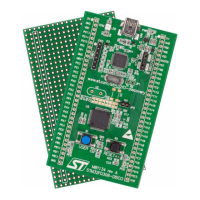
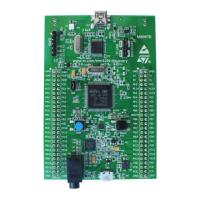
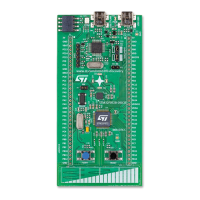
Figure 1. STM32F072 Discovery kit
Picture is not contractual.
www.st.com
Question and Answer IconNeed help?

Do you have a question about the ST STM32F072 and is the answer not in the manual?

Summary

Introduction

Features

Ordering Information

Product Marking

Details on evaluation sample ('ES' or 'E') product marking on the device.

Codification

Explains the meaning of the product codification for the discovery kit.

Development Environment

System Requirements

Lists the operating systems and cable needed for development.

Development Toolchains

Specifies the recommended software tools for development.

Demonstration Software

Information about the preloaded demo software and its source code.

Conventions

ON;OFF Conventions

Defines jumper and solder bridge states (ON/OFF) used in the document.

Hardware Layout

Embedded ST-LINK;V2

Describes the integrated ST-LINK/V2 debugger and its usage modes.

ST-LINK;V2 Connections

Details how to connect the ST-LINK/V2 for on-board programming.

External ST-LINK;V2 Connection

Explains connecting ST-LINK/V2 to an external STM32 application.

Power Supply and Selection

Covers power supply options and selection on the discovery board.

LEDs and Pushbuttons

Describes the function and connections of LEDs and pushbuttons.

Touch Sensors and USB Device

Details linear touch sensor, touch keys, and USB device functionality.

BOOT0 Configuration and Bootloader

Explains BOOT0 pin configuration and the embedded USB bootloader.

Gyroscope and Connectors

Covers the MEMS gyroscope and extension/EEPROM connectors.

OSC Clock Configuration

Details the configuration of OSC clock sources for the MCU.

Solder Bridges

Explains the function and states of various solder bridges on the board.

Extension Connectors

Describes the male headers P1 and P2 for connecting to external boards.

MCU Pin Description

Provides a detailed mapping of MCU pins to board functions.

Mechanical Drawing

Revision History

Overview

The STM32F072 Discovery kit, also known as the 32F072BDISCOVERY, is a comprehensive evaluation tool designed to help users explore the full capabilities of the STM32F0 Series microcontrollers and develop their applications. It is built around an STM32F072RBT6 microcontroller, which is based on the Arm Cortex-M0 processor and features 128 Kbytes of Flash memory and 16 Kbytes of SRAM in an LQFP64 package.

Function Description

The primary function of the STM32F072 Discovery kit is to provide a platform for programming, debugging, and testing applications for the STM32F072RBT6 microcontroller. It integrates an ST-LINK/V2 embedded debug tool interface, which allows for in-circuit programming and debugging of the on-board MCU or an external STM32 application. The kit supports Serial Wire Debug (SWD) for STM32 devices.

The board includes a variety of peripherals to facilitate diverse application development. For motion sensing, it incorporates an I3G4250D ST MEMS motion sensor, a 3-axis digital output gyroscope. User interaction is enabled through six LEDs (one red/green for USB communication, one red for 3.3 V power on, and four user-configurable LEDs in red, orange, green, and blue) and two push-buttons (one for user input and one for reset).

For human interface applications, the kit features a linear touch sensor, which can be configured as a 3-position linear touch sensor or four individual touch keys. This allows for the development of touch-sensitive interfaces.

Connectivity options include a USB Mini-B connector for USB FS (Full Speed) communication, enabling the board to act as a USB device (e.g., a joystick or mouse). An RF EEPROM connector is also provided for connecting an RF EEPROM daughterboard, supporting applications involving dynamic NFC tags.

The board offers flexible power supply options, allowing it to be powered via the USB bus from a host PC or an external 5 V supply voltage. It also provides 3 V and 5 V power outputs for external applications, with a consumption limit of 100 mA.

Usage Features

The STM32F072 Discovery kit is designed for ease of use, making it suitable for both beginners and experienced developers.

  • Programming and Debugging: The embedded ST-LINK/V2 can be configured in two ways. By default, with both CN5 jumpers fitted, it programs and debugs the on-board STM32F072RBT6. To program an external STM32 application, the CN5 jumpers must be removed, and the external application connected to the CN4 debug connector. This flexibility allows the kit to serve as a standalone ST-LINK/V2 debugger.
  • Power Management: The board can be powered by either the USB ST-LINK or USB USER connector, or an external 5 V supply. Diodes D1 and D2 protect the 5 V and 3 V pins from external power supplies, ensuring safe operation. The kit can also power external application boards, providing 3 V and 5 V outputs.
  • Bootloader Functionality: The STM32F072 line microcontrollers include an embedded USB bootloader, enabling firmware programming or upgrades over USB without a dedicated programmer. By setting a jumper between BOOT0 (P2.6) and VDD (P2.5) and connecting a cable to the USER USB Mini-B connector, users can program the microcontroller's Flash memory.
  • Clock Configuration: The default clock source is the high-speed internal (HSI) RC oscillator. However, users can configure other clock sources, such as an MCO signal from the ST-LINK, an external crystal (X3) on the board, or an external oscillator through pin 7 of the P1 connector. Similarly, the 32 KHz clock supply can be configured using an on-board crystal (X2) or an external oscillator.
  • Extension Capabilities: Male headers P1 and P2 allow the kit to be connected to a standard prototyping or wrapping board, making all STM32F072RBT6 GPIOs accessible for custom circuit development. These headers also serve as probing points for oscilloscopes, logic analyzers, or voltmeters.
  • Software Support: The kit comes with comprehensive free software, including examples from STM32CubeF0 or STM32SnippetsL0 packages, and STSW-STM32139 for legacy Standard Libraries usage. Demonstration software, preloaded in the STM32 Flash memory, allows for easy demonstration of device peripherals in standalone mode.

Maintenance Features

The design of the STM32F072 Discovery kit includes features that aid in troubleshooting and customization.

  • Idd Measurement: Jumper JP2, labeled "Idd," allows users to measure the current consumption of the STM32F072RBT6. By removing the jumper and connecting an ammeter, developers can monitor power usage, which is crucial for optimizing low-power applications. If no ammeter is connected, the STM32F072RBT6 will not be powered.
  • Solder Bridges: The board incorporates various solder bridges (SBx) that enable or disable specific connections and functionalities. These bridges allow for advanced customization, such as disconnecting I/O pins from certain functions (e.g., linear touch sensor) to make them available as general-purpose I/Os, or configuring clock sources. The default states of these bridges are clearly documented.
  • Reset Configuration: The BOOT0 pin is pulled down by resistor R33 by default, setting BOOT0 to level "0." Users can set BOOT0 to level "1" by fitting a jumper between P2.6 (BOOT0) and P2.5 (VDD). For continuous BOOT0 level "1" operation, resistor R33 can be unsoldered to avoid additional current consumption.
  • Documentation and Support: The kit is accompanied by a detailed user manual (UM1690), datasheets for the target STM32, and application notes available on the STMicroelectronics website. This extensive documentation provides guidance for product marking, codification, system requirements, development toolchains, and demonstration software. Regular updates to the documentation ensure users have access to the latest information.

ST STM32F072 Specifications

General IconGeneral
SeriesSTM32F0
CoreARM Cortex-M0
Operating Frequency48 MHz
Flash Memory128 KB
SRAM16 KB
ADC Resolution12-bit
Number of ADCs1
DAC Resolution12-bit
Number of DACs1
Number of I2Cs2
Number of SPIs2
Operating Voltage2.0 V to 3.6 V
Communication InterfacesI2C, SPI, USART
USBUSB 2.0 Full-Speed
Operating Temperature-40 to 85 °C
PackageLQFP48, LQFP64, UFQFPN48

Related product manuals