EasyManua.ls Logo

ST STM32L053 - User Manual

ST STM32L053
39 pages
Print Icon
To Next Page IconTo Next Page
Loading...
September 2021 UM1775 Rev 4 1/39
UM1775
User manual
Discovery kit with STM32L053C8 MCU
Introduction
The STM32L053 Discovery kit (32L0358DISCOVERY) helps the user to discover the full
feature range of the STM32L0 Series and develop applications. It is based on the
STM32L053C8T6 microcontroller and includes an embedded ST-LINK/V2-1
debugger/programmer, linear touch sensor, touchkeys, I
DD
current measurement, 2.13” E-
paper display, NFC connector for the PLUG-CR95HF-B board, LEDs, push-buttons and a
USB Mini-B connector.
The STM32L053 Discovery kit comes with a comprehensive STM32 software HAL library
with various packaged software examples available in the STM32CubeL0 MCU Package,
as well as direct access to Arm
®
Mbed™ on-line resources at https://os.mbed.com/.
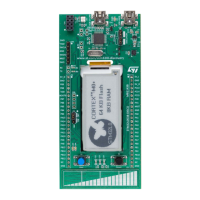
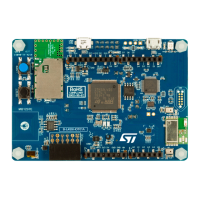
Figure 1. STM32L053 Discovery board
Picture is not contractual.
www.st.com

Table of Contents

Question and Answer IconNeed help?

Do you have a question about the ST STM32L053 and is the answer not in the manual?

Overview

The STM32L053 Discovery kit (32L0358DISCOVERY) is a low-cost, easy-to-use development kit designed to help users discover the full feature range of the STM32L0 Series and develop applications. It is built around the STM32L053C8T6 microcontroller, which boasts 64 Kbytes of Flash memory and 8 Kbytes of RAM, all housed in an LQFP48 package.

Function Description:

The kit serves as a comprehensive evaluation platform for the STM32L0 Series microcontrollers, offering a wide array of integrated peripherals and features for rapid prototyping and application development. It includes an embedded ST-LINK/V2-1 debugger/programmer, enabling in-circuit debugging and programming of the on-board microcontroller or an external STM32 application. The board supports various power supply options, including USB VBUS from the ST-LINK or USB USER connectors, or external 3V and 5V sources.

Important Technical Specifications:

  • Microcontroller: STM32L053C8T6 (LQFP48 package) with 64 Kbytes Flash memory and 8 Kbytes RAM.
  • Display: 2.13" E-paper display with 122×250 pixels, offering high contrast, high reflectance, and ultra-wide viewing angle. This display is a TFT active matrix electrophoretic type, capable of displaying 1-bit white/black images. The STM32L053C8T6 controls this peripheral and can switch off its power supply.
  • USB Connectivity: USB 2.0 FS (Full Speed) support, with a USB Mini-B connector for the ST-LINK/V2-1 and another for USB Device support (USB USER).
  • Debugging/Programming: On-board ST-LINK/V2-1 debugger/programmer with USB re-enumeration capability, providing mass storage, Virtual COM port, and debug port functionalities.
  • Power Supply Options: Flexible power supply via ST-LINK USB, USB VBUS, or external 3V and 5V sources. The board requires 300 mA from the host PC, with 90 mA for a simple E-paper demo, 100 mA for an extension board, and 100 mA as a safety margin. External power supply inputs (5V_IN or USB USER CN3) are automatically detected and recommended if current consumption exceeds 300 mA.
  • Current Measurement: IDD current measurement capability via jumper JP4, allowing direct measurement of STM32L053C8T6 consumption from 100 nA to 50 mA using an on-board module or an external ammeter.
  • Sensors and User Interface:
    • One linear touch sensor or four touchkeys, with three pairs of I/O ports (PA2/PA3, PA6/PA7, PB0/PB1) dedicated to touch sensing.
    • Reset and user push-buttons (B1 USER connected to PA0, B2 RESET connected to NRST).
    • Four LEDs: LD1 (red/green) for USB communication, LD2 (red) for 3.3 V power on, LD3 (green) and LD4 (red) as user LEDs connected to PB4 and PA5 respectively.
  • Expansion:
    • NFC expansion connector for the PLUG-CR95HF-B daughterboard, allowing access in SPI or UART mode.
    • 2.54 mm pitch expansion headers (P2 and P3) for direct access to various STM32L053C8T6 microcontroller features and easy probing of LQFP48 I/Os.
  • Clock Supply:
    • OSC clock supply: MCO from ST-LINK/V2-1 (fixed 8 MHz) or external PH0 oscillator.
    • OSC 32 KHz clock supply: HSE oscillator onboard from X2 crystal (not provided) or external PC14 oscillator.
  • USART Configuration: USART1 interface on PA9 and PA10 can be connected to the ST-LINK/V2-1 MCU for Virtual COM port function, enabled by closing solder bridges SB2 and SB3.

Usage Features:

  • Quick Start: The kit is designed for quick evaluation and development. Users are advised to accept the Evaluation Product License Agreement and refer to the product packaging for the sequence of operations.
  • Development Environment: Supports multiple operating systems (Windows® 10, Linux® 64-bit, macOS®) and various Integrated Development Environments (IDEs) including IAR Embedded Workbench®, Keil® MDK-ARM, STM32CubeIDE, and Arm® Mbed™ Studio.
  • Programming/Debugging:
    • On-board MCU: Simply plug in two jumpers on CN4 to program/debug the STM32L053C8T6 on board.
    • External MCU: Remove jumpers from CN4 and connect the external application to the CN5 debug connector (SWD) for programming/debugging. SB13 must be OFF if CN5 pin 5 (NRST) is used externally.
  • Power Management: The ST-LINK/V2-1 supports USB power management, allowing the board to request up to 300 mA from the host PC. External power supply is recommended if current consumption exceeds this limit.
  • Virtual COM Port (VCP): Enabled by closing solder bridges SB2 and SB3, allowing communication between the target MCU and the ST-LINK/V2-1.
  • USB Device Support: The STM32L053C8T6 can act as a USB Device (e.g., joystick, mouse) when powered through the USB USER connector, running applications in standalone mode.
  • BOOT0 Configuration: BOOT0 is at level “0” by default via a pull-down resistor R65. To set BOOT0 at level “1”, a jumper can be used between P2.6 (BOOT0) and P2.5 (VDD). Unsolder R65 for continuous BOOT0 “1” to avoid 6 mA consumption.
  • Touch Sensing: The linear touch sensor can be configured as a three-position linear touch sensor or four touchkeys, demonstrating touch sensing capabilities.
  • Extension Connectors: Male headers P2 and P3 allow connection to prototyping boards, enabling access to GPIOs for probing with an oscilloscope, logical analyzer, or voltmeter.

Maintenance Features:

  • ST-LINK/V2-1 Firmware Upgrade: The ST-LINK/V2-1 includes a firmware upgrade mechanism via the USB port. Users are encouraged to visit www.st.com periodically for the latest firmware versions, which may include new functionalities, bug fixes, or support for new microcontroller families.
  • Driver Installation: Dedicated USB drivers for ST-LINK/V2-1 are available from www.st.com for Windows® 7, 8, and 10. If the board is connected before driver installation, interfaces might appear as "Unknown" in Device Manager, requiring manual driver update.
  • Solder Bridges: The board features various solder bridges (e.g., SB2, SB3, SB13, SB18, SB19, SB20, SB21, SB22, SB29) for configuring different functionalities such as VCP, external NRST, clock sources, and push-button connections. Default states are provided, and users can modify them for specific application needs.
  • IDD Measurement: Jumper JP4 allows for easy measurement of the microcontroller's current consumption, aiding in power optimization and debugging.
  • Documentation: Comprehensive free software libraries and examples are available with the STM32CubeL0 MCU Package, and direct access to Arm® Mbed™ on-line resources is provided. Application notes (e.g., AN4312 for touch sensing, AN2867 for oscillator design) offer detailed guidance for specific design aspects.
  • Product History and Limitations: The manual provides a detailed product history, including board revisions (MB1143 revision B-01, B-03) and associated silicon revision codes ("Z", "X", "P", "1"). Known limitations for specific board revisions (e.g., MB1143 revision B-03 having U4 E-paper display replaced and no demonstration software provided) are documented to inform users.

ST STM32L053 Specifications

General IconGeneral
BrandST
ModelSTM32L053
CategoryMicrocontrollers
LanguageEnglish

Related product manuals