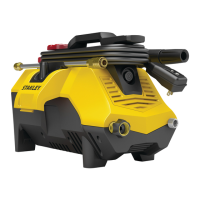
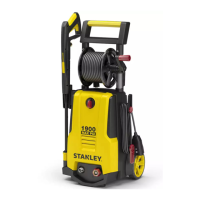
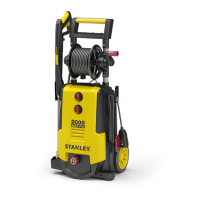
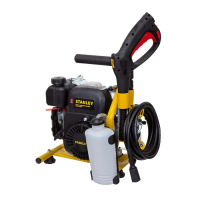
Connection points:
Water outlet (OUTLET)
Water inlet with filter (INLET)
Connection to the mains water supply
The appliance may only be connected directly to the mains
drinking water supply if the supply hose is fitted with a
backflow preventer valve as per current regulations in
force. Make sure that the hose is at least Ø 13 mm, that it is
reinforced and that it is not more than 25 m long.
ADJUSTMENT INFORMATION (Fig. C)
f Adjusting the spray nozzle (for models with this
feature) Water flow is adjusted by regulating the nozzle (2).
f Adjusting the detergent To deliver detergent at the
correct pressure, set the nozzle (2) on “ ” or fit the
detergent tank (10) as shown.
f The quantity of detergent delivered is adjusted using
the regulator (11).
USE OF THE APPLIANCE (Fig. D)
CONTROLS
Starter device (12)
Set the starter switch on (ON/I) to:
a. Start the motor (In models without TSS device);
b. Set the motor ready to start (In models with TSS device).
If there is a pilot light on the starter device, it should
light up. Set the starter device switch on (OFF/0) to stop
the appliance. If there is a pilot light on the starter
device, it should go out.
f Water jet control lever (15).
Warning! During operation the appliance must be
positioned as shown in Fig. D on a firm, stable surface.
Start-up (see Fig. D)
1. Turn on the water supply tap fully.
2. Release the safety catch (16).
3. Depress the gun trigger for a few seconds and start
up the appliance using the starter device (ON/I).
Warning! Before starting up the appliance check that it is
receiving water correctly; use of the appliance without water
will damage it. Do not cover the ventilation grilles when the
appliance is in use.
TSS Models - In TSS models with automatic delivery flow
cut-o system:
a. When the gun trigger is released, the dynamic
pressure automatically cuts out the motor;
b. When the gun trigger is depressed, the automatic
drop in pressure starts the motor and the pressure
is restored after a very slight delay;
c. If the TSS is to function correctly all gun trigger
releasing and depressing operations, must be
at least 4 - 5 seconds apart.
To prevent damage to the appliance, do not allow it to
operate dry and check that it is properly supplied with water.
For models without TSS, to prevent damage to the appliance
due to an increase in water temperature, do not cut off the jet
of water for more than 5 minutes with the appliance running.
Stopping
1. Set the starter device switch on (OFF/0).
2. Depress the gun trigger and discharge the residual
pressure inside the pipes.
3. Engage the safety catch (16).
Restarting
1. Release the safety catch (16).
2. Depress the gun trigger and discharge the residual
air inside the pipes.
3. Set the starter device on (ON/I).
Storage
1. Turn o the water supply tap.
2. Discharge the residual pressure from the gun until
all the water has come out of the appliance.
3. Switch the appliance off (OFF/0).
4. Remove the plug from the socket.
5. Drain and wash out the detergent tank at the end of
the working session. To wash out the tank, use clean
water instead of the detergent.
6. Engage the gun safety catch (16).
Recommended cleaning procedure
Dissolve dirt by applying the detergent mixed with water to the
surface while still dry. When dealing with vertical surfaces work
from the bottom upwards. Leave the detergent to act for 1-2
minutes but do not allow the surface to dry. Starting from the
bottom, use the high pressure jet at a minimum distance of 30cm.
Do not allow the rinse water to run onto unwashed surfaces. In
some cases, scrubbing with brushes is needed to remove dirt.
High pressure is not always the best solution for good washing
results, since it may damage some surfaces. The finest
adjustable nozzle jet setting or the rotopower nozzle should
not be used on delicate or painted parts, or on pressurised
components (e.g tyres, inflation valves, etc.). Effective washing
depends on both the pressure and volume of the water used,
to the same degree.
·
ENGLISH
9


 To Next Page
 Loading...