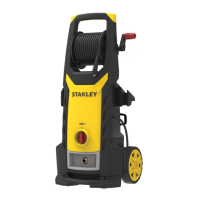
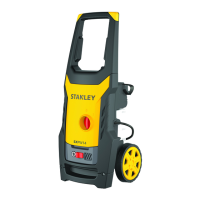
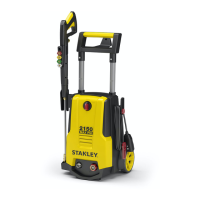
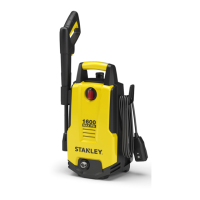
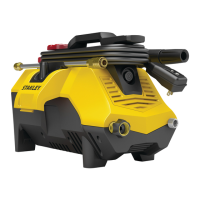
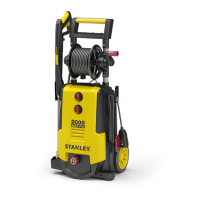
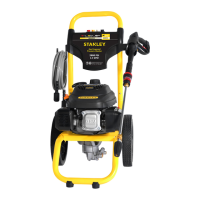
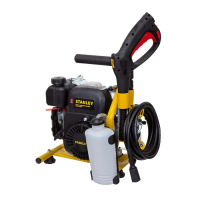
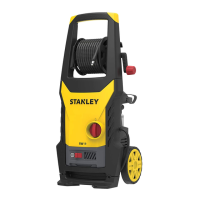
This document is a user manual for the STANLEY SW19 and SW21 pressure washers.
Function Description
The STANLEY SW19 and SW21 pressure washers are designed for individual use for cleaning vehicles, machines, boats, and masonry. They effectively remove stubborn dirt using clean water and biodegradable chemical detergents. The appliance can be connected directly to the mains drinking water supply if a backflow preventer valve with a drain facility is installed in the supply hose.
Important Technical Specifications
The manual provides technical data for both models:
SW21:
- Rated Voltage: 220-240V~
- Frequency: 50Hz
- Power: 2100W
- Working flow: 6 l/min
- Max water flow: 7.5 l/min
- Pressure: 11 MPa (110 bar)
- Maximum pressure: 14.5 MPa (145 bar)
- MAX PSI: 2103
- T° input: 50 °C
- Maximum input pressure: 1 MPa
- Repulsive force of the gun to the maximum pressure: 14.8 N
- Degree of protection: IPX5
- Sound level K=2.5 dB(A) (LPA): 72 dB(A)
- Sound level K=2.5 dB(A) (LWA): 88 dB(A)
- Unit vibrations (K = 1 m/s²): <2.5 m/s
- Weight: 14.2kg (31.3lb)
SW19:
- Rated Voltage: 220-240V~
- Frequency: 50Hz
- Power: 1900W
- Working flow: 5.3 l/min
- Max water flow: 6.6 l/min
- Pressure: 10 MPa (100 bar)
- Maximum pressure: 13 MPa (130 bar)
- MAX PSI: 1885
- T° input: 50 °C
- Maximum input pressure: 1 MPa
- Repulsive force of the gun to the maximum pressure: 12.5 N
- Degree of protection: IPX5
- Sound level K=2.5 dB(A) (LPA): 72 dB(A)
- Sound level K=2.5 dB(A) (LWA): 88 dB(A)
- Unit vibrations (K = 1 m/s²): <2.5 m/s
- Weight: 13kg (28.7lb)
Both models are compliant with IEC 60335-1 and IEC 60335-2-79 standards. The intake water temperature should be as per the data plate, intake water pressure between 0.1 MPa and 1 MPa, and operating ambient temperature above 0 °C.
Usage Features
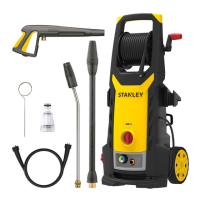
The pressure washer includes several main components: Lance, Gun with safety catch, High pressure hose, Nozzle cleaning tool, Rotating nozzle kit, Nozzle, Adapter, Water filter, Detergent kit, Screws, Electric cable with plug, Wheels, Hose reel, Handle, Lever, and Brackets.
Safety Devices:
- Safety valve and/or pressure limiting valve: Opens to recirculate water through the pump inlet or discharge it to the ground when the gun trigger is released.
- Thermostat valve (where fitted): Discharges hot water and draws in cold water if the water temperature exceeds the set limit, restoring the correct temperature.
- Safety catch (21): Prevents accidental spraying of water.
- Overload cutout: Stops the appliance in case of overload.
Installation and Assembly:
- All installation and assembly operations must be performed with the appliance disconnected from the mains power supply.
- The assembly sequence is illustrated in Fig. B.
- Fitting the rotating nozzle: Provides greater washing power due to water jet rotation, though it may reduce pressure by 25% compared to the adjustable nozzle.
- Electrical connection: Ensure the electrical supply voltage and frequency match the appliance data plate. Use "IPX5" protection level cables and plugs for extension cords, with cross-section proportionate to length.
- Water supply connection: Only clean or filtered water should be used. The delivery of the water intake tap should equal pump capacity. Position the appliance close to the water supply system. The supply hose must be at least Ø 13 mm, reinforced, and not more than 25 m long.
Adjustment Information (Fig. C):
- Adjusting the spray nozzle (6): Water flow is adjusted by regulating the nozzle.
- Adjusting the detergent: Set the nozzle (6) on " " or fit the detergent kit (9) for correct detergent delivery.
Operation (Fig. D):
- Starter device (19): Set to (ON/I) to start the motor or set it ready to start (TSS models). A pilot light will indicate operation. Set to (OFF/0) to stop.
- Water jet control lever (20).
- Start-up: Turn on the water supply tap fully, release safety catch (21), depress the gun trigger for a few seconds, then start the appliance using the starter device (ON/I). Ensure the appliance is receiving water correctly before starting to avoid damage. Do not cover ventilation grilles.
- TSS Models: In models with automatic delivery flow cut-off, the motor cuts out when the gun trigger is released and restarts when depressed. Operations should be 4-5 seconds apart for correct function.
- Stopping: Set the starter device to (OFF/0), depress the gun trigger to discharge residual pressure, and engage the safety catch (21).
- Restarting: Release the safety catch (21), depress the gun trigger to discharge residual air, and set the starter device to (ON/I).
- Recommended cleaning procedure: Apply detergent mixed with water to a dry surface, working from bottom upwards on vertical surfaces. Allow detergent to act for 1-2 minutes without drying. Use the high-pressure jet at a minimum distance of 30cm, avoiding unwashed surfaces. Scrubbing may be needed for stubborn dirt. High pressure may damage delicate surfaces; the finest adjustable nozzle jet or rotopower nozzle should not be used on delicate parts or tires.
Maintenance Features
Any maintenance operations not covered in the manual should be carried out by an authorized sales and service center. Always disconnect the plug from the power socket before any work.
- Cleaning the nozzle: Disconnect the lance from the nozzle and remove dirt deposits from the nozzle hole using the tool (4).
- Cleaning the filter: Inspect and clean the inlet filter (8) and detergent filter (if fitted) before each use.
- Unjamming the motor (On models with this feature): In case of lengthy stoppages, limescale sediments may cause the motor to seize. To unjam the motor, turn the drive shaft with a tool.
- End-of-season storage: Treat the appliance with non-corrosive, non-toxic antifreeze before storing it in a dry, frost-protected place.
- Storage and Transportation (Fig. E): Store and transport accessories and the machine as shown in Fig. E.
Troubleshooting: The manual includes a comprehensive troubleshooting guide for common issues such as the pump not reaching working pressure, pressure drops, motor "buzzing" or failing to start, water leakage, noisy appliance, oil leakage, and specific TSS model issues. Solutions range from cleaning filters and nozzles to checking connections and contacting an authorized service center.
Environmental Protection: The product should not be disposed of with normal household waste. Separate collection of used products and packaging allows materials to be recycled and reused, preventing environmental pollution and reducing demand for raw materials. Local regulations may provide for separate collection of electrical products.


 To Next Page
 General