Need help?
Do you have a question about the Stelpro Maestro SMC402AD and is the answer not in the manual?
Explore features for remote control and home comfort management.
Details on heating systems the thermostat controls and Wi-Fi compatibility.
Lists items in the box and necessary tools for installation.
Guidance on leveraging the full capabilities of the MAESTRO system.
Critical safety step to disconnect electrical power before installation.
Procedure for safely removing the old thermostat from the wall.
Instructions for attaching the MAESTRO controller-thermostat mounting plate.
Detailed guide on wiring the controller-thermostat to the heating system.
How to attach the controller-thermostat unit to the installed mounting plate.
Restoring power to the heating system and verifying thermostat operation.
Initial configuration of language, temperature format, time, and heating mode.
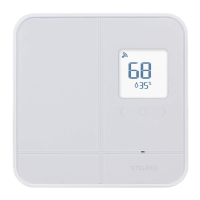
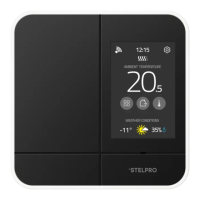
Overview of the MAESTRO controller-thermostat's main display and interactive elements.
How to use the mobile app to manage your home's temperature remotely.
Steps to connect the controller-thermostat to your home Wi-Fi and register it.
Procedure to get the registration code for linking the controller to the MAESTRO system.
Guide for connecting thermostats to the controller via the Zigbee network.
Alternative method for connecting thermostats directly to the controller.
Explanation of available home statuses (Away, Home, Vacation, Standby).
Illustrative scenarios showing how statuses and activities change temperature settings.
How to manually choose a home status or activate a pre-programmed activity.
Explanation of geofencing boundary and automatic status changes based on location.
Steps to enable or disable the geofencing feature on the controller or app.
How to remove paired mobile devices from the geofencing system.
Changing the language displayed on the controller-thermostat screen.
Switching between Celsius and Fahrenheit display for temperature.
Selecting the appropriate heating system type (baseboard, fan-forced).
Configuring the lobby mode for specific heating scenarios.
Setting the time display to 12-hour or 24-hour format.
Adjusting the inactivity timer before the display goes into screen saver mode.
Table listing typical alerts and malfunctions with their respective solutions.
Steps to resolve when a thermostat is offline or has no power.
Actions to take when the system detects an open window.
Troubleshooting steps for when the heating system overheats.
Solutions for when the controller-thermostat loses Wi-Fi connectivity.
Understanding and resolving the "Cold" status message.
Understanding and resolving the "Hot" status message.
What to do if the controller-thermostat cannot measure the ambient temperature.
Troubleshooting steps for establishing or maintaining thermostat connections.
Solutions for problems related to Wi-Fi network detection and availability.
Steps to resolve issues when the device fails to connect to the Wi-Fi.
Diagnosing and fixing issues where heating remains active incorrectly.
Troubleshooting when the heating system fails to activate despite thermostat indication.
Solutions for when the controller-thermostat display does not turn on after installation.
Addressing issues with inaccurate temperature readings on the display.
Resolving rapid on/off cycles for fan-forced heating systems.
Details on supply voltage, minimum, and maximum load capacities.
Information on temperature measurement ranges and display increments.
Supported wireless protocols like Zigbee and Wi-Fi.
Environmental requirements for storing and operating the device.
 General
| Control Type | Digital |
|---|---|
| Display | LCD |
| Temperature Range | 5°C to 30°C (41°F to 86°F) |
| Color | White |
| Maximum Load | 4000 W |
| Certification | cULus |
| Wi-Fi Connectivity | No |
| Wattage | 4000 W |
| Accuracy | ±0.5°C |
| Mounting | Wall |
| Weight | 0.2 kg (0.4 lb) |
| Compatibility | Electric baseboards, convectors, and fan heaters |
| Amperage | 16.7 A |
| Programmability | 7-day programmable |

 To Next Page