stewmac.com
13
Final setup
Remove the generic strings and install the included higher
quality strings (or your own preferred brand/gauge). Tune
the guitar to pitch and adjust the neck using the included
4mm hex wrench.
Straight neck, or a little relief?
Neck relief refers to adjusting a neck so that it has a very slight
upbow, rather than being perfectly straight. This relief allows
a little more room for string vibration, reducing the chance
of hitting the lower frets and causing fret buzz.
Depending on your playing style, and how perfectly level
your fret tops are, a neck should be anywhere from perfectly
straight to having 0.012" of relief. This measurement refers
additional string height over the 12th fret, compared to a
perfectly straight neck.
A straight neck tends to play and sound better, but very few
guitars end up with no relief at all, and several thousandths
of an inch or more is perfectly normal.
Set the action at the nut
Lower your string nut slots for better playability, using
gauged nut files. Measure string height over the 1st fret,
between the bottom of the string and the top of the fret.
A comfortable medium action is:
Unwound strings (G, B, E): 0.012" at the 1st fret
Wound strings (E,A,D): 0.020" at the 1st fret
Use feeler gauges to measure the gap, or use guitar strings
whose gauges match the measurement you’re after. Stop
when the string sits on your feeler gauge. Go slow and check
your work frequently—it’s easy to go too far in this step and
ruin the nut.
Set the action at the bridge
Adjust the action at the bridge by raising or lowering the
string saddles. Measure string height over the 12th fret,
between the bottom of the string and the top of the fret.
A good starting point is:
High (unwound) E string: 1/16" at the 12th fret
Low (wound) E string: 5/64" at the 12th fret
You can always go lower or higher depending on your play-
ing style. After setting the two E strings, dial in the remaining
strings to match the curve of the fretboard’s 16" radius using
the cut out gauge included on page 15.
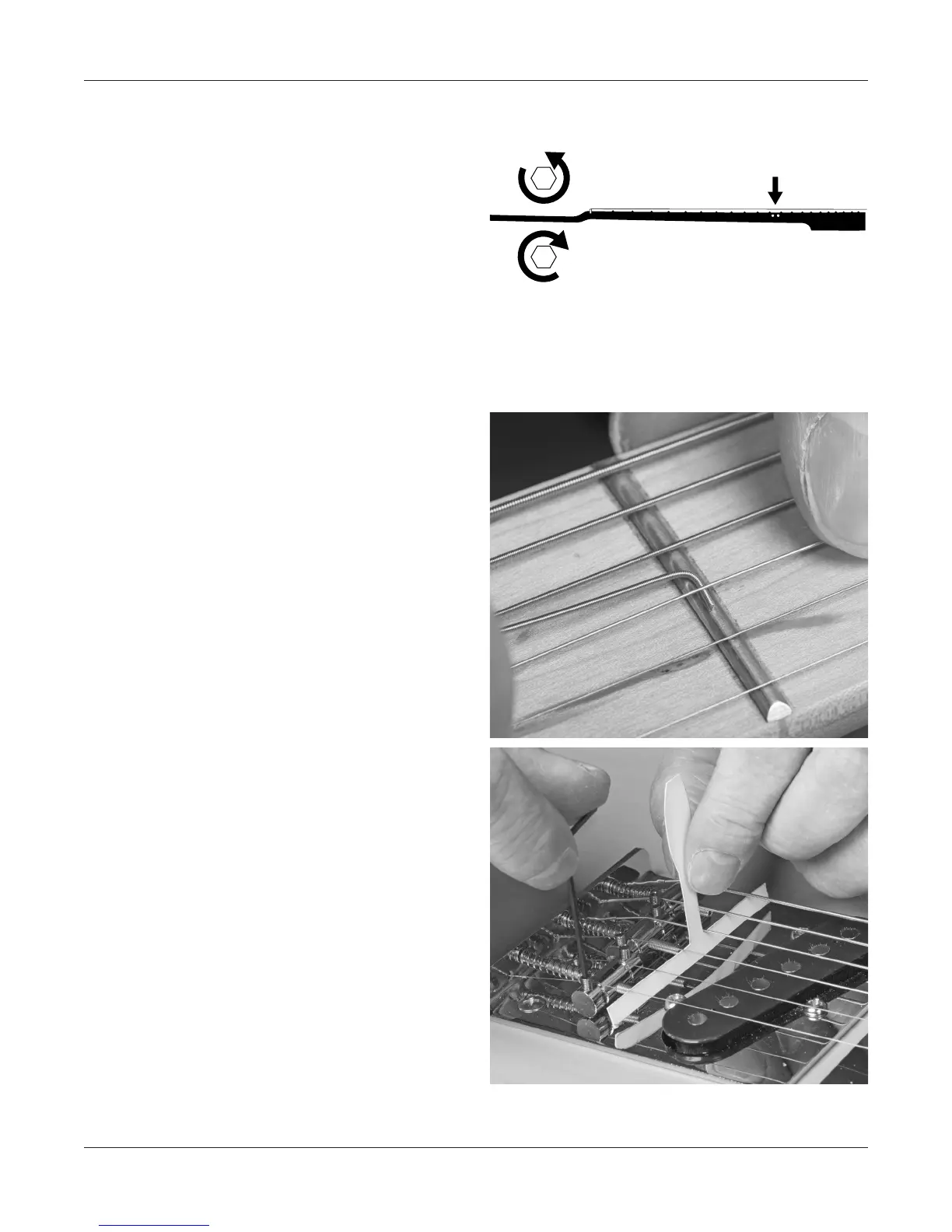
Turn the truss rod nut
counterclockwise to bring
the neck up, adding relief.
Measure string relief
at the 12th fret.
Turn clockwise to pull the
neck back, reducing relief.
Go slow: a little does a lot!


 To Next Page