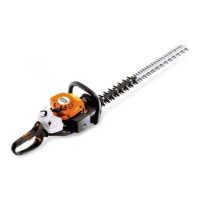
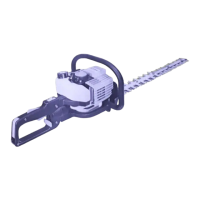
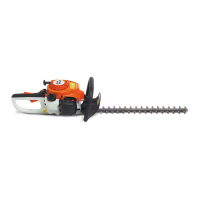
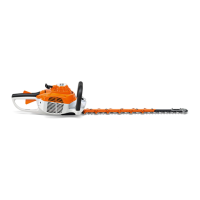
This document is an instruction manual for the STIHL HS 82 series hedge trimmers, which includes models HS 82 T, HS 82 R, and HS 82 RC. The manual provides comprehensive information on the safe operation, maintenance, and technical specifications of these power tools.
Function Description
The STIHL HS 82 series hedge trimmers are designed for cutting hedges, shrubs, bushes, and similar vegetation. The HS 82 T model is specifically for shaping and trimming hedges and shrubs with thinner branches, while the HS 82 R model is intended for cutting hedges with thicker branches. The HS 82 RC is also mentioned as a variant. The machines are powered by a single-cylinder two-stroke engine and feature high-speed cutting blades.
Important Technical Specifications
Engine:
- Type: STIHL single-cylinder two-stroke engine
- Displacement: 22.7 cc
- Bore: 34 mm
- Stroke: 25 mm
- Engine power (ISO 7293): 0.7 kW (1 bhp) at 8,500 rpm
- Idle speed: 2,800 rpm
- Cut-off speed: 9,300 rpm
Ignition System:
- Type: Electronic magneto ignition
- Spark plug (resistor type): NGK CMR6H, BOSCH USR 4 AC
- Electrode gap: 0.5 mm
Fuel System:
- Carburetor: All position diaphragm carburetor with integral fuel pump
- Fuel tank capacity: 460 cc (0.46 l)
- Fuel Mixture: Requires a mixture of gasoline and STIHL two-stroke engine oil (50:1 ratio). STIHL MotoMix is recommended.
Weight (complete with cutting attachment, dry, without blade scabbard):
- HS 82 T:
- 500 mm blade: 4.9 kg
- 600 mm blade: 5.1 kg
- 750 mm blade: 5.3 kg
- HS 82 R:
- 600 mm blade: 5.3 kg
- 750 mm blade: 5.6 kg
- HS 82 RC:
- 600 mm blade: 5.3 kg
- 750 mm blade: 5.7 kg
Noise and Vibration Data (measured at idling and maximum rated speed in a 1:4 ratio):
- Sound pressure level Lp (ISO 22868):
- HS 82 T (all blade lengths): 95 dB(A)
- HS 82 R (all blade lengths): 94 dB(A)
- HS 82 RC (all blade lengths): 94 dB(A)
- Sound power level Lw (ISO 22868):
- HS 82 T (all blade lengths): 107 dB(A)
- HS 82 R (all blade lengths): 107 dB(A)
- HS 82 RC (all blade lengths): 107 dB(A)
- Vibration measurement ahv,eq (ISO 22867, without tip guard):
- HS 82 T:
- 500 mm blade: Left handle 3.1 m/s², Right handle 2.4 m/s²
- 600 mm blade: Left handle 2.7 m/s², Right handle 2.1 m/s²
- 750 mm blade: Left handle 3.6 m/s², Right handle 2.2 m/s²
- HS 82 R:
- 600 mm blade: Left handle 2.7 m/s², Right handle 3.1 m/s²
- 750 mm blade: Left handle 2.4 m/s², Right handle 2.8 m/s²
- HS 82 RC:
- 600 mm blade: Left handle 2.5 m/s², Right handle 2.9 m/s²
- 750 mm blade: Left handle 2.6 m/s², Right handle 2.6 m/s²
- Vibration measurement ahv,eq (ISO 22867, with tip guard):
- HS 82 T:
- 500 mm blade: Left handle 2.7 m/s², Right handle 2.2 m/s²
- 600 mm blade: Left handle 2.7 m/s², Right handle 2.1 m/s²
- 750 mm blade: Left handle 3.6 m/s², Right handle 2.1 m/s²
- HS 82 R:
- 600 mm blade: Left handle 2.4 m/s², Right handle 2.6 m/s²
- 750 mm blade: Left handle 2.6 m/s², Right handle 2.7 m/s²
- HS 82 RC:
- 600 mm blade: Left handle 2.6 m/s², Right handle 2.3 m/s²
- 750 mm blade: Left handle 3.2 m/s², Right handle 2.8 m/s²
Cutting Blades:
- Sharpening angle to horizontal: 45°
Usage Features
- Safety First: Emphasizes reading and understanding the user manual, wearing proper protective clothing (safety glasses, ear defenders, sturdy shoes, gloves), and maintaining a safe working environment.
- Fueling: Detailed instructions on safe fueling practices, including using the correct fuel mix (gasoline and STIHL two-stroke engine oil at 50:1), avoiding spills, and proper storage of fuel.
- Starting the Engine: Step-by-step guide for starting the engine, both cold and warm, with specific instructions for models with and without ErgoStart. It highlights the importance of starting at least 3 meters from the fueling spot and ensuring blades are clear of obstructions.
- Stopping the Engine: Instructions for safely shutting off the engine.
- Holding and Guiding: Emphasizes holding the unit firmly with both hands, maintaining good balance, and keeping cutting blades away from the body. It also describes right-handed and left-handed user positions.
- Working Technique: Provides guidance for vertical and horizontal cutting. For vertical cuts, it suggests swinging the blade in an arc from bottom upwards. For horizontal cuts, it recommends holding the cutter bar at a 0° to 10° angle and swinging in an arc towards the outside of the hedge.
- Working at Heights: Advises using a lift bucket and never operating the machine from a ladder, tree, or insecure support.
- Rotating Handle: The rear handle can be rotated 90° to the left or right for better control and comfort in various cutting situations.
- Cutting Season and Sequence: Recommends observing local regulations for cutting hedges and suggests cutting thick branches first with lopping shears or a chainsaw, then cutting the sides of the hedge, followed by the top.
- Disposal: Advises against throwing cuttings in the garbage and suggests composting them. STIHL products should be taken to an approved disposal site for environmentally friendly recycling.
Maintenance Features
- Regular Servicing: STIHL recommends that all servicing and repair work, except for basic maintenance described in the manual, be carried out by an authorized STIHL servicing dealer.
- Maintenance Chart: A detailed chart outlines maintenance intervals for various components:
- Before starting work: Visual inspection (condition, leaks) of the complete machine, function test of control handle, visual inspection of anti-vibration elements, visual inspection of cutting blades.
- At the end of work and/or daily: Clean complete machine, clean air filter (felt), clean cutting blades.
- Whenever tank is refilled: Check manual fuel pump.
- Weekly: Clean air filter (paper).
- Monthly: Clean spark arresting screen in muffler, check fuel pickup body in fuel tank, check idle speed of carburetor, check gearbox lubrication.
- Annually: Replace air filter (felt and paper), have fuel pickup body replaced by servicing dealer, clean fuel tank, readjust idle speed of carburetor.
- If faulty: Have manual fuel pump repaired by a specialist dealer, have fuel pickup body checked by dealer, check idle speed of carburetor, adjust electrode gap of spark plug.
- If damaged: Have fuel pickup body replaced by servicing dealer, replace safety information label.
- As required: Replace spark arresting screen, replace air filter (felt and paper), sharpen cutting blades, replace cutting blades, adjust adjustable blade clearance.
- Air Filter: Instructions for cleaning and replacing felt and paper air filter elements.
- Spark Arresting Screen: Instructions for checking, cleaning, and replacing the spark arresting screen in the muffler after every 20 hours of operation or if engine power is down.
- Spark Plug: Instructions for checking, cleaning, adjusting the electrode gap, and replacing the spark plug after about 100 operating hours.
- Carburetor Adjustment: Guidance for adjusting the idle speed screw (LA) to ensure the cutting blades remain still when the engine idles.
- Gearbox Lubrication: Instructions for lubricating the blade drive gear with STIHL gear lubricant after about 25 hours of operation.
- Cutting Blades: Instructions for sharpening the cutting blades using a flat crosscut sharpening file at a 45° angle. Emphasizes filing only the cutting edge, removing burrs with a whetstone, and spraying with STIHL resin solvent after sharpening.
- Storage: Recommendations for storing the machine for periods of 3 months or longer, including draining and cleaning the fuel tank, running the engine until the carburetor is dry, cleaning and spraying cutting blades, and cleaning the machine thoroughly.
- Minimize Wear and Avoid Damage: Advises against unauthorized modifications, using unapproved tools or accessories, using the product for unintended purposes, or continuing to use the product with defective components.

 Need help?

 To Next Page
 General