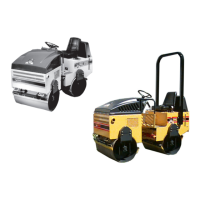
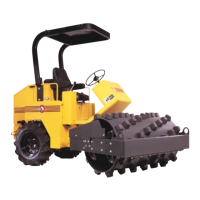
The provided document is an operator manual for the Stone WolfPac™ 2500, a 1-1/4 ton static ride-on roller. This machine is designed for compaction tasks, particularly for asphalt.
Function Description:
The Stone WolfPac™ 2500 is a ride-on roller primarily used for compacting surfaces, especially asphalt. It operates as a static roller, meaning it relies on its weight to achieve compaction rather than vibration. The machine is hydrostatically controlled, offering infinitely variable speed in both forward and reverse directions. A variable flow pump delivers oil to a fixed displacement motor, which in turn drives the rear drum via a chain. The "feathering characteristics" of the pump are designed to eliminate scuffing or tearing of the asphalt mat when changing direction. Power steering is a key feature, enhancing operator comfort and control by preventing hard steering and erratic movement often associated with units lacking this feature. The roller is equipped with a water tank and sprinkler system, along with cocoa mats and scrapers, to prevent asphalt from sticking to the drums and to ensure even water application.
Important Technical Specifications:
- Model: Stone WolfPac™ 2500
- Type: 1-1/4 Ton Static Ride-On Roller
- Dimensions (L x W x H): 84" x 36" x 56"
- Weight (Total Dry): 1585 lbs.
- Operating Weight: 2070 lbs.
- Weight (Ballasted Out): 2680 lbs.
- Front Roller Diameter: 20"
- Rear Roller Diameter: 24"
- Front Roller Width: 28"
- Rear Drive Roller Width: 32"
- Wall Clearance: 1/2"
- Curb Clearance: 9"
- Wheelbase: 58"
- Drum Thickness: 3/8"
- Engine Options:
- 8.5 hp Robin with low oil alert
- 8 hp Honda with low oil alert
- 11 hp Honda with low oil alert
- Power Steering: Yes (hydraulic)
- Transmission: Hydrostatic
- Hydrostatic Pump: Eaton #11
- Drive Motor: Char-Lynn
- Hydraulic Reservoir Capacity: 6.7 gallons (25.4 liters)
- Water Tank: Polyethylene (with level gauge), 30 gallons capacity
- Front Roller Mounting: (4) Ball Bearings
- Rear Roller Mounting: (2) Ball Bearings
- Speed: Infinitely Variable, 0 - 4.5 mph
- Inside Turning Radius: 8.3 ft
- Gradeability: 30% (17°)
- Recommended Fuel: Gasoline 86 Octane Minimum (specific capacities for GX240/EH25 and GX340 engines)
- Electric System: 12-Volt System Battery BCI Group U1 - 12, 165 cca 5 amp Charge System
- Hydraulic Oil: Mobilfluid 424 (VI-152) or SUS255 55CST ISO VG55
- Engine Oil: Mobil Delvac 1200 10W-30 (API, SH or SJ) (specific capacities for GX240/GX340 and EH25 engines)
- Spark Plugs: NGK BRP6ES (Honda GX240/GX340) or NGKBGHS (Robin EH250) with specified gaps.
- Grease: Mobilgrease XHP 222 (NLGI 2EP lithium complex)
- Sound Level at Operator Position: 95 dba (8 Honda), 93 dba (11 Honda)
Usage Features:
- Ergonomic Design: Engineered for optimal operator interface, offering good visibility to the roll-edge and work surface, with controls positioned for maximum comfort.
- Infinitely Variable Speed: The hydrostatic control allows for smooth and precise speed adjustments in both forward and reverse, preventing abrupt changes that could damage the compacted surface.
- Power Steering: Simplifies operation and provides better control, reducing operator fatigue.
- Water System: A 30-gallon polyethylene water tank with a level sight gauge provides extended operating time between refills. The gravity flow sprinkler system features dual controls and noncorrosive sprinkler bars for even water distribution.
- Asphalt Compaction Aids: Cocoa mats and scrapers are included on both drums. Cocoa mats ensure uniform water application, while scrapers prevent dirt and asphalt buildup on the drums.
- Safety Features: Includes a neutral ignition interlock, enclosed engine compartment, and a hand-operated disc parking brake. The engine is equipped with a low oil shut-down system to prevent damage.
- Operational Guidelines: The manual provides detailed instructions for starting, stopping, and operating the roller, including recommendations for asphalt compaction techniques such as maintaining appropriate asphalt temperature (around 285° F), making two passes for sufficient compaction, and avoiding sharp turns or standing the roller on fresh asphalt to prevent depressions. It also advises on starting breakdown passes downhill and compacting on low edges first.
- Tie-Down Rings: Equipped with front and rear tie-down rings for secure transport.
Maintenance Features:
- Maintenance Chart: A comprehensive chart (Section 3.16) outlines daily, weekly, and other periodic maintenance tasks for both the engine and the machine.
- Engine Maintenance: Includes checking oil level, fuel cap and strainer, sediment cup and filter, air filter and precleaner, spark plugs, engine RPM, cooling system, valve clearance, and fuel tank. Specific replacement intervals are provided for different engine components and models (Honda/Robin).
- Hydraulic System Maintenance: Involves checking hydraulic oil level, and replacing the hydraulic filter and breather at specified intervals. A caution is given to change the oil filter after the first 5 hours of operation for new units to remove trapped contamination.
- Lubrication: Weekly lubrication with lithium base grease is recommended for steering pivot pin, steering tilt block, steering pivot arm, and rear drum bearings.
- Chain Maintenance: Weekly checking, tensioning, and lubrication of the chain and connecting links.
- General Machine Checks: Regular inspection of fuel lines and clamps, controls (lubricating cables and levers), battery/charge system (checking for 13-14 volts at full RPM), parking brake, scrapers/cocoa mats, sprinklers, and hardware/engine mount (checking torque).
- Fluid Management: Instructions for checking and maintaining proper levels of engine oil, hydraulic oil, and fuel. Emphasizes using fresh, unleaded gasoline and not mixing oil with fuel.
- Draining Drums and Water Tank: Instructions for draining water from drums and the water tank to prevent freezing damage.
- Safety in Maintenance: Strict adherence to safety precautions during maintenance, such as turning off the engine, disconnecting spark plug wires, and supporting raised machine elements.

 Need help?
 General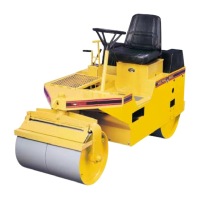

 To Next Page