5
Chapter I
Theory of Operation
A. Ultrasonic Wave
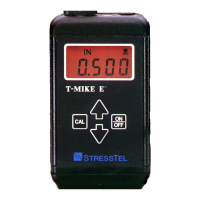
The T-Mike E measures the thickness of a material by launching an ultrasonic wave into the material using an
ultrasonic transducer and calculating the time for the wave to pass through the material and reflect back to the
transducer. The time is multiplied by the previously determined velocity in the material and the thickness is
then displayed on the readout in inches or millimeters.
B. Zero Probe Function
Each transducer (probe) and the electronics varies in the amount of time to transmit the signal to be measured.
This time must be subtracted from the total transmission time. The time correction is accomplished automatically
by performing a “PROBE” recognition operation. The means to perform this simple task is resident on the T-
Mike E and will be explained in detail later.
C. Single Point Velocity Calibration
Upon recognition of the probe a calibration of the velocity of the material to be measured must be done. A
representative piece of the material to be measured should be used for the CAL operation. Through the CAL
operation the T-Mike E measures the ultrasonic transit time, calculates the velocity of the material and implants
the velocity calculation in the T-Mike E’s memory for future measurements. If the velocity of the material is
already known then it may be entered using the keypad. Important: Since this velocity constant is used to
determine thickness for all measurement (until it is changed through another CAL or PROBE function) the
accuracy of the thickness measurement depends upon the constancy of the ultrasonic properties in the
material being measured.


 To Next Page