25 BA_310D-R_3100D-R_A16-3_180117_en
4.8 Plunger stop
Frequently it is necessary when trimming fabric to sew over different fabric
thicknesses at the same work piece, whereby the penetration depth of the
needle, viewed from the upper side of the sewing material, must always remain
the same.
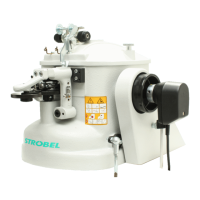
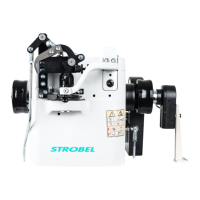
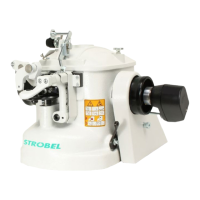
The plunger built- into our machines carries out this work automatically in
cooperation with an adjustable plunger stop mounted on the stitch plate.
(This is not true for all machines or stitch plates.)
4.8.1 Adjusting the plunger stop (Fig. 14)
CAUTION! Danger of Injury!
When adjusting in the area of the stitch plate there is
danger of injury, especially a danger of crushing fingers due
to accidental activation of the pedals!
First set the plunger with the stitch depth regulation button so high that the
required thickness of the sewing material, in most cases the outside fabric, is
stitched blind satisfactory.
Then the plunger stop supported on the stitch plate is adjusted with the knurled
screw (partly also hexagon nut) in such a way, that the sewing material is
pressed from above onto the plunger.
Now the plunger, under pressure from a spring, can rise above several layers of
fabric, cross seams, thickenings etc lying above each other only to such a
height, that the upper fabric layers and not the outside fabric is stitched.
The above adjustment requires some technical knowledge and experience.
Care must be taken that the pressure spring (1) is only adjusted as much as is
necessary for the correct effect of the plunger stop. This keeps the pressure of
the plunger onto the plunger stop as low as possible and less stress is put on
stitch plate and machine.
With adjustment of the plunger pressure at the works, the screw for the plunger
regulation (2) is flush with the plunger guide (4).
By turning the plunger adjusting screw (3), including the screw for the plunger
regulation (2), to the right it increases, to the left it decreases.


 To Next Page