
 Need help?
Do you have a question about the Sullivan-Palatek D210PHKR and is the answer not in the manual?
Company contact details, address, phone, fax, and website.
Records changes made to the manual over time.
Explains safety labels and general safety information throughout the manual.
Describes the structure and content of each section of the manual.
Lists additional documentation available for specific components or optional equipment.
Outlines fundamental safety practices for all personnel involved with the compressor.
Details procedures for safely releasing pressure from air, oil, and cooling circuits.
Addresses hazards related to fuel, liquids, batteries, wiring, and combustibles.
Warns about the dangers of rotating components and the need for clearance.
Identifies potential hazards from chemicals and fumes associated with the compressor.
Highlights risks from heat, physical contact, and vacuum hazards.
Provides precautions to prevent electrocution when working with the compressor's electrical system.
Warns about the risk of being trapped within the compressor enclosure during maintenance.
Notifies about potential carcinogens in diesel engine exhaust as per California law.
Instructions for checking the compressor upon delivery and initial inspection.
Details procedures and safety checks for lifting the compressor unit.
Covers proper installation, inspection, and torque for drawbars and brake components.
Steps to ensure the compressor is ready for safe towing.
Guidelines for safe towing, including speed limits and vehicle requirements.
Instructions for safely parking and securing the compressor at the job site.
Key safety rules to follow during compressor operation.
Steps to take before the first operation or after shipment.
Step-by-step guide for starting the engine and compressor.
Procedures for safely shutting down the compressor.
How to quickly stop the compressor in an emergency situation.
Guide to using the Sullivan-Palatek Electronic Controller (SPEC) for compressor management.
Procedures for refueling the compressor safely.
Advice for operating the compressor in cold, hot, or dusty environments.
Safety and best practices for using pneumatic tools with the compressor.
Instructions for safely jump-starting the compressor's battery.
Accesses brightness, contrast, language, units, time, and date settings.
Displays setpoints for automatic compressor shutdowns.
Shows when filters or other components require servicing.
Displays the current software and revision level of the controller.
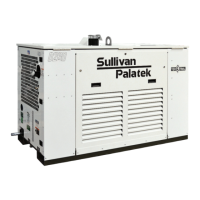
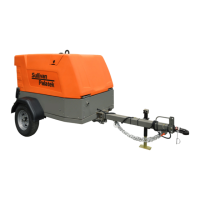
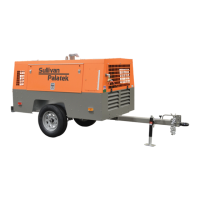
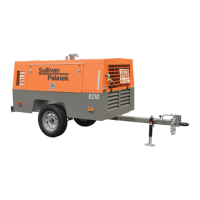
Overview of the complete compressor unit and its enclosure.
Information about the diesel engine powering the compressor.
Description of the rotary screw air compression mechanism.
Explanation of how compressed air and oil are handled after compression.
Details on the oil circulation and cooling system for the compressor.
How the compressor adjusts air output based on demand.
Information on the compressor's electrical setup and safety shutdown features.
Explanation of systems that protect the engine from damage.
Components and design for reducing operational noise.
Overview of gauges, controls, and the electronic controller display.
Explains the default functions of the SPEC controller's keypad buttons.
Selects between low (100 psi) and high (150 psi) discharge pressure settings.
Manages compressor unloading for starting and transition to running mode.
Controls engine starting and shutdown sequences.
Recommended service intervals for various maintenance tasks.
Specifications for tightening bolts to ensure proper assembly and safety.
Procedures and recommendations for lubricating the compressor.
Information on the specific lubricant recommended by Sullivan-Palatek.
Instructions for collecting and submitting oil samples for condition monitoring.
Maintenance procedures for the air intake filter.
Replacement and inspection of the compressor oil filter.
Checks for leaks at the compressor shaft seal.
Maintenance of the line that returns oil to the sump.
Replacement and maintenance of the air/oil separator element.
Inspection and cleaning of the thermal bypass valve.
Cleaning and maintenance of the oil cooling system.
Recommendations for grease types for various components.
Lubrication requirements for the axle.
Reference to engine-specific lubrication guidelines.
Procedures for adjusting pressure regulators and engine speed.
List of essential spare parts for the D210PHKR model.
Information on available service kits for maintenance.
Explains how to use the troubleshooting section to address issues.
Lists common causes and actions for unexpected compressor shutdowns.
Identifies reasons for low output pressure and solutions.
Addresses issues with excessive pressure or relief valve activation.
Specific troubleshooting for relief valve activation during idle.
Solutions for residual pressure remaining after stopping the unit.
Diagnosing and fixing excessive oil consumption.
Troubleshooting steps when oil is found in the service air lines.
Resolving issues with engine performance and speed.
Causes and solutions for a blocked air/oil separator.
Troubleshooting engine speed control when idle is expected.
Diagnosing why the engine doesn't reach full speed under load.
Identifying and fixing oil leaks in the control system.
 General
| Model | D210PHKR |
|---|---|
| Type | Rotary Screw |
| Voltage | 460V |
| Phase | 3 |
| Drive Type | Direct Drive |
| Cooling Method | Air Cooled |
| Operating Pressure | 100 PSI |
| Rated Pressure | 100 PSI |


 To Next Page