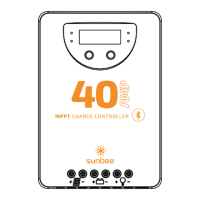
Sunbee Solar MPPT controllers are based on an advanced maximum power point tracking (MPPT)
technology. The controller conversion efficiency up to 98%.
It comes with several outstanding features, such as:
A combination of multiple tracking algorithms enables tracking the maximum power point quickly and
accurately
Innovative Max Power Point Tracking(MPPT) technology, tracking efficiency >99.9%
Full digital technology, high charge conversion efficiency up to 98%
LCD display design, read operating data and working condition easily
Real-time energy statistics function
12/24/36/48V automatic recognition
Flexible System battery selection: Liquid, Gel, AGM and Lithium
Extends battery life through accurate remote temperature sensor
Controller is protected against over-temperature due to built-in power reduction function
Four stages battery charging process: MPPT, boost, equalization, float
Dual automatic protection to avoid exceeding the rated charging power and current
Multiple load control modes: Always on, Dusk to Dawn, Evening and Manual
Bluetooth communication functions
Optional APP version for Bluetooth communication
Monthly charging data can be calculated and displayed by grouping and graphs
Perfect EMC & thermal design
Fully automatic electronic protect function for increased charge controller availability
MPPT profile
The full name of the MPPT is maximum power point tracking. It is an advanced charging technology which
detects the real-time power of the solar Module and the maximum point of the I-V curve that make the
highest battery charging efficiency.
Current Boost
Under most conditions, MPPT technology will "boost" the solar charge current.
MPPT Charging:Power Into the controller (Pmax)=Power out of the controller (Pout)
Iin x Vmp= Iout x Vout
* Assuming 100% efficiency.
If the solar module's maximum power voltage (Vmp) is greater than the battery voltage, it follows that the
battery current must be proportionally greater than the solar input current so that input and output power are
balanced. The greater the difference between the Vmp and battery voltage, the greater the current boost.
Current boost can be substantial in systems where the solar array is of a higher nominal voltage than the
battery as described in the next section.


 To Next Page