Adjusting the controls
There are two main methods for adjust-
ing the
volume,
crossover frequency and
phase
controls to match a system:
Preferred method: By
listening and
making the adjustments to suit your
taste.
Laboratory method: By measur-
ing the output with a microphone
and adjusting for a flat frequency
response.
Excellent results
can be obtained if you
make the adjustments based on
simply
listening.
This is our preferred method as
it
allows
the system to be voiced based
on what sounds the best, whereas labo-
ratory-flat frequency response can often
be
clinical
and less
than exciting.
The
following
procedure is for those
who prefer a more methodical and scien-
tific approach. This excerpt is from
"The
Audio
Critic,"
issue 24, page 31, written
by contributing editor David Rich, and is
reprinted here with their kind permission.
You
will
need a test
CD
with
low-fre-
quency
warble tones, and a sound pres-
sure-level
meter. The Radio
Shack®
SPL
meter
will do fine, as
will
the
Stereophife®
test
CD.
"Step
1.
Disconnect the subwoofer
and run the main speaker with a tone
in
its passband (80-1 00
Hz). Measure the
level.
Step
2.
Disconnect the main speaker
and reconnect the subwoofer.
Set
the
subwoofer to its highest crossover
frequency.
Set the
volume control
of
the
subwoofer to give the same sound pres-
sure
level with the .same tone you used
in
Step
1.
Step
3.
With both the subwoofer and
the main speaker connected, measure
the
level
of
the tones at the
available
frequencies. Because the crossover
is set too high, you
will
have a peaked
response. Adjust the crossover
control
to
get the smoothest response.
Step
4.
Use the phase
control
to make
the response even smoother.
It
has its
biggest effect at the crossover frequency.
You
can iterate between the crossover
and the phase
controls.
Keep your hands
off the
volume control! It
was set
correctly
in
step
2.
Step
5.
Listen to the subwoofer. Resist
all
temptations to turn up the
volume
control. Play
something with
really deep
bass to confirm that your subwoofer is
working."
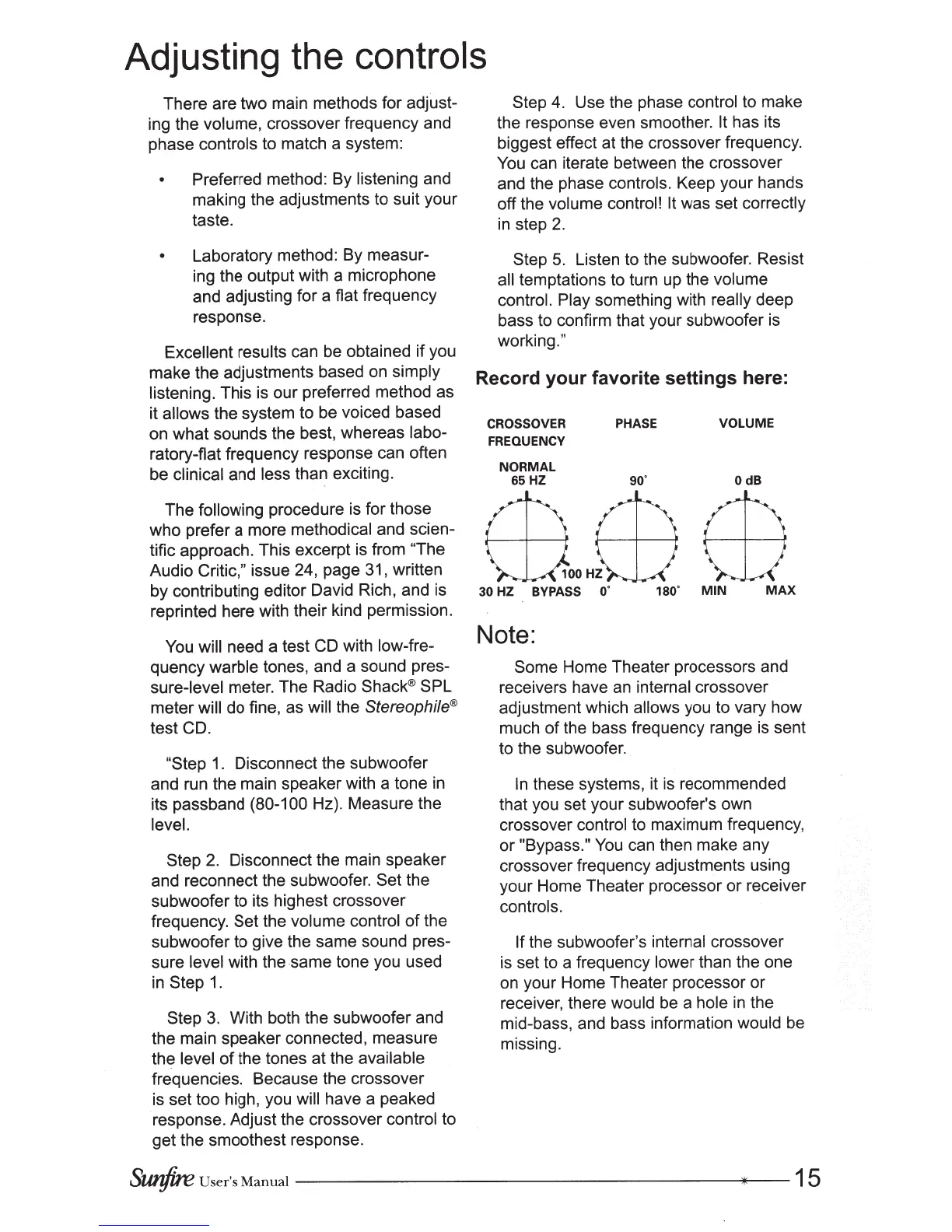
Record
your
favorite
settings
here:
CROSSOVER
FREQUENCY
NORMAL
PHASE
VOLUME
65HZ
90°
0
dB
ffiOOHffi
ffi
30 HZ BYPASS
0°
180°
MIN
MAX
Note:
Some
Home Theater processors and
receivers have
an
internal
crossover
adjustment which allows
you to vary how
much
of
the bass frequency range
is
sent
to the
su
bwoofer.
In
these systems, it
is
recommended
that you set your subwoofer's own
crossover
control
to maximum frequency,
or
"Bypass."
You
can then make any
crossover frequency adjustments using
your Home Theater processor or receiver
controls.
If
the subwoofer's
internal crossover
is set to a frequency
lower
than the one
on your Home Theater
processor or
receiver, there would
be
a
hole
in
the
mid-bass, and bass information
would
be
missing.
SUJ?fire
User's
Manual
----------------------*---15


 To Next Page