The Super Handy Electric Power Dolly is a robust and versatile towing tool designed to assist with moving trailers and other heavy loads with ease. This instruction manual provides comprehensive guidance on its assembly, operation, and maintenance, ensuring safe and efficient use. The dolly is engineered to simplify the often strenuous task of maneuvering trailers, making it an invaluable asset for various applications, from personal use to light commercial tasks.
Function Description
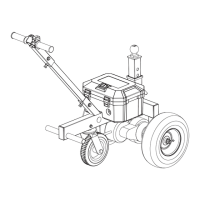
The Electric Power Dolly serves as a motorized assistant for towing trailers, boats, and other towable equipment. Its primary function is to provide controlled forward and reverse movement, allowing users to precisely position trailers in tight spaces or over short distances without the need for a full-sized vehicle. The dolly is equipped with a powerful motor that drives the rear wheels, enabling it to handle significant trailer weights and tongue weights. A key feature is its speed controller, which allows for variable speed adjustments, giving the operator fine control over the dolly's movement. The handlebar incorporates a switch button for selecting forward or reverse, enhancing maneuverability. The adjustable hitch ball mount ensures compatibility with various trailer types and allows for precise height adjustments to match the trailer's coupler. The inclusion of a swivel wheel at the front provides excellent steering capabilities, making turns and intricate movements straightforward. The power supply is managed by lead-acid batteries, which are housed in a protective battery box, ensuring reliable operation. An integrated overload protection system is a critical safety feature, designed to shut down the dolly if it exceeds its operational limits, thereby preventing damage to the machine and ensuring user safety.
Usage Features
Operating the Electric Power Dolly involves several user-friendly features designed for convenience and safety. Before operation, users are instructed to perform a thorough check of all bolts, tire pressure, battery volume, and switch functionality. The dolly should be started without a load to confirm forward and reverse movement. The adjustable hitch ball mount is a crucial feature, allowing users to set the ball height to match their trailer's coupler, ensuring a secure connection. This adjustment is made easy with a latch and pin mechanism. Once connected, the dolly's speed controller enables the operator to drive the trailer at various speeds, from 0 to 2.5 km/h, providing precise control. The D/R switch on the handlebar allows for quick changes between forward and reverse directions. For optimal performance and safety, the dolly is designed for use on flat roads with a slope angle of less than 4 degrees, and it is explicitly stated that it should not be used on downhill roads due to the absence of a brake system. The instruction manual emphasizes the importance of removing any obstacles that may hinder safe operation and disconnecting the power supply when not in use or during maintenance. The overload protection system is a built-in safety measure that automatically shuts down the dolly if it is overloaded, preventing potential damage. Users are advised to reduce the load before restarting the dolly after an overload shutdown.
Maintenance Features
Proper maintenance is essential for the longevity and safe operation of the Electric Power Dolly. The manual provides clear guidelines for battery care, which is critical for lead-acid batteries. Users are instructed to charge the battery at specific temperature ranges (32°F-120°F / 0°C-49°C) and store it within another specified range (32°F-86°F / 0°C-30°C). Regular charging is emphasized, even when the dolly is not in use, with a recommendation to charge the battery every three months to prevent damage. The manual also warns against charging damaged battery packs and stresses the importance of using only the Landworks charger provided. Battery connections are detailed with clear instructions and warnings against incorrect wiring, which could lead to short-circuits, fire, or physical danger. The assembly section of the manual serves as a guide for understanding the components and their proper installation, which is indirectly a maintenance feature as it helps users identify and correctly reassemble parts if needed. The troubleshooting section offers practical solutions for common issues, such as the dolly not working or stopping during operation. It guides users to check battery status, power switch status, and cable connections, and to recharge the battery or reduce the load if necessary. The manual also advises against disassembling the battery pack, as it contains no user-serviceable parts, and to dispose of or recycle batteries according to local regulations, protecting terminals with insulating tape prior to disposal. These maintenance guidelines are crucial for ensuring the dolly remains in optimal working condition and for extending its operational life.


 To Next Page
 General