Electric Booster– Installation, Operating and Maintenance Instructions
8
3.2 CONTROLS
A “rapid response” aquastat provides temperature control and ensures safe operation. The aquastat switch
incorporates a magnetic contactor to complete the power circuit to the heating elements and control the
water temperature. By use of an adjustable dial the operating aquastat can control the water to the desired
temperature.
The electrical controls come pre-wired on the right-hand side of each booster heater where it is protected
from high ambient temperatures.
An indicator light visible on the front panel indicates that there is power to the heating elements when the
booster heater is in operation.
The low water cut-off (optional) uses a resistance-sensing probe to determine if the booster heater is filled
with water. If the booster heater is filled with water, the relay coil will close and allow the element to turn
on. Sensing resistance is dial-adjustable, turn dial clockwise to increase sensitivity.
Start-up Instructions Section 4
4.1 START-UP
WARNING
The following instructions are intended as a guide for qualified persons.
Before filling the booster, make sure that the T&P relief valve is installed and that the unit is
properly grounded.
Before switching power on, fill system with water and vent air. Check for and repair any
leaks in water piping.
Perform the following procedure to check for proper booster heater operation:
1. Ensure power to the booster heater is turned OFF.
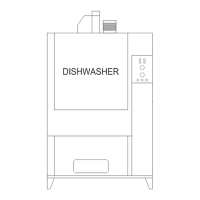
2. Set operating aquastat to give desired water temperature for dishwasher (usually 180ºF).
3. The operating aquastat setting should be at least 20ºF less than the temperature setting of T&P relief
valve (210ºF).
4. Run water through the booster heater for 5 minutes (or longer, if necessary) to ensure it is purged of
air and completely filled with water.
5. Check flow pressure with water flowing through the booster heater and, if necessary, readjust the
pressure reducing valve to 20 psi or to pressure recommended by dishwasher manufacturer.
6. Switch power to the booster heater ON.
7. The pilot lamp indicates that power is on when booster heater is operating.
8. Run a test cycle of dishwashing to confirm proper operation.
Maintenance Instructions Section 5
5.1 IMPORTANT
Many times when a booster heater does not appear to be functioning properly, the fault lies not with the
booster heater itself but with factors outside of the heater. Therefore, before becoming involved in corrective
work on the booster heater, the following steps should be followed:
Check the temperature of the water feeding into the booster heater tank. It must be 140ºF or
the temperature designed and must be in sufficient quantity to hold its temperature throughout
the dishwashing operation.
Incoming water temperature to the booster heater should not exceed 170ºF.
If incoming water exceeds 20 psi, a pressure reducing valve must be installed.


 To Next Page
 Loading...