Need help?
Do you have a question about the SUPER73 S1 and is the answer not in the manual?
Provides contact details for Super73 customer support in North America and Europe.
Explains warning, danger, and tip symbols used throughout the manual for safe operation.
Defines the proper and intended use of the Super73 electric bike, including restrictions and limitations.
Lists items included in the packaging and recommended additional tools for assembly.
Step-by-step guide for correctly installing the handlebars onto the bike's fork crown.
Instructions for installing the left and right pedals correctly using the provided wrench.
Guidance on inflating tires to the correct pressure for safe riding and proper seating.
Details on how battery capacity affects power output and factors influencing range.
Covers checks for wheels, battery, brakes, cables, display, and kickstand before riding.
Instructions on how to turn the bike on and operate the front and rear lights.
Explains how to select and use different pedal assist modes for riding.
Details on how the brakes work and the correct procedure for turning off the bike.
Provides essential safety rules, legal compliance, and riding best practices for all users.
Advice for riding in wet weather and at night, emphasizing visibility and caution.
Guidelines on replacement parts, tampering, and parental responsibility for young riders.
Important safety instructions for using the battery charger to prevent damage or injury.
Procedures for responsibly recycling packaging and disposing of electronic components and batteries.
Covers essential precautions, helmet use, pre-ride checks, and operational safety for all users.
Outlines recommended checks for before/after rides, monthly, and every six months.
Procedures for cleaning and maintaining the bike's frame and components.
Information on tire sizes, inflation, condition checks, and wheel alignment.
Guidance on helmet use, reflector importance, and detailed brake system maintenance.
Process for bedding in new brake pads/rotors and instructions for replacing worn pads.
Best practices for optimizing battery life, charging, storage, and safety precautions.
Explains how temperature, terrain, rider weight, and maintenance impact the bike's range.
Recommendations for optimizing battery performance and increasing riding range.
Details about the seat's fixed height and general wear and tear on bike components.
Guidelines for parking, storing, and transporting the bike safely and securely.
Outlines the limited warranty period, coverage, remedies for claims, and requirements for application.
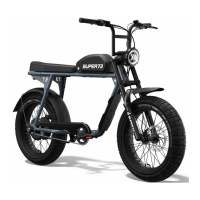
The device is an electric bicycle, specifically the SUPER73-S1 model, designed for adventurous exploration and community engagement. It is intended for use on paved paths and is not approved for participation in competitions or commercial use. The bike is equipped with a rear hub motor, a battery, a display, a throttle, and mechanical disc brakes.
The SUPER73-S1 is an electric bicycle that provides pedal assistance and throttle-activated power. The electric motor assists the rider, making it easier to pedal and reach higher speeds. The bike features multiple pedal assist modes: "Throttle Only" (no pedal assistance), "ECO" (20% Speed Power), "MED/TOUR" (60% Speed Power), and "HIGH/SPORT" (100% Speed Power). The pedal assist sensor activates the motor when the rider begins pedaling, accelerating the bike to the selected assist level. The throttle on the right side of the handlebar allows for direct motor control.
The bike is powered by a lithium-ion battery, which can be charged either while mounted on the bike or separately. Two keys are provided for unlocking and locking the battery. The battery must be switched to the "I" (on) position for charging to occur. During charging, the throttle is disabled, and a charge icon appears on the display. The charger LED turns red during charging and green when the battery is fully charged.
The SUPER73-S1 comes equipped with a front headlight and a rear brake light. The front headlight is activated by pressing the power button on the display once. The rear brake light illuminates automatically when the bike is powered on and gets brighter when the brake levers are engaged.
Braking is handled by Tektro mechanical disc brake systems. The brake levers are equipped with sensors that cut power to the motor when either lever is compressed, ensuring safety. The right lever activates the rear brakes, and the left lever activates the front brakes.
To power on the bike, the kickstand must be disengaged, the brake handle engaged, and the rider seated. The battery is then switched to the "I" position, and the power button on the display is pressed and held for 1-3 seconds until the display illuminates. Once powered on, the throttle becomes active.
Pedal assist modes can be selected by briefly pressing the "M" button on the display. The S1 defaults to "Throttle Only" when powered on. Riders should familiarize themselves with the operation of the throttle and pedal assist levels, starting with the lowest assist level until comfortable with controlling the power.
When riding, users are advised to obey all road laws, including giving right of way to pedestrians and stopping at red lights and stop signs. Correct hand signals should be used for turning or stopping. Riders should concentrate on the path ahead, avoiding potholes, gravel, wet or oily roads, curbs, train tracks, speed bumps, and other obstacles. It is recommended to walk the bike across all train tracks and be aware of unexpected situations like opening car doors or cars backing out of driveways.
The bike is designed for use on paved paths only. Riders should avoid riding on stairs, jumping, or performing wheelies or similar activities. It is recommended to wear proper riding clothes, avoid open-toe shoes, and secure loose pants to prevent them from getting caught in the chain. Carrying passengers or cargo that interferes with control is not advised.
For safety, users should never operate the bike and use their phone simultaneously. Music devices such as headphones should not be used while riding, as they can impair awareness of the surrounding environment. Maintaining a comfortable stopping distance from other objects, riders, and vehicles is crucial, with safe braking distances dependent on weather and lighting conditions.
When riding in wet weather, extra caution is advised. It is recommended not to ride in puddles, heavy rain, or streams, and never immerse the product in water to prevent damage to the electrical system. Brake earlier and decrease riding speed in wet conditions. Reflective clothing and approved safety lights should be used.
For night riding, the SUPER73-S1 should be equipped with a full set of correctly positioned and clean reflectors, a properly functioning white front light, and a red rear light. Riders should wear reflective and light-colored clothing, slow down, and use familiar roads with street lighting.
To turn off the bike, the power button on the battery should be switched to the "O" position. The bike also features an automatic shut-off when left idle for more than 10 minutes.
Before each use, a pre-ride safety check is essential. This includes checking the condition and pressure of both tires (recommended 20-25 PSI), ensuring wheels are true and properly seated in the dropouts with tight wheel nuts. The battery's secure insertion and charge status should be verified. Both brake levers should be pulled to ensure an obvious pressure point and that they cannot touch the handle. All cables should be checked for looseness, proper connection of plugs, and absence of strain or damage near moving parts. The display should turn on and function properly, and the kickstand should be tightly secured and not rubbing against the ground or tires.
Regular maintenance is crucial for prolonging the bike's life. Every month, the handlebar and steer tube should be inspected for unusual movement, and cables, tires, and handles should be checked. Brake rotors and pads should be inspected for wear and replaced if necessary. The tension of spokes should be checked, and wheels should be true and properly dished. The chain should be lubed and its tension checked. Suspension components should be inspected for wear, and all hardware should be properly tightened.
Every six months, or depending on frequency and type of use, the frame and fork should be inspected for signs of cracks. The bottom bracket and crankshaft should be checked, and bolts on each crank tightened. Wheel hubs, headset, and all friction parts should be greased. Suspension components should also be greased, and hardware tightened.
For cleaning, the bike should be regularly cleaned with clear water and a gentle soap to dissolve grease and residues. A lightly damp cloth should be used to wipe down dirt or debris, and surfaces treated with a care product after drying. Strong water jets or steam jets should be avoided, as water can get past seals and into bearings, diluting lubricants and increasing friction.
Tires should be inflated using a pump with a Schrader valve tip to a recommended pressure of 18-25 PSI (1.24-1.72 bar). It is important to inflate to a maximum of 30 PSI (2.06 bar) initially to ensure proper seating in the rim, then deflate to the recommended range. Proper inflation, good maintenance, and timely replacement of tires are vital. Uneven tire wear may indicate a need for wheel alignment by a professional cycle mechanic.
Brake pads and rotors require a bed-in process when replaced. This involves accelerating to 20mph and engaging brakes to a near stop, repeating 8-10 times. This ensures even wear and removes surface glaze. The wear of mechanical disc brake pads can be regulated by unscrewing the cable tension knob and adjusting the inner pad with a 5mm Allen key. To maximize service life, brake components should be protected from greasy substances. Cables, ducts, harness, and pads should be regularly checked for wear.
The battery is a critical component, and its life can be optimized by following best practices. It should not be stored discharged, as this can reduce its life and void the warranty. Recharging at the end of each ride is recommended. For optimal shelf life, the battery should be stored at room temperature (65°-75°F / 18°-23°C) and operated between 40°F - 85°F (4°C - 30°C). Exposure to high temperatures or direct sunlight for prolonged periods should be avoided. Battery contacts should be kept clean, and metal objects should not be inserted. The battery should be charged using only the original or manufacturer-approved charger, and charging should be done in a well-ventilated, dry, fireproof environment. The battery should not be left connected to the charger for more than 48 hours.
For storage and transportation, the bike should be parked in accordance with local regulations, preferably indoors. If parked outdoors in wet conditions, it should not be for an extended period and should be dried afterward. The power and lights should be switched off to conserve battery power. The battery key should be removed, and the battery locked to the frame in the off position, or removed and taken for security. When transporting the ebike on a vehicle rack, the battery should be removed and secured inside the vehicle, protecting its plugs and connectors. This also reduces the bike's weight for easier lifting.
 General
| Brakes | Tektro mechanical disc brakes |
|---|---|
| Frame | Steel |
| Max Load | 275 lbs |
| Charging Time | 6-7 hours |
| Display | LCD display |
| Throttle | Yes |
| Motor | 500W |
| Battery | 48V lithium-ion |
| Range | 35-40 miles |
| Top Speed | 28 mph (with pedal assist) |
| Tires | 20" x 4" |

 To Next Page