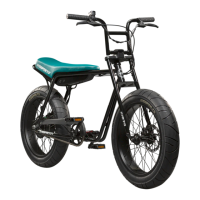
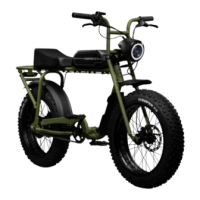
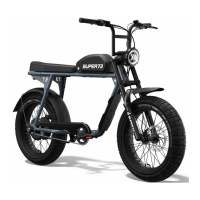
The Super73-ZX is an electric bicycle designed for adventurous exploration and community engagement, suitable for both US and European markets. It is intended for use on paved paths and is not approved for competitive use or activities like riding on stairs, jumping, or performing wheelies. The bike has a permitted overall weight of 325 lbs (147kg).
Function Description:
The Super73-ZX functions as an electric bicycle, providing pedal assistance and, in US models, throttle operation. European models are classified as Electric Power Assisted Cycles (EPAC) according to EN 15194, with a maximum speed of 25 km/h and a 250 Watt motor output. These models require continuous pedaling for assistance, which cuts off beyond 25 km/h. US models offer Class 1 (pedal assist only, 20 mph max speed), Class 2 (throttle and pedal assist, 20 mph max speed), and Class 3 (pedal assist only, 28 mph max speed) riding modes. An "Unlimited" mode (up to 2000 watts, throttle speeds above 28 mph) is available for off-public-road and private property use in US models, and similar off-road experience modes are available for European models. The bike is powered by a lithium-ion battery, which can be charged either mounted on the bike or separately. The display shows information such as speed, range, assist level, and total miles.
Usage Features:
- Assembly: The Super73-ZX requires some assembly upon arrival, including handlebar installation, pedal installation, and tire inflation. Detailed instructions are provided, along with recommendations for additional tools. Users are advised to read all instructions fully and contact Super73 or a specialized retailer if uncertain about configuration.
- Pre-ride Safety Check: Before each ride, a comprehensive safety checklist must be completed. This includes checking tire condition and pressure (recommended 20-25 psi), wheel alignment, battery security and charge status, brake function, cable integrity, display operation, and kickstand stability.
- Powering On/Off: To power on, disengage the kickstand, engage the brakes, switch the battery to the "I" position, and press the power button on the display until it illuminates. To power off, switch the battery to the "O" position.
- Pedal Assist Modes: The bike offers four pedal assist levels (0-4), with 0 being off and 4 providing 100% speed power. These modes can be selected via the display, allowing riders to adjust the level of electric assistance.
- Braking System: The ZX uses Tektro mechanical disc brakes. The right lever activates the rear brake, and the left lever activates the front brake. Brake levers are equipped with sensors that cut power to the motor when compressed.
- Lighting System (EU Models): European models come with a front headlight and rear light, which can be activated or deactivated by pressing the UP arrow on the display or via the Super73 app.
- Display Settings: Holding down the "O" button on the display activates a settings menu, allowing adjustments for contrast, units (mi/F), display orientation, backlight power, and viewing the software version.
- Super73 App Integration: The Super73 app allows riders to change riding modes and control lights. It is crucial not to use the app or adjust settings while in motion to ensure safe riding.
- Bluetooth Functionality: The bike is equipped with wireless Bluetooth. Users are cautioned against using Bluetooth in areas where electronic equipment is forbidden, near pacemakers, or automatically controlled equipment to avoid interference.
Maintenance Features:
- Regular Cleaning: The bike should be regularly cleaned with clear water and gentle soap to protect against corrosion and remove dirt. A lightly damp cloth should be used, avoiding strong water jets or steam directly on electronics and bearings. After cleaning, surfaces should be treated with a care product.
- Tire Maintenance: Tires should be checked before each use for punctures, cracks, and deformations. Proper inflation (20-25 psi) is crucial for safety and optimal performance. Uneven tire wear should prompt a professional wheel alignment check.
- Chain Tension (USA Models): The chain tensioner should be inspected for wear, and the chain should be lubricated periodically. The chain should allow about one inch of vertical movement; if looser, it needs tightening or replacement. Lube should be applied carefully to each link, avoiding brake calipers and pads.
- Brake Maintenance: Brake pads and rotors require regular inspection for wear. Pads should have at least 1/4 inch (0.6 mm) of material. Worn pads should be replaced, and clearances between the rotor and pad should be equally adjusted. Handling new brake pads with rubber gloves is recommended to prevent contamination.
- Battery Care: The lithium-ion battery should not be opened, exposed to mechanical damage, extreme heat, fire, or immersion in water. It should be charged using only the original charger, in a dry, fireproof, and well-ventilated environment. The first charge should be 4-5 hours for optimal cell conditioning. The battery should not be left connected to the charger for more than 48 hours, nor stored empty for more than 24 hours. It should be charged and used at least once every 90 days. For prolonged storage, the battery should be removed, stored indoors in a cool (10-20°C) and dry place, with a charge above 50%, and checked monthly.
- General Inspections: The handlebar, steer tube, cables, and handles should be inspected monthly for unusual movement or wear. Spokes should be checked for tension, and wheels for trueness. Suspension components should be inspected for wear and adjusted as needed. Every six months, the frame, fork, bottom bracket, crankshaft, wheel hubs, and headset should be inspected for cracks, tightened, and greased.
- Professional Servicing: For any maintenance procedures beyond the user's skill set, it is recommended to take the Super73-ZX to a certified E-Bike specialist or professional cycle mechanic.
- Recycling: All electronic components, including the motor, battery, charger, display panel, and torque sensor, must be disposed of and recycled responsibly, not with household waste. Specific guidelines for Europe are provided for electrical devices and battery packs.

 Need help?
 General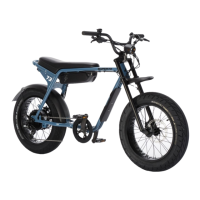

 To Next Page