Need help?
Do you have a question about the Superchips Pulsar LT and is the answer not in the manual?
Explains WARNING, CAUTION, NOTICE, and NOTE designations for user safety.
Provides critical safety guidelines for operating the device and vehicle safely.
Guides users on downloading and installing the necessary Update Agent software.
Details the step-by-step process to update the Pulsar LT device via USB.
Lists the included materials and required tools for installing the Pulsar LT module.
Details the initial steps for installing the Pulsar LT, including battery disconnection and connector release.
Describes how to install the harness, module, and secure the unit using zip ties and Velcro.
Explains how to access and navigate the device's programming menu using cruise control switches.
Guides users on adjusting the speed limiter setting for the vehicle between 82 and 140 MPH.
Explains how to adjust the TPMS inflate to number, reprogramming the vehicle ECM.
Guides the user on how to input stock and modified tire sizes for the vehicle.
Details how to input stock and modified axle ratio values for the vehicle.
Explains the procedure to clear Diagnostic Trouble Codes (DTCs) from the vehicle.
Guides the user on how to disable the Auto Start/Stop feature of the vehicle.
Explains how to disable the Dynamic Fuel Management (DFM) feature, which also disables Auto Start/Stop.
Details how to adjust the vehicle's throttle responsiveness levels using the device.
Answers common questions regarding the Pulsar LT's features, usage, and compatibility.
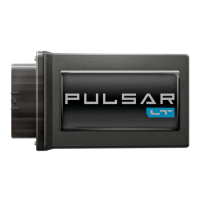
The Pulsar LT is an inline control module designed to enhance vehicle performance and offer programmable features. It connects to the vehicle's existing wiring and can be updated via a USB connection using a Windows computer.
The Pulsar LT serves as an inline control module that modifies various aspects of a vehicle's performance. It allows users to adjust parameters such as speed limiter, tire pressure monitoring system (TPMS) settings, tire size, axle ratio, and disable features like Auto Start/Stop and Dynamic Fuel Management (DFM). Additionally, it offers responsiveness level adjustments, providing different throttle response settings. The device works by intercepting and modifying signals within the vehicle's system, offering a range of performance and convenience enhancements without requiring a full engine reflash. It is designed to be installed under the hood, typically near the air intake, and connects to the factory wiring harness.
The Pulsar LT offers a user-friendly programming interface that utilizes the vehicle's cruise control switches and speedometer for navigation and input. To access the programming menu, the vehicle must be running, and cruise control must be turned off. The process involves turning the ignition to the RUN position (without starting the engine), adjusting the vehicle's screen cluster to the digital speedometer, and then holding the cancel cruise control button until the speedometer sweeps to 140 MPH. Users can then navigate through seven different programming modes using the +RES or –SET wheel on the cruise control.
The available programming modes include:
In addition to these programming modes, the Pulsar LT offers Responsiveness Level Adjustment. When the vehicle is running and cruise control is off, the throttle responsiveness can be adjusted. The speedometer indicates the responsiveness level, ranging from Level 0 (Stock) to Level 5 (Increased responsiveness up to 65% over stock). Levels also include reduced responsiveness (up to 15% less than stock) and various stages of increased responsiveness (up to 15%, 30%, and 48% over stock). Users adjust the level using the +RES or -SET controls.
The Pulsar LT includes features for software updates to ensure optimal performance and compatibility.
For troubleshooting and support, the manual provides a FAQ section addressing common questions, such as adjusting power levels (only when cruise control is off), removing the device before dealer visits, checking current power levels (by pressing Cancel on the steering keypad), and warnings against "stacking" or using other tuners simultaneously to prevent vehicle damage. It also offers guidance on accurately measuring tire size. Technical support contact information is provided for further assistance.
 General
| Product Type | Performance Tuner |
|---|---|
| Tuning Options | Multiple performance levels |
| Installation | Plug-and-Play |
| Features | real-time data monitoring |
| Adjustable Parameters | tire size, speed limiter |
| Adjustability | Real-time adjustability |
| Fuel Economy Improvement | Potential for improved fuel economy |
| Data Monitoring | Real-time data monitoring |

 To Next Page