NOTE: DIAGRAMS & ILLUSTRATIONS NOT TO SCALE.
18
Figure 46
Methods of Determining Hearth Extension
and Wall Shield Equivalents
To determine the thickness required for any
material when either the k or r values are
known:
T
M
= Thickness of material in inches
k
M
= K value of desired material
r
M
= R value of desired material
T
L
= Minimum listed thickness
Example: Micore CV230 is to be used for the
hearth extension fireplace. How thick must this
material be?
Using the k formula:
Desired k value of desired Min. thickness
Required = material (per inch) x of Listed
Thickness k value of listed Material
material (per inch)
T
M
(inches) = k
M
x T
L
0.84
T
M
(inches) = 0.43* x ⁵⁄₈"
0.84
Answer using k = 0.51 x ⁵⁄₈" = 0.32 = ³⁄₈"
³⁄₈" thickness Micore will be required.
Using the r formula:
Desired r value of listed Min. thickness
Required = material (per inch)x of Listed
Thickness r value of desired Material
material (per inch)
T
M
(inches) = 1.19 x T
L
r
M
T
M
(inches) = 1.19 x ⁵⁄₈"
2.33*
Answer using r = 0.51 x ⁵⁄₈" = 0.32 = ³⁄₈"
³⁄₈" thickness Micore will be required.
At times it is important to know what combina-
tion of materials are acceptable for use as
hearth extensions. The “R values” are used to
determine acceptable combinations of materi-
als because “R values” are additive where r and
k values are not.
“R value” = 1 = r x thickness of material used
k
Alternative Hearth Extension
and Wall Shield Materials
Listed Values Min. Thick
Material k r T
L
Millboard .84 1.19 1"
Alternative Values Min. Thick
Materials k r T
M
Wonderboard 1.92 0.56 2 ¹⁄₄"
Common brick 5.00 0.20 6"
Cement mortar 5.00 0.20 6"
Ceramic tile 12.5 0.08 15"
Marble 11.0 0.09 13"
Micore CV230 0.43 2.33 ¹⁄₂"
(U.S. Gypsum)
Ceraform 126 0.27 3.70 ³⁄₈"
(Johns-Manville)
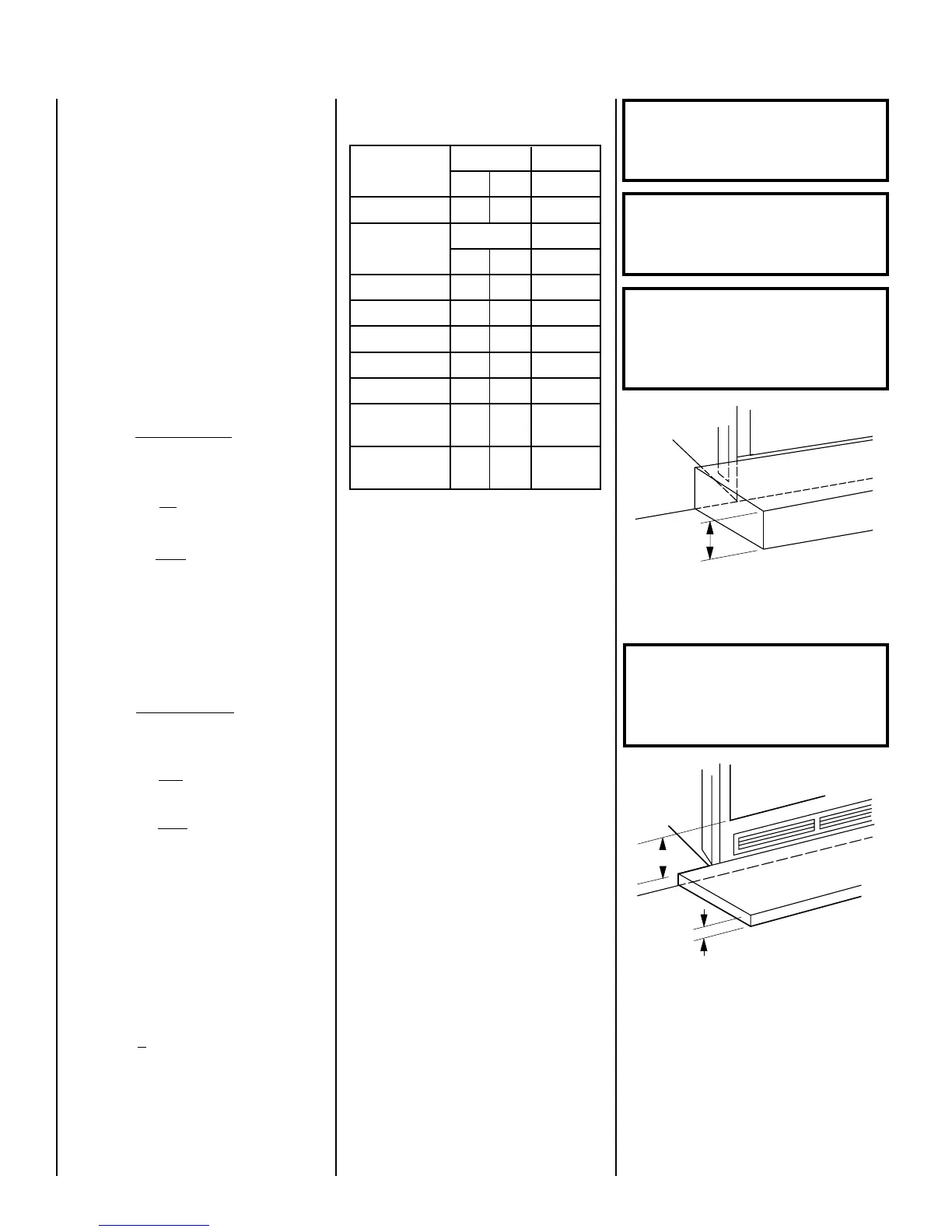
WARNING: WHEN INSTALLING BRF
MODELS, THE FIREPLACE MUST BE
RAISED IF HEIGHT OF HEARTH EXTEN-
SION EXCEED 7" ABOVE THE BOTTOM OF
THE FIREPLACE (
FIGURE 45
).
5 1/2"
1 1/2"
Max Thickness of Hearth Extension
When BCF Models Are On Floor
7"
Max. Thickness Of Hearth Extension
When BRF Models Are On The Floor
Secure the hearth extension to the floor to
prevent possible shifting.
WARNING: THE CRACK BETWEEN THE
FIREPLACE AND THE HEARTH EXTEN-
SION MUST BE SEALED WITH A NON-
COMBUSTIBLE MATERIAL.
WARNING: WHEN INSTALLING THE
HEARTH EXTENSION, BE CAREFUL NOT
TO BLOCK THE HEAT-CIRCULATING AIR
INLET GRILL ON BCF MODELS.
*value taken from chart
Example: Given that the required “R value” for
a suitable hearth extension used must be equal
to or greater than:
“R” = r x T
L
= 1.19 x ⁵⁄₈" = 0.74.
If it is desired to elevate a marble hearth exten-
sion to a level of 5" or more above the floor
surface. What combination of noncombustible
materials can be used to accomplish this?
If common brick is used so that the 3 ¹⁄₂"
dimension is the height, “R” for the common
brick becomes:
“R”
M
= r x T
M
= 0.20 x 3 ¹⁄₂" = 0.70
Using ¹⁄₂" of mortar to set the brick, “R” for the
mortar is calculated as follows:
“R”
M
= r x T
M
= 0.20 x ¹⁄₂" = 0.10
A ³⁄₄" marble slab set in ¹⁄₂" mortar covers the
brick, “R” for the marble and mortar becomes:
“R”
M
= r x T
M
= 0.09 x ³⁄₄" = .068
“R”
M
= r x T
M
= 0.20 x ¹⁄₂" = .10
The sum of all “R values” is:
.70 + .10 +. 068 + .10 = .968
This would not be an acceptable combination of
material for the hearth extension since the total
calculated “R value” of the materials used does
not exceed the required “R value” of 1.19.
Figure 45
WARNING: WHEN INSTALLING BCF
MODELS, THE FIREPLACE MUST BE
RAISED IF HEIGHT OF HEARTH EXTEN-
SION EXCEEDS 1 ¹⁄₂" ABOVE THE BOT-
TOM OF FIREPLACE (
FIGURE 46
).



 To Next Page