NOTE: DIAGRAMS & ILLUSTRATIONS NOT TO SCALE.
9
Security's chimney sections do not need to be
screwed together. Additional reinforcement is
not necessary except in certain offset condi-
tions (refer to page 14,
Figure 36
).
Step 5. The height of vertical chimney pipe
supported only by the fireplace must not ex-
ceed 30'. Chimney heights above 30' must be
supported by a Model FTF8-S4 stabilizer in-
stalled at 30' intervals.
Note: Models FTF8-S4 and FTF10-S4 add 3" net
effective height to the total chimney system.
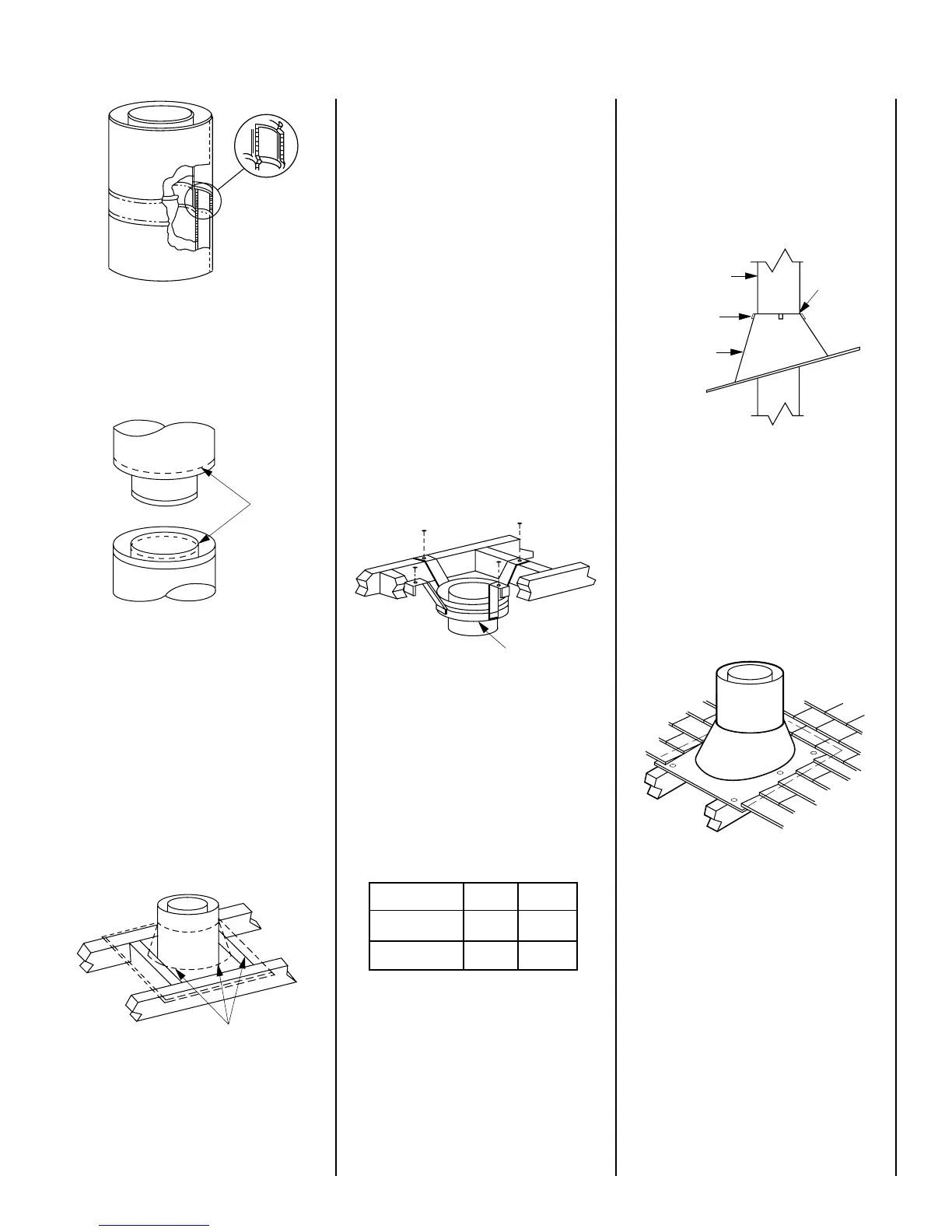
Install Models FTF8-S4 and FTF10-S4 stabilizers
by fitting inner section down into respective
section of proceeding flue pipe and locking outer
stabilizer section into place over the outer chim-
ney pipe. Position for proper clearance through
framed opening and nail straps securely (under
tension in “shear”) into place on framing. Use 8d
nails. Attach successive lengths of chimney pipe
directly to stabilizer using same techniques as
described in Step 4 (
Figure 25
).
Figure 25
Note: Do not apply excessive pressure to any
subsequent chimney sections following the
stabilizer when installing. Ensure each subse-
quent chimney section is securely attached by
testing as noted in Step 4.
Step 6. Select the proper Security Chimneys
roof flashing based on pitch of roof. Use chart
below for selection:
Locking
Tabs
(Lances)
FTF8-S4 Stabilizer
Figure 24
2" Min. Air Space To Combustibles
(
See **Note
)
**Note: 1" clearance when installing FTF8 on
38" models or FTF10 on 43" models.
Figure 23
Note: Assemble one component of chimney at a
time (inner section first, then outer section last)
before proceeding with the next complete section.
Continue to assemble the chimney up through
framed opening. Assemble just enough to pen-
etrate the roof flashing openings (
Figure 24
).
Always maintain 2" minimum air space to com-
bustible materials and always check each chim-
ney joint (inner and outer) to ensure proper
engagement (
See **Note
). Check vertical align-
ment of chimney so that it projects from the
roof in true vertical position.
Figure 22
Outer pipe section installs in just the opposite
way; the lanced end goes down and each new
section goes OVER the outside of the previous
section installed (
Figure 23
).
Roof Pitch FTF8 FTF10
Flat to 6/12 F8F6 F10F6
6/12 to 12/12 F8F12 F10F12
Next, slide roof flashing over extended chimney
section that previously has been installed above
the roof opening in Step 4. FTF8 flashings
require flashing spacers. Slide flashing all the
way down until the flashing base rests flat on
the roof (
Figure 26
). Again, check the vertical
position of the chimney and the 2" minimum air
space to combustibles (
see **Note
).
Figure 26
Note: Do not caulk or seal the ventilating
openings.
Step 7. Secure flashing by nailing along the
perimeter into roof using 8d nails. If shingled
roof, slide upper end and sides of roof flashing
under shingles (trim if necessary), seal the top
and both sides of the flashing to the roof with
roof caulking. Cover nail heads with roof caulk-
ing (
Figure 27
).
Figure 27
Step 8. The standard Security Chimneys FTF8
roof flashing assemblies include a storm collar.
Slide the storm collar over outer chimney, rest
on flashing spacers and align with top surface
of flashing. Insert tab in slot, pull tight and bend
tab back over slot. Seal storm collar to outer
chimney with roof caulking or mastic around
entire circumference of pipe. Also add extra
roof caulking to the tab/slot area to seal com-
pletely against water penetration (
see Figure 28
). Check all joints very carefully to ensure no
water intrusion can take place.
FTF8 Chimney
FTF8 Flashing
Flashing Spacers
Do Not Seal



 To Next Page