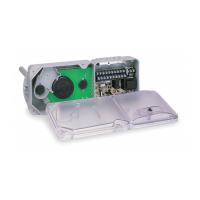
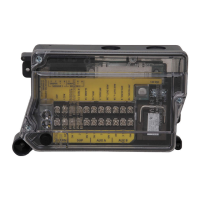
D4120 Duct Smoke Detector
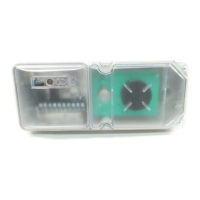
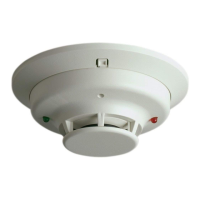
D4S Sensor Component
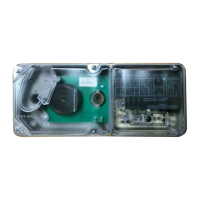
D4P120 Power Board Component
INSTALLATION AND MAINTENANCE INSTRUCTIONS
3825 Ohio Avenue, St. Charles, Illinois 60174
1-800-SENSOR2, FAX: 630-377-6495
www.systemsensor.com
TABLE OF CONTENTS PAGE
[1] Limitations of Duct Smoke Detectors. . . . . . . . . . . . . . . . . . . . . . . . . . 1
[2]
Exploded View of Duct Smoke Detector Components
.............2
[3] General Description ......................................2
[4] Contents of Duct Smoke Detector Kit. . . . . . . . . . . . . . . . . . . . . . . . . . 2
[5] Detector Installation . . . . . . . . . . . . . . . . . . . . . . . . . . . . . . . . . . . . . . 2
[6] Sampling Tube Installation .................................3
[7] Measurement Tests . . . . . . . . . . . . . . . . . . . . . . . . . . . . . . . . . . . . . . . 3
[8] Field Wiring Installation Guidelines. . . . . . . . . . . . . . . . . . . . . . . . . . . 4
[9] Unit Configuration .......................................5
[10] Detector Status Indication . . . . . . . . . . . . . . . . . . . . . . . . . . . . . . . . . 6
[11] Interconnection (Multiple Fan Shut Down). . . . . . . . . . . . . . . . . . . . . 6
[12] Verification of Operation . . . . . . . . . . . . . . . . . . . . . . . . . . . . . . . . . . 6
[13] Detector Cleaning Procedures ..............................7
[14] Sensor replacement. . . . . . . . . . . . . . . . . . . . . . . . . . . . . . . . . . . . . . 7
[15] Optional Accessories. . . . . . . . . . . . . . . . . . . . . . . . . . . . . . . . . . . . . 7
Wiring Diagrams . . . . . . . . . . . . . . . . . . . . . . . . . . . . . . . . . . . . . . . . . . 5-7
Warranty . . . . . . . . . . . . . . . . . . . . . . . . . . . . . . . . . . . . . . . . . . . . . . . . 8
BEFORE INSTALLING
Read System Sensor’s Applications Guide for Duct Smoke Detectors
(HVAG53), which provides information on detector spacing, placement,
zoning, wiring, and special applications. This manual is available online at
www.systemsensor.com. NFPA Standards 72 and 90A should also be refer-
enced for detailed information.
NOTICE: This manual shall be left with the owner/user of this equipment.
I56-2967-008R
NOTE: The D4120 duct detector consists of D4P120 Power Board component and the D4S Sensor component.
SPECIFICATIONS
Operating Temperature: D4120 & D4S: –4° to 158° F (–20° to 70° C) D4P120: –40° to 158° F (–40° to 70° C)
Storage Temperature: D4120 & D4S: –22° to 158° F (–30° to 70° C) D4P120: –40° to 158° F (–40° to 70° C)
Humidity: 0% to 95% Relative Humidity Non-condensing
Air Velocity: 100 to 4000 ft./min. (0.5 to 20.3 m/sec.)
D4120 Footprint Dimensions: Rectangular - 14.38 in L x 5 in W x 2.5 in D (37cm L x 12.7cm W x 6.36cm D)
Square - 7.75 in L x 9 in W x 2.5 in D (19.7cm L x 22.9cm W x 6.35cm D)
D4S/D4P120 Footprint Dimensions: 7.75 in L x 5 in W x 2.5 in D (19.7cm L x 12.7cm W x 6.35cm D)
D4120 Weight: 2.5 pounds; 1.14 kg
Electrical
Power supply voltage: 20-29 VDC 24 VAC 50-60-Hz 120 VAC 50-60 Hz
Input capacitance: 270 µF max. 270 µF max. N/A
Reset Voltage: 3.0 VDC min. 2.0 VAC min. 10 VAC min.
Reset Time (with RTS451/RTS151): .03 to 0.3 sec. .03 to 0.3 sec. .03 to 0.3 sec.
Reset Time (by power down): 0.6 sec. max. 0.6 sec. max. 0.6 sec. max.
Power Up Time: 35 sec. max. 35 sec. max. 35 sec. max.
Alarm response time: 15 sec. 15 sec. 15 sec.
Sensitivity Test: See detector label See detector label See detector label
Current Requirements (Using No Accessories)
Max. standby current 21 mA @ 24 VDC 65 mA RMS @ 24VAC 60Hz 20 mA RMS @ 120 VAC 60 Hz
Max. alarm current 65 mA @ 24 VDC 135 mA RMS @ 24 VAC 60 Hz 35 mA RMS @ 120 VAC 60 Hz
CONTACT RATINGS
Alarm initiation contacts (SPST) 2.0A @ 30 VDC (resistive)
Alarm auxiliary contatcs (DPDT) 10A @30 VDC (resistive)
10A @250 VAC (resistive)
1
/2 HP @240 VAC
1
/4 HP @120 VAC
NOTE: Alarm auxiliary contacts shall not be connected to initiating circuits of
control panels. Use the alarm initiation contact for this purpose.
Supervisory Contacts (SPDT) 2.0A @ 30 VDC (resistive)
2.0A @ 125 VAC (resistive)
ACCESSORY CURRENT LOADS AT 24 VDC
DEVICE STANDBY TROUBLE ALARM
APA151/APA451 12.5mA n/a 30mA Max.
MHR/MHW 0mA n/a 29mA Max.
RA400Z/RA100Z 0mA n/a 12mA Max.
RTS451/RTS151 0mA n/a 12mA Max.
RTS451KEY/RTS151KEY 12mA n/a 12mA Max.
RTS2 3mA Max. 16mA Max. 30mA Max.
RTS2-AOS 3mA 16mA Max. 55mA Max.
NOTE: Any combination of accessories may be used such that the given accessory
loads are: 110mA or less at the Aux output, and 50mA or less at the Alarm output.
IMPORTANT: This detector must be tested and maintained regularly following
NFPA 72 requirements. The detector must be tested an maintained regularly fol-
lowing NFPA 72 requirements. According to NFPA, the detector should be visu-
ally inspected semiannually and functionally tested at least once a year. This
may need to be more frequent depending on the air quality of the duct supply air.
[1] LIMITATIONS OF DUCT SMOKE DETECTORS
The National Fire Protection Association has established that DUCT DETEC-
TORS MUST NOT BE USED AS A SUBSTITUTE FOR OPEN AREA DETECTOR
PROTECTION as a means of providing life safety. Nor are they a substitute for
early warning in a building’s regular fire detection system.
System Sensor supports this position and strongly recommends that the user
read NFPA Standards 90A, 72, and 101. The D4120 Air Duct Smoke Detectors
are listed per UL 268A.
This device will not operate without electrical power. Fire situations may
cause an interruption of power. The system safeguards should be discussed
with your local fire protection specialist.
This device will not sense smoke unless the ventilation system is operating
and the cover is installed.
For this detector to function properly, it MUST be installed according to the in-
structions in this manual. Furthermore, the detector MUST be operated within
ALL electrical and environmental specifications listed in this manual. Failure
to comply with these requirements may prevent the detector from activating
when smoke is present in the air duct.
I56-2967-008R
21/09/2020
Amended by Pertronic Industries, 21 September 2020 (DST1 not available in Australia and New Zealand)
For Australia and New Zealand

 Need help?
 General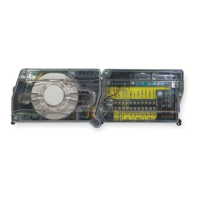

 To Next Page