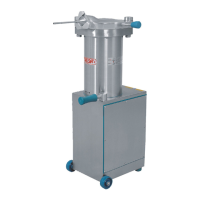
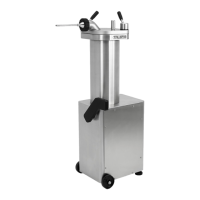
H PISTON FILLERS/STUFFERS
EN-30
8.2 Maintenance & Inspection Tips
Lid gasket (green):
Replace if damaged or if leaks are observed.
This gasket is reversible – it can be installed with either side facing up.
Align the gasket’s glued joint so that it is under the lid bolt.
Before closing the lid, grease the top of the gasket (and bottom edge of the lid) with animal fat or other USDA approved
shortening in order to reduce friction and prolong the gasket’s life.
The gasket is made from a non-toxic, food-safe material.
A spare gasket is provided with the machine.
Piston gasket (black/transparent):
Replace if damaged or if leaks are observed.
To reduce noise when the piston is in motion, grease this gasket with animal fat or other USDA approved shortening
before reassembling the piston.
Some models utilize two piston gaskets
Cylinder ram: In order to prolong the life of the hydraulic cylinder ram, leave the piston head at the bottom of the meat barrel
when the machine is not in use. The ram will thus be completely submerged in hydraulic oil.
Lid adjustement: The barrel’s lid can be tightened or loosened depending on the requirements of the food mixture. If the food
mixture is relatively dry, the lid can be loosened to allow easier opening and closing. If, however, the mixture is comparatively
moist, the lid should be tightened in order to avoid leaks.
To adjust the lid:
Loosen the two lock nuts located beneath the clamp.
Loosen or tighten the two lid fixing bolts as needed.
Retighten the two lock nuts completely.
Electric cord: If the electric cord becomes damaged, immediately have a qualified electrician replace it with a cord of identical
specifications. Contact your dealer’s service department to obtain the replacement cord.
Spare parts: Contact your dealer to obtain spare parts. Be sure to provide your dealer with all necessary details (such as model,
serial number, year of manufacture, power, voltage, frequency, etc.) when ordering. These details may be found on the technical
specifications plate affixed to the machine.
8.3 Hydraulic Oil
Checking the oil level:
The oil level can be checked using the oil cap/dipstick provided.
Maintain the reservoir filled to the maximum level indicated on the dipstick without exceeding the mark. This will provide
the greatest cooling efficiency for the hydraulic system and prolong the life of the oil.
If the oil level drops too low air will enter the hydraulic circuit and the piston will not move smoothly since
Oil temperature: After prolonged use the hydraulic oil may reach temperatures of up to 60ºC (140ºF) due to the pressures
generated by the pump. The base side panel may become warm to the touch. This machine is not designed for constant,
uninterrupted use at high pressure; it is built to run intermittently to allow dissipation of the heat produced during use. The amount
of heat generated will also depends on the consistency of the food dough being processed.
Oil filter: The oil filter is located inside the oil reservoir and not accessible to the user; it should be replaced only by a qualified
technician. To replace the filter first remove the two screws that attach the closing clamp to the filter and pull the filter out. The
filter should not become dirty or suffer damage under normal use. If the filter must be replaced, use a similar filter with a thread
of 3/8” BSP and a filtering capacity of 10 liters per minute (5 liters per minute for the H15 &H20 models). After reassembling the
unit, the closing clamp must be tightly sealed.
Oil longevity: The life of the hydraulic oil depends on such factors as temperature, pressure, environmental humidity, whether
moisture has entered the oil reservoir, etc. Under normal use the oil will last between 2,500 and 5,000 service hours. The level
should remain unchanged for several years since the hydraulic oil does not evaporate under normal circumstances. If the oil loses
viscosity, becomes contaminated, or turns whitish from exposure to moisture, follow the instructions below to change the oil.
www.talsaparts.com
www.davisonsbutcher.com


 To Next Page