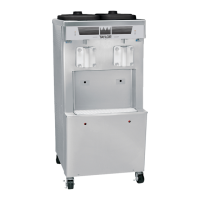
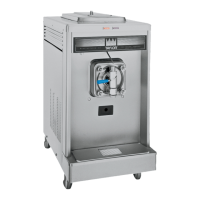
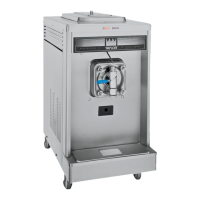
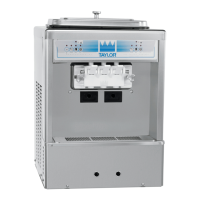
This document is an operator's manual for Taylor Granita Merchandising Freezers, specifically models 369, 370, and 371. These machines are designed for dispensing frozen beverages, often referred to as granita or slush.
Function Description
The Taylor Granita Merchandising Freezers are commercial appliances used to prepare and dispense frozen beverages. They operate by continuously mixing and freezing a liquid product, such as fruit juice, coffee, or other flavored mixes, to a slushy consistency. The machines are equipped with transparent bowls to showcase the product, enhancing merchandising appeal. They feature controls for adjusting product consistency (viscosity) and temperature, as well as a defrost timer option for automated defrost cycles. The design emphasizes ease of operation, cleaning, and maintenance, with clear instructions for assembly, disassembly, and sanitizing procedures.
Important Technical Specifications
The manual provides technical characteristics for models 369, 370, and 371, which differ primarily in the number of bowls and overall dimensions.
General Specifications:
- Transparent removable bowls: The number of bowls varies by model: 1 for Model 369, 2 for Model 370, and 3 for Model 371.
- Capacity of each bowl: approximately 10 liters.
- Dimensions (approximate):
- Width: 28 cm (Model 369), 44 cm (Model 370), 64 cm (Model 371)
- Depth: 47 cm for all models
- Height: 69 cm for all models
- Net weight (approximate): 26 kg (Model 369), 48 kg (Model 370), 64 kg (Model 371)
- Gross weight (approximate): 32 kg (Model 369), 54 kg (Model 370), 70 kg (Model 371)
- Adjustable thermostats: 1 per bowl.
- Refrigerant: R404A.
- Air-cooled compressor.
- Overload protector.
- Safety pressure switch.
- Noise level: lower than 70 dB (A).
Electrical Specifications (Voltage, Cycle, Phase):
The manual includes a table for electrical specs based on the identification label. Examples provided in the parts list indicate various configurations:
- 24 (369/370/371): 046478 (240V, 50Hz), 046478 (220V, 60Hz), 046478 (115V, 60Hz)
- 43 (369): 057890 (240V, 50Hz), 057890 (220V, 60Hz), 057889 (115V, 60Hz)
- 43 (370): 057891 (240V, 50Hz), 057891 (220V, 60Hz), 057889 (115V, 60Hz)
- 43 (371): 057892 (240V, 50Hz), 057892 (220V, 60Hz), 057889 (115V, 60Hz)
- 58 (369): 057896 (240V, 50Hz), 057896 (220V, 60Hz), 048356-12 (115V, 60Hz)
- 58 (370): 057897 (240V, 50Hz), 057897 (220V, 60Hz), 048356-12 (115V, 60Hz)
- 58 (371): 057898 (240V, 50Hz), 057898 (220V, 60Hz), 048356-12 (115V, 60Hz)
It is crucial to check the identification label on the machine for exact electrical specifications.
Usage Features
- Operating Controls: The machines feature a main power switch, light switch, and thermostat for each bowl.
- Power Switch: Turns the machine ON (position I) or OFF (position 0). In position I, power is supplied to all functions, and the other switches are enabled. The fan motor runs.
- Light Switch: Turns the bowl lights ON (position I) or OFF (position 0).
- Thermostat: Adjusts the beverage temperature. Turning clockwise decreases temperature (for a colder, thicker product), and counter-clockwise increases temperature (for a warmer, thinner product).
- Granita Viscosity Adjustment: A screw on the evaporator cylinder allows for fine-tuning of the granita's thickness. Turning clockwise increases viscosity, while turning counter-clockwise decreases it.
- Beverage Temperature Adjustment: The thermostat knob adjusts the temperature. Turning clockwise decreases temperature, and counter-clockwise increases it.
- Mix Level: Maintain the mix level above the evaporator cylinder to prevent damage to the motor and ensure proper freezing.
- Defrost Timer (Optional): An optional 24-hour timer allows programming defrost cycles. Tabs on the timer face correspond to hours, and pushing a tab in activates defrost for that hour. This feature helps prevent product from freezing solid overnight and reduces ice accumulation.
- Safety Features: The machine includes a safety pressure switch and an overload protector. It also warns against operating the dispenser without reading the manual, operating with panels removed, or inserting objects into openings.
Maintenance Features
- Daily Cleaning and Sanitizing:
- Disassembly: Involves removing the bowl lid, bowl, faucet, outer spiral, and evaporator cylinder.
- Cleaning: Wash all disassembled parts with warm water and a mild detergent. Use a soft bristle brush for cleaning the evaporator cylinder.
- Sanitizing: Prepare a sanitizing solution (e.g., two gallons of warm water with 1.00 PPM sodium hypochlorite). Immerse parts for at least two minutes, then rinse with clean water. Wipe all external surfaces.
- Assembly: Reassemble the machine after cleaning and sanitizing.
- Routine Maintenance (To be carried out by qualified service personnel only):
- Monthly (Model 370 only): Remove dust from the condenser and clean the 2-pole wall breaker and panels.
- Annually: Remove panels and clean the inside of the machine, including the base, side panels, condenser, etc. Check for wear on the insulation jacket, motor, and other components. Replace worn parts.
- General: Prevent damage to the dispenser by using only original Taylor parts and lubricating plastic parts with food-grade lubricant.
- Parts Replacement Schedule:
- Every 3 Months: Inspect and replace the outer spiral scraper blade and rear hopper gasket as necessary.
- Every 6 Months: Minimum inspection for the outer spiral scraper blade and rear hopper gasket. Replace the draw valve O-ring.
- Troubleshooting Guide: The manual provides a troubleshooting guide for common issues like product being too stiff, too soft, or not dispensing, excessive mix leakage, and freezer not operating. It lists probable causes and remedies.
- Condenser Cleaning: Condenser fins are very sharp, so extreme caution is advised when cleaning.
- Electrical Safety: Always disconnect power before performing any disassembly, cleaning, or maintenance to prevent electrical shock.
- Identification Label: Important information, including serial number, voltage, cycle, and phase, is found on the identification label. This data is crucial for service and parts ordering.

 Need help?

 To Next Page
 General