This document describes the TCL FLIP 2, a mobile phone designed for ease of use and accessibility. It provides an overview of the device's physical features, essential information, and special functions, along with guidance on maintenance and safety.
Function Description
The TCL FLIP 2 is a flip-style mobile phone that offers basic communication features such as making calls, sending text messages, and managing contacts. It also includes a range of special features to enhance user experience, including a camera, music player, calendar, and web browser. The device is designed with accessibility in mind, offering features like Readout, Larger text, Color inversion, and Color correction to assist users with various needs.
Usage Features
Physical Features and Navigation:
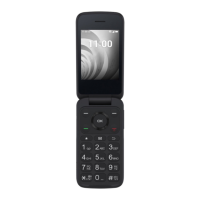
The phone features a main screen that displays the current time, date, and status information, including voicemail notifications, SIM status, connection strength, Wi-Fi connection, and battery charge level. The bottom of the Home screen provides access to Notifications (left soft key) and Shortcuts (right soft key). Menu items are accessed by pressing the OK Center key from the Home screen.
- LEFT SOFT KEY: Used to select options at the bottom left corner of the screen. These options change based on the application or function in use.
- RIGHT SOFT KEY: Used to select options at the bottom right corner of the screen, also context-dependent.
- HEADSET CONNECTOR: For connecting a headset.
- CALL KEY: Initiates or answers calls, and provides access to recent, missed, received, and dialed calls.
- FAVORITE CONTACTS: Allows quick access to frequently used contacts.
- CHARGING PORT: For charging the device.
- CAMERA: The device includes a camera for taking pictures and recording videos.
- QUICK DIAL BUTTON: Located on the front, below the camera. Pressing it three times quickly calls an emergency contact. This function automatically switches to hands-free mode. Users must set up an emergency contact and activate this feature in Settings before use.
- NAVIGATION KEYS: The edges of the OK Center key (up/down/left/right) are used to navigate through menus and options, or to move the cursor.
- Navigate up: Accesses the internet.
- Navigate down: Accesses recent apps.
- Navigate left: Accesses email.
- Navigate right: Accesses contacts.
- OK CENTER KEY: Selects a highlighted item on the screen or performs the function shown at the bottom center of the display. From the Home screen, it accesses Menu options.
- VOLUME KEY: UP and DOWN volume keys adjust volume for different phone functions: earpiece/headset volume during calls, muting the ringtone, media volume, and ringtone/notification volume when the phone is closed or from the Home screen.
- END/POWER KEY:
- ON: Press and hold until the screen lights up.
- OFF: Press and hold to see options, then select "Power off" and press OK.
- END: Ends a call.
- HOME SCREEN: Press twice to return to the Home screen.
- OTHER FUNCTIONS: Press once to return to the previous screen, close a dialog box, or exit an options menu. Long press (press and hold) to restart or power off the phone.
- BACK / DELETE KEY: Used to go back or delete characters.
- MESSAGES KEY: Directly accesses the messaging feature.
Core Applications:
- Google Account: Requires a Google (Gmail) account to access Google cloud and other phone features. Provides 15GB of storage linked to the account.
- Messages: Allows sending and receiving text (SMS) and multimedia (MMS) messages, including pictures, video clips, and contacts. Users can add a subject line, attachments, or save texts as drafts.
- Typing a message: Uses the main keypad and navigation keys. For letters, press a number key (2-9) repeatedly until the desired character appears. For numbers, long-press the corresponding key. To insert punctuation, special characters, or emojis, press the
* key, navigate to the symbol, and press OK. The BACK/DELETE key deletes typed letters or symbols.
- Contacts: Create and manage contact entries. Frequently called contacts can be added to a favorites list or assigned to speed dial. Contacts can be shared via text messages, email, or Bluetooth. An emergency contact can be set for the Quick Dial button.
- Camera: Takes pictures and records videos. Zoom in/out using volume keys. Preview images before saving by pressing the left soft key. Pictures and videos are saved to the phone's Gallery by default, or to an optional memory card (not included) if installed.
- Gallery: Displays all visual images stored on the device. Navigation keys scroll through images. The Options menu allows deleting, sharing, editing, setting as wallpaper or contact photo, viewing full screen, and accessing file information.
- Clock: Displays time and date on the Home screen. Includes alarm, timer, stopwatch, and World clock functions.
- Alarm: Set alarm time, repeat days, ringtone, snooze time, and a name for the alarm.
- Timer: Set hour, minute, and seconds using left/right navigation keys.
- Stopwatch: Measures event length in a continuous timeline or in laps.
- World clock: Add locations or time zones.
- Notes: Create daily to-do lists, track appointments, or jot down ideas. Notes can be shared via Email, Bluetooth, or Messages.
- File Manager: Access and manage stored, transferred, and downloaded files on the phone and microSD card. Allows creating new folders, copying, cutting, deleting, renaming, playing, and sharing files.
- Music: Listen to music files stored on the phone. Music can be downloaded from a computer via USB cable.
- Browser: Connects to the mobile web. Data usage begins when connected to the web and ends when the connection terminates. Total data charges depend on access time and content size. Access to mobile web may take up to 1 hour after phone activation.
- Calendar: Track events, meetings, and appointments. Syncs with email accounts. View by day, week, or month. Set reminders for calendar entries.
- VPN: A virtual private network allows secure connection to a private internal network over public wires. Requires connection information from a VPN administrator and a secured screen lock. VPN settings allow adding, editing, or deleting connections.
- Wi-Fi: Connects to wireless high-speed internet and network connections. The device scans for available networks when Wi-Fi is ON. Public/unprotected networks connect automatically, but secure networks require a password. Connecting to public Wi-Fi networks can leave personal data vulnerable, so using known, secure networks with passwords is recommended.
Settings and Security:
- Settings: Customize device preferences, including Network & Connectivity, Personalization, Privacy & Security, Storage, Device, and Account.
- Screen Lock: Secure the device with a numeric PIN to prevent unauthorized access to personal data and email accounts.
- SIM Card Lock: Create a SIM card PIN to protect SIM card information (phone number, voice/data plans) from being compromised if the card is placed into another device.
Accessibility Features:
- Readout: Reads interface element labels and provides spoken responses.
- Larger text: Increases text size for easier viewing.
- Color inversion: Inverts screen colors (e.g., black backgrounds with white text) for better visibility.
- Color correction: Adjusts screen color for users with color blindness or difficulty reading the display due to screen color.
- Captions: Displays captions for the hearing impaired, with customizable text size and style.
- Mono Audio: Selects mono or stereo sound.
- Hearing Aid Compatibility (HAC): Hearing aid mode for deaf or hearing/speech impaired users. Connects phone and hearing aid to a relay service that converts speech to text and outgoing text to spoken voice.
- RTT (Real Time Text): An alternative to external TTY devices, allowing text communication during voice calls. Requires LTE or Wi-Fi calling to be ON.
Maintenance Features
General Care:
- Handling: Treat the phone and accessories with care. Keep them in a clean, dust-free place.
- Environmental Protection: Avoid open flames, lit tobacco products, liquids, moisture, high humidity, and extreme temperatures (above 140°F/60°C). Do not leave the device in a vehicle or in direct sunlight for prolonged periods, as this can damage the product, overheat the battery, or pose a risk to the vehicle.
- Physical Protection: Do not drop, throw, or bend the phone or its accessories. Do not apply excessive pressure to the screen or carry the phone in a back pocket where it might break when sitting down. Using a protective case is recommended.
- Cleaning: Unplug the product from the wall outlet before cleaning. Use a damp cloth; do not use liquid or aerosol cleaners, and NEVER use water to clean the LCD screen.
- Disassembly: Do not attempt to disassemble the phone or its accessories. Only authorized personnel should perform service.
- Heat Sources: Place the product away from heat sources like radiators, heat registers, stoves, or amplifiers.
- Wet Locations: Never use the product in a wet location.
- Temperature Changes: If moving the device between environments with very different temperatures or humidity, allow sufficient time for condensation to evaporate before use. Allow the device to acclimate to room temperature before turning on power when moving from low to high temperature conditions.
- Object Insertion: Never push objects into cabinet slots or other openings, as these are for ventilation and must not be blocked.
Battery Care:
- Charging: The battery is not fully charged out of the box. Do not remove the battery pack while the phone is charging.
- Handling Battery Packs: Handle Lithium-ion polymer or Lithium-ion batteries carefully. Do not open, service, disassemble, crush, puncture, short external contacts, dispose of in fire or water, or expose to temperatures higher than 140°F (60°C).
- Battery Replacement: Danger of explosion if the battery is incorrectly replaced. Replace only with specified batteries. Recycle or dispose of used batteries according to local regulations.
- Battery Condition: Do not use a battery that appears damaged, deformed, discolored, has rust on its casing, overheats, or emits a foul odor.
- Dropping: If the phone or battery is dropped, especially on a hard surface, and damage is suspected, take it to a service center for inspection.
- Leaks: If the battery leaks, avoid contact with skin or clothing; flush affected areas with clean water and seek medical advice. If fluid contacts eyes, do not rub; rinse with clean water immediately and seek medical advice. Keep leaking batteries away from fire due to explosion risk.
Accessory Usage:
- Approved Accessories: Use only approved accessories. Do not connect with incompatible products or accessories.
- Battery Terminals: Take precautions to avoid metal objects (coins, key rings) from contacting or short-circuiting battery terminals.
- Antenna: Use only the supplied integral antenna. Unauthorized or modified antennas may impair call quality, damage the phone, or violate regulations. Do not use the phone with a damaged antenna; if contact occurs, it may cause a minor burn. Contact the dealer for replacement.
Safety Precautions:
- Hearing Protection: To prevent hearing damage, do not listen at high volumes for long periods. Exercise caution when holding the device near your ear while the loudspeaker is in use.
- Aircraft Use: Turn off the phone or switch to Airplane Mode on board an aircraft to avoid interference with navigation and communication systems.
- Explosive Atmospheres: Turn off the product in gas stations, fuel depots, chemical plants, or areas with blasting operations or potentially explosive atmospheres (fueling areas, fuel storehouses, below deck on boats, chemical plants, fuel/chemical transfer/storage facilities, and areas with chemicals or particles like grain, dust, or metal powders). Sparks can cause explosions or fires.
- Road Safety: Give full attention to driving. Using a phone while driving (even hands-free) can cause distraction and accidents. Comply with local laws and regulations restricting wireless device use while driving.
- RF Exposure: Avoid using the phone near metal structures (e.g., steel frames of buildings) or strong electromagnetic sources (microwave ovens, sound speakers, TV, radio). Use only original manufacturer-approved accessories that do not contain metal. Non-original accessories may violate RF exposure guidelines.
- Medical Equipment: The device may cause medical equipment to malfunction. Its use is forbidden in most hospitals and medical clinics. Consult the manufacturer of any personal medical device to determine if it is shielded from external RF energy. Turn off the phone in healthcare facilities if regulations require it.
- Nonionizing Radiation: The device has an internal antenna. Operate in a normal-use position to ensure radiative performance and safety. Avoid human body contact with the antenna during operation.
- Pacemakers: Maintain a minimum separation of 15 cm (6 inches) between the phone and a pacemaker. Do not carry the phone in a breast pocket. Use the ear opposite the pacemaker to minimize interference. Turn off the phone immediately if interference is suspected.
- Hearing Aids: Digital wireless phones may interfere with some hearing aids. Consult the service provider or customer service for alternatives.
- Emergency Calls: The phone operates using radio signals and cannot guarantee connection in all conditions. Do not rely solely on any wireless phone for emergency communications.
- Small Children: Do not leave the phone and accessories within reach of small children. They could cause injury or damage the phone. Small parts with sharp edges can cause injury or choking hazards.
- Repetitive Motion Injuries: To minimize RSI when texting or gaming: do not grip too tightly, press buttons lightly, use special features that minimize button presses (message templates, predictive text), and take breaks to stretch and relax.
- Operating Machinery: Give full attention to operating machinery to reduce accident risk.
- Loud Noise: The phone can produce loud noises that may damage hearing.
- FCC ID: The product is assigned a model number T408DL. Use only listed accessories. Operating temperature range: 32°F to 104°F (0°C to 40°C).
- FCC Compliance: The device complies with Part 15 of FCC Rules. It generates, uses, and can radiate radio frequency energy. Any changes or modifications not expressly approved by the party responsible for compliance could void the user's authority to operate the equipment.
- Radiation Exposure: Complies with FCC radiation exposure limits. Follow operating instructions for RF exposure compliance.
- Hearing Aid Compatibility (HAC) Rating: M4/T4. Wireless devices rated M3 or M4 meet FCC requirements for less interference with hearing devices. T3 or T4 ratings indicate usability with a hearing device's telecoil.
- RoHS Compliance: Complies with Directive 2011/65/EU on hazardous substances in electrical and electronic equipment.
- Electronic Recycling: Visit TCL Electronic Recycling Program website or call TCL USA Customer Support.
- Battery Recycling: TCL partners with Call2Recycle® for a safe and convenient battery recycling program. Visit the USA and Canada website for more information.

 Need help?
 General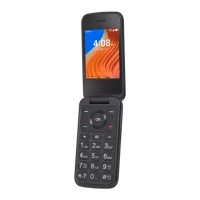

 To Next Page