EasyManua.ls Logo

Teac 450 - The Dolby Noise Reduction System Explained

Teac 450
16 pages
Print Icon
To Next Page IconTo Next Page
To Previous Page IconTo Previous Page
Loading...
The
Dolby
noise
reduction
system
T
r
B
-T?--
'ii
20
Hz
300
500
1COO
St
GOO
5
i
'
-
-
-
t
v
-
Principle
and
Outline
of
the
Dolby
System
Dolby
System
comes
in
two
types,
A
Type
and
B
Type.
The
A
Type
is
designed
for
studio
use
and
comprises
a
complex
and
enormous
circuitry
structure
which
divides
the
record/
playback
frequency
band
(20Hz
20
kHz)
into
four
bands.
The
B
Type,
designed
for
popular
use,
features
simpler
circuitry
and
is
easy
to
handle.
500
mm
sec
1
00
mm
SEC
The
Dolby
System
mentioned
in
this
manual
refers
to
B-Type
Dolby
System
unless
otherwise
indicated.
Inter-deck
Compatibility
of
Dolby-encoded
Tapes
Cassette
tapes
recorded
by
a
Dolby-system
recorder
(Dolby-
encoded
cassette
tapes)
give
the
best
results
when
reproduc
ed
by
a
similar
Dolby-system
recorder
or
player.
Needless
to
say,
no
Dolby
effects
will
be
demonstrated
when
such
tapes
are
played
back
by
an
ordinary
cassette
tape
deck,
but
the
treble
range
may
be
heard
somewhat
emphasized
when
very
soft
signals
are
reproduced.
This
slight
emphasis
of
the
treble
range
is
almost
unnoticeable
unless
compared
with
the
original
source
program
or
with
the
sound
reproduction
made
through
the
Dolby
circuit.
For
playback
of
Dolby-encoded
tapes
with
an
ordinary
tape
deck,
it
is
advisable
to
somewhat
de-emphasize
the
treble
range.
Effects
of
the
Dolby
System
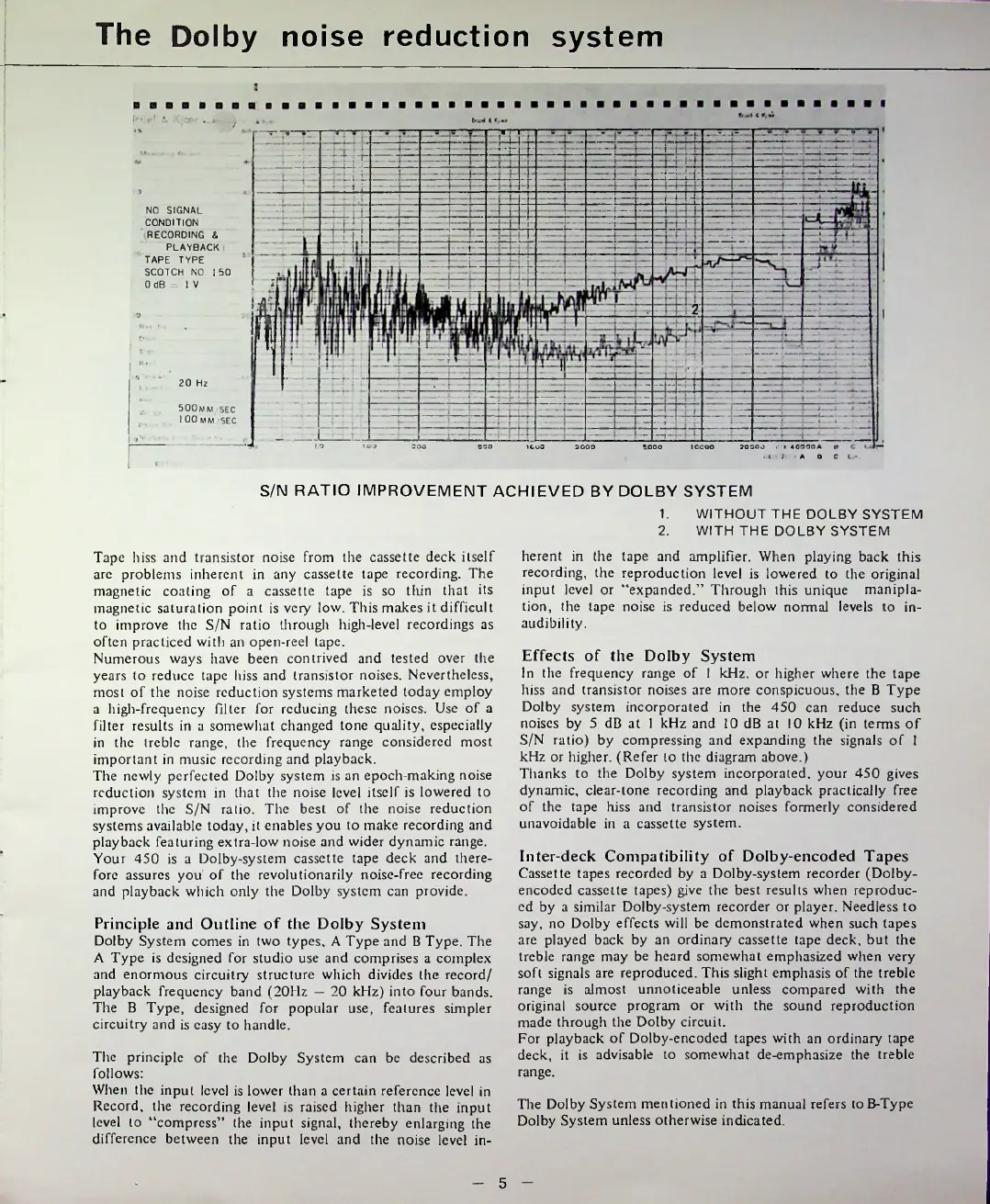
In
the
frequency
range
of
1
kHz.
or
higher
where
the
tape
hiss
and
transistor
noises
are
more
conspicuous,
the
B
Type
Dolby
system
incorporated
in
the
450
can
reduce
such
noises
by
5
dB
at
1
kHz
and
10
dB
at
10
kHz
(in
terms
of
S/N
ratio)
by
compressing
and
expanding
the
signals
of
1
kHz
or
higher.
(Refer
to
the
diagram
above.)
Thanks
to
the
Dolby
system
incorporated,
your
450
gives
dynamic,
clear-tone
recording
and
playback
practically
free
of
the
tape
hiss
and
transistor
noises
formerly
considered
unavoidable
in
a
cassette
system.
herent
in
the
tape
and
amplifier.
When
playing
back
this
recording,
the
reproduction
level
is
lowered
to
the
original
input
level
or
expanded.
Through
this
unique
manipla-
tion,
the
tape
noise
is
reduced
below
normal
levels
to
in
audibility.
i
'2
/-ft
22
.....
2
I-
t.
Tape
hiss
and
transistor
noise
from
the
cassette
deck
itself
are
problems
inherent
in
any
cassette
tape
recording.
The
magnetic
coating
of
a
cassette
tape
is
so
thin
that
its
magnetic
saturation
point
is
very
low.
This
makes
it
difficult
to
improve
the
S/N
ratio
through
high-level
recordings
as
often
practiced
with
an
open-reel
tape.
Numerous
ways
have
been
contrived
and
tested
over
the
years
to
reduce
tape
hiss
and
transistor
noises.
Nevertheless,
most
of
the
noise
reduction
systems
marketed
today
employ
a
high-frequency
filter
for
reducing
these
noises.
Use
of
a
filter
results
in
a
somewhat
changed
tone
quality,
especially
in
the
treble
range,
the
frequency
range
considered
most
important
in
music
recording
and
playback.
The
newly
perfected
Dolby
system
is
an
epoch-making
noise
reduction
system
in
that
the
noise
level
itself
is
lowered
to
improve
the
S/N
ratio.
The
best
of
the
noise
reduction
systems
available
today,
it
enables
you
to
make
recording
and
playback
featuring
extra-low
noise
and
wider
dynamic
range.
Your
450
is
a
Dolby-system
cassette
tape
deck
and
there
fore
assures
you
of
the
revolutionarily
noise-free
recording
and
playback
which
only
the
Dolby
system
can
provide.
rr
I
:
r.o
W
r
NO
SIGNAL
CONDITION
RECORDING
&
PLAYBACK
TAPE
TYPE
SCOTCH
NO.
150
0
dB
-
IV
I
3
A
J2Z22
ZZHT
The
principle
of
the
Dolby
System
can
be
described
as
follows:
When
the
input
level
is
lower
than
a
certain
reference
level
in
Record,
the
recording
level
is
raised
higher
than
the
input
level
to
compress
the
input
signal,
thereby
enlarging
the
difference
between
the
input
level
and
the
noise
level
in-
i
12
EE
:
:
I
1
T-
000
iccoo
2
2-jj
.-.
-
S/N
RATIO
IMPROVEMENT
ACHIEVED
BY
DOLBY
SYSTEM
1.
WITHOUT
THE
DOLBY
SYSTEM
2.
WITH
THE
DOLBY
SYSTEM
------------
20000
.
1
4COOOA
It
I
A
Q

Related product manuals