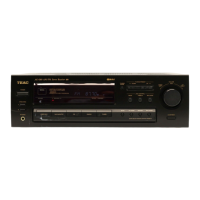
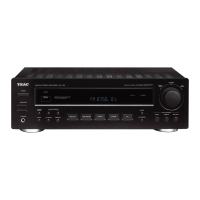
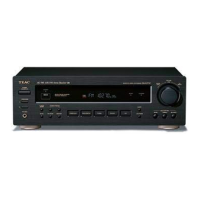
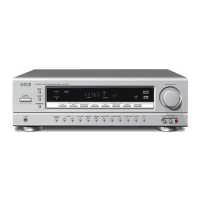
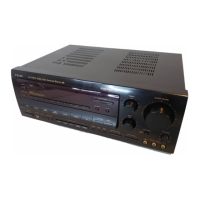
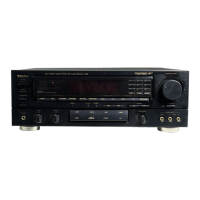
The TEAC AG-620 is an AM/FM stereo receiver designed to be the central component of an audio system, offering amplification, radio reception, and control over various connected devices.
Function Description:
The AG-620 serves as a versatile hub for audio playback and recording. It integrates an amplifier to drive speakers, an AM/FM tuner for radio reception, and multiple input/output connections for external audio components. The receiver can manage signals from a turntable (PHONO), CD player, VCR/VDP, and two tape decks (TAPE 1 and TAPE 2). It supports both playback and recording functions, including tape dubbing between the two connected tape decks.
A key feature is its system remote-controlled operation. The provided UR-401 Remote Control Unit allows users to control not only the AG-620 but also other compatible TEAC components, such as CD players and cassette decks, from a distance. This remote control functionality extends to synchronized operations, like CD-to-cassette recording, when compatible TEAC devices are connected via CD/DECK SYNC terminals.
The receiver includes audio adjustment controls such as BASS, TREBLE, and BALANCE to tailor the sound output. A LOUDNESS button compensates for the human ear's non-linear response at low volume levels. Speaker selection buttons (SPEAKERS A and B) allow users to choose which pair of speakers to use, or both simultaneously, engaging a built-in surround sound circuit for an enhanced listening experience.
For radio reception, the AG-620 offers Auto Tuning, Manual Tuning, Direct Tuning (using numeric keys), and Preset Tuning, which allows storing up to 30 AM/FM stations for quick access. Memory Scan and Memory Skip functions facilitate browsing and skipping through preset stations.
Important Technical Specifications:
Amplifier Section:
- Output Power (U.S.A./Canada): 50 watts RMS per channel minimum, both channels driven into 8 ohms from 30 Hz to 20 kHz with no more than 0.08% total harmonic distortion.
- Output Power (Europe/U.K.): DIN Power: 55 watts; RMS Power (30-20 kHz): 48 watts 0.04%.
- Total Harmonic Distortion: 0.02% at 54 watts, 1 kHz.
- Input Sensitivity/Impedance:
- PHONO (MM): 2.5 mV/47k ohms
- CD, TAPE 1/2: 150 mV/47k ohms
- Frequency Response:
- PHONO: 20 Hz - 20 kHz ±1 dB
- CD, TAPE 1/2: 10 Hz - 70 kHz +1, -3 dB
- Signal-to-Noise Ratio (IHF A Network):
- PHONO (MM): 70 dB
- CD, TAPE 1/2: 94 dB
- Tone Control:
- Bass: ±10 dB at 100 Hz
- Treble: ±10 dB at 10 kHz
FM Tuner Section (without notes 98.1 MHz 65 dBf):
- Tuning Range:
- U.S.A./Canada: 87.5 MHz - 108.0 MHz (100 kHz steps)
- Europe/U.K.: 87.50 MHz - 108.00 MHz (50 kHz steps)
- Usable Sensitivity (IHF):
- Mono (U.S.A./Canada): 10.8 dBf
- Mono (Europe/U.K.): 13 dBf
- 50 dB Quieting Sensitivity:
- Mono/Stereo (U.S.A./Canada): 18 dBf/38 dBf
- Mono/Stereo (Europe/U.K.): 20 dBf/42 dBf
- Capture Ratio:
- U.S.A./Canada: 1.5 dB
- Europe/U.K.: 1.8 dB
- Image Rejection Ratio:
- U.S.A./Canada: 55 dB
- Europe/U.K.: 80 dB
- AM Suppression Ratio: 60 dB
- RF Intermodulation: 65 dB
- Total Harmonic Distortion (1 kHz): Mono 0.2%/Stereo 0.4%
- Frequency Response: 30 Hz - 15 kHz +1 dB, -1.5 dB
- Stereo Separation (1 kHz): 40 dB
- Signal-to-Noise Ratio: Mono 78 dB/Stereo 70 dB
AM Tuner Section:
- Tuning Range:
- U.S.A./Canada: 530 kHz - 1,710 kHz (10-kHz steps)
- Europe/U.K.: 522 kHz - 1,611 kHz (9-kHz steps)
- Usable Sensitivity: 50 dB/m
- Total Harmonic Distortion: 0.6% at 85 dB/m
- Signal-to-Noise Ratio: 50 dB at 85 dB/m
General:
- Power Requirements:
- U.S.A./Canada: 120 V AC, 60 Hz
- Europe: 230 V AC, 50 Hz
- U.K.: 240 V AC, 50 Hz
- Power Consumption:
- U.S.A./Canada: 1.3 A
- Europe/U.K.: 260 W
- AC Outlets:
- U.S.A./Canada: Switched x 2, Total 200W max or 2A max
- Europe/U.K.: Switched x 1, 200W max
- Dimensions (WxHxD): 435 x 126 x 290 mm (17-1/8" x 4-15/16" x 11-7/16")
- Weight (net): 7.0 kg (15.5 lbs.)
Usage Features:
- Antenna Connections: The manual provides detailed instructions for connecting both FM and AM antennas. For FM, a "T"-type 300-ohm antenna is provided for strong signal areas, while a 75-ohm outdoor FM antenna with a matching transformer is recommended for weaker signals, especially in Europe. For AM, a loop antenna is provided, with options for an outdoor AM antenna for improved reception in challenging environments. Proper grounding for outdoor antennas is emphasized, referencing the National Electrical Code.
- Speaker Impedance Selector: A switch on the rear panel allows users to select the appropriate impedance setting (4Ω, 6Ω, 8Ω, 16Ω) based on the connected speakers, ensuring optimal performance and preventing damage.
- Remote Control Unit (UR-401): The remote control simplifies operation, allowing control of the receiver and other TEAC components from a listening position. Battery installation and replacement guidelines are provided, along with precautions for battery usage (e.g., correct polarity, avoiding mixing old/new or different types).
- Basic Operations: Step-by-step instructions guide users through initial setup, including setting volume to zero, adjusting tone controls, powering on, selecting input sources, and choosing speakers.
- Radio Reception: The receiver supports various tuning methods:
- Auto Tuning: Automatically scans and stops at the next broadcasting station.
- Manual Tuning: Allows fine-tuning to weak signals by incrementally changing the frequency.
- Direct Tuning: Enables direct input of desired frequencies using numeric keys.
- Preset Tuning: Stores up to 30 stations for quick recall, with Memory Scan and Memory Skip functions for navigation.
- Recording: The AG-620 facilitates recording from various sources (PHONO, CD, VCR/VDP, TAPE 1) to TAPE 2. Tape dubbing from TAPE 1 to TAPE 2 (and vice versa) is also supported, allowing simultaneous recording to both tape decks if desired.
- TEAC System Remote-Controlled Operation: The manual illustrates how the AG-620 can integrate with other TEAC components (CD player, cassette deck) for unified remote control. It details connections for both cassette decks with and without a REMOTE SENSOR window, including the use of optional remote control cables for non-logic control decks. Specific remote control buttons for operating other TEAC components (e.g., TAPE PAUSE, CD SYNC, TAPE I/II controls, CD SKIP/PLAY/PAUSE/STOP/DISC SKIP) are explained.
Maintenance Features:
- Placement: The unit should be placed in a well-ventilated area, away from heat sources, direct sunlight, high humidity, and dust, due to heat radiated from the amplifier. Short connection cables are recommended for optimal sound quality.
- Cleaning: The appliance should be cleaned only as recommended by the manufacturer.
- Troubleshooting: A dedicated section provides a guide to common problems and their probable causes and remedies. This includes issues related to the remote control (exhausted batteries, out of range), tuner (weak signal, interference), and amplifier (no sound, unbalanced sound, hum/noise).
- Microprocessor Reset: In case of incorrect operation due to external noise, users are advised to disconnect the power plug, wait ten seconds, and then restart the receiver.
- Memory Backup Function: The receiver retains preset station memories and function settings (TAPE 2 MONITOR, AM/FM settings, reception frequency, reception band, preset channel number) indefinitely as long as the power plug is connected to a wall outlet. These settings are retained for approximately 4 hours even if the power plug is disconnected.
- Safety Instructions: Emphasizes reading and saving all instructions, heeding warnings, and following proper usage guidelines, including precautions regarding water, ventilation, heat, power sources, grounding, power-cord protection, and servicing by qualified personnel. It also includes specific warnings for outdoor antenna grounding as per the National Electrical Code.

 Need help?
 General

 To Next Page