Need help?
Do you have a question about the Teac AG-V1200 and is the answer not in the manual?
Covers essential safety guidelines for operating the audio equipment, including handling and environmental factors.
Details on proper grounding, power cord protection, and outdoor antenna grounding requirements.
Instructions on when to seek qualified service personnel and precautions for damaged equipment.
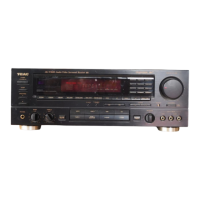
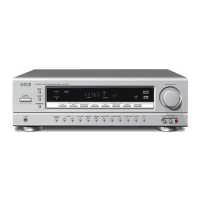
Diagram and labeling of the receiver's front panel controls and indicators.
Illustration and identification of the remote control unit (UR-400) and its buttons.
Diagram showing how to connect remote control cables between components.
Instructions and diagrams for connecting FM and AM antennas to the receiver.
Diagrams illustrating connections for various audio and video components to the receiver.
Guidelines for optimal placement of the unit, considering ventilation, heat, and humidity.
Overview of the remote control's capabilities and identification of its key buttons.
Instructions for installing, replacing, and safely using batteries in the remote control.
Step-by-step guide for initial operation of the audio receiver unit.
Instructions for listening to radio broadcasts, including tuning methods and FM modes.
Procedures for playing records, CDs, cassette tapes, and recording audio.
Guide on how to play sources connected via the VIDEO 1 or VIDEO 2 inputs.
Adjusting front/rear speaker balance and total output volume for surround sound.
Setting the delay time for rear speakers to enhance surround sound effects.
Guidelines for operating the receiver with the remote, including battery management.
Explanation of how preset stations and settings are retained when power is off.
Details on specific remote buttons for tape decks and CD players.
Tables detailing audio and video signal outputs based on selected function and monitor settings.
A visual representation of the internal signal paths and component connections.
Detailed technical data for the amplifier section and FM/AM tuner sections.
Technical details for the video section, power requirements, dimensions, and accessories.
 General
| Speaker Impedance | 4 - 16 ohms |
|---|---|
| Tuning range | FM |
| Input Sensitivity | 200 mV (line) |
| Signal-to-Noise Ratio | 95 dB |
| Dimensions | 430 x 150 x 380mm (W x H x D) |
| Power Output | 100W per channel (8 ohms, 20Hz-20kHz, 0.08% THD) |

 To Next Page