EasyManua.ls Logo

Teac V-770 - Page 9

Teac V-770
32 pages
Print Icon
To Next Page IconTo Next Page
To Previous Page IconTo Previous Page
Loading...
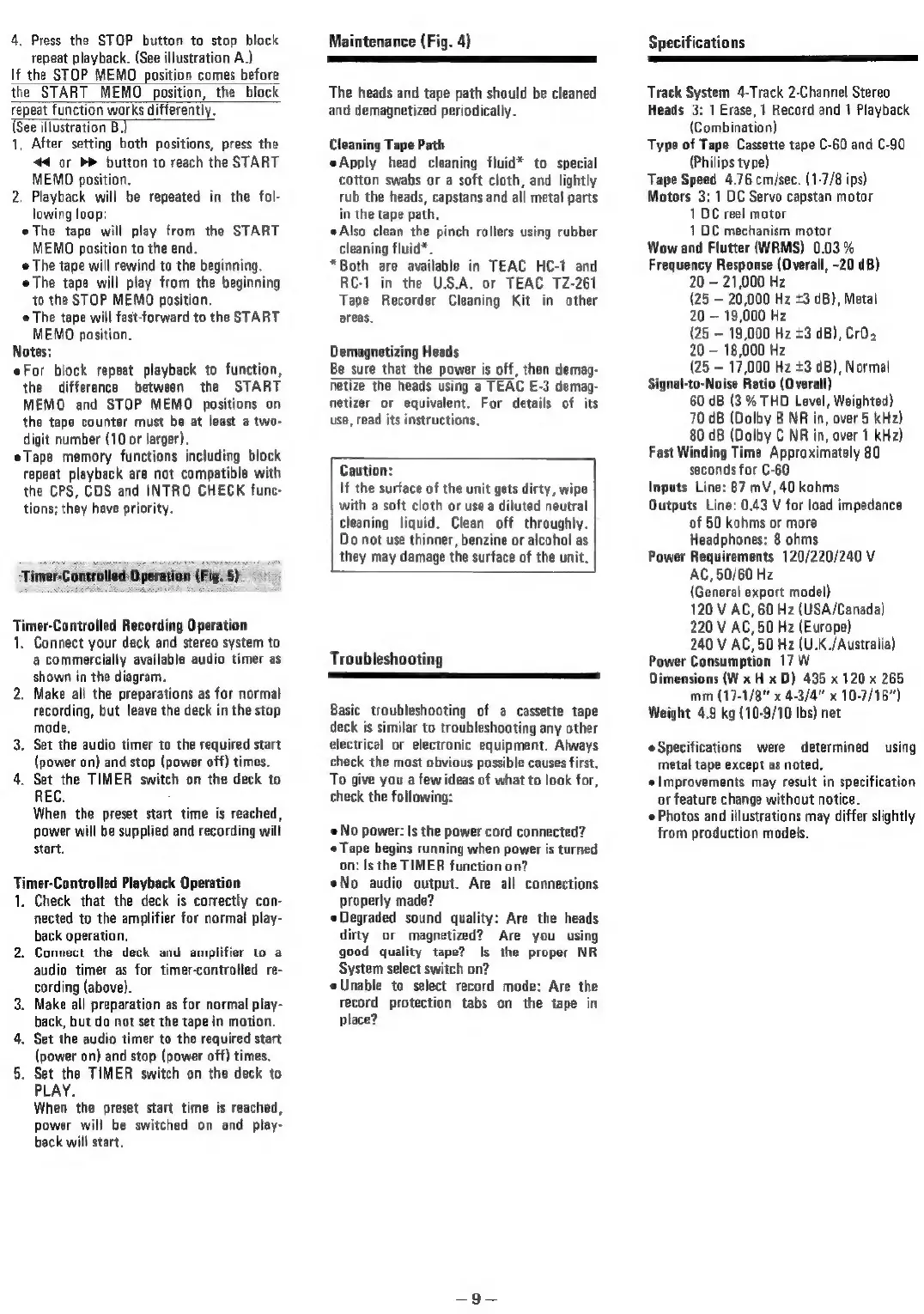
4.
Press
the
STOP
button
to
stop
block
repeat
playback.
(See
illustration
A.)
If
the
STOP
MEMO
position
comes
before
the
START
MEMO
position,
the
block
repeat
function
works
differently.
(See
illustration
B.
1,
After
setting
both
positions,
press
the
44
or
D>
button
to
reach
the
START
MEMO
position.
2.
Playback
will
be
repeated
in
the
fol-
lowing
loop:
The
tape
will
play
from
the
START
MEMO
position
to
the
end.
The
tape
will
rewind
to
the
beginning.
The
tape
will
play
from
the
beginning
to
the
STOP
MEMO
position.
The
tape
will
fast-forward
to
the
START
MEMO
position.
Notes:
eFor
block
repeat
playback
to
function,
the
difference
between
the
START
MEMO
and
STOP
MEMO
positions
on
the
tape
counter
must
be
at
least
a
two-
digit
number
(10
or
larger),
Tape
memory
functions
including
block
repeat
playback
are
not
compatible
with
the
CPS,
CDS
and
INTRO
CHECK
func-
tions;
they
have
priority.
Timer-Controlled
Operation
(Fig.
5)
Timer-Controlled
Recording
Operation
1.
Connect
your
deck
and
stereo
system
to
a
commercially
available
audio
timer
as
shown
in
the
diagram.
2.
Make
all
the
preparations
as
for
normal
recording,
but
leave
the
deck
in
the
stop
mode,
3.
Set
the
audio
timer
to
the
required
start
(power
on)
and
stop
(power
off)
times.
4.
Set
the
TIMER
switch
on
the
deck
to
REC.
When
the
preset
start
time
is
reached,
power
will
be
supplied
and
recording
will
start.
Timer-Controlled
Playback
Operation
1.
Check
that
the
deck
is
correctly
con-
nected
to
the
amplifier
for
normal
play-
back
operation.
2.
Connect
the
deck
and
amplifier
to
a
audio
timer
as
for
timer-controlled
re-
cording
(above).
3.
Make
all
preparation
as
for
normal
play-
back,
but
do
not
set
the
tape
in
motion.
4.
Set
the
audio timer
to
the
required
start
(power
on)
and
stop
(power
off)
times.
5.
Set
the
TIMER
switch
on
the
deck
to
PLAY,
When
the
preset
start
time
is
reached,
power
will
be
switched
on
and
play-
back
will
start.
Maintenance
(Fig.
4)
The
heads
and
tape
path
should
be
cleaned
and
demaynetized
periodically.
Cleaning
Tape
Path
Apply
head
cleaning
fluid*
to
special
cotton
swabs
or
a
soft
cloth,
and
lightly
rub the
heads,
capstans
and
all
metal
parts
in
the
tape
path,
Also
clean
the
pinch
rollers
using
rubber
cleaning
fluid*.
*Both
are
available
in
TEAC
HC-1
and
RC-1
in
the
U.S.A,
or
TEAC
TZ-261
Tape
Recorder
Cleaning
Kit
in
other
areas,
Demagnetizing
Heads
Be
sure
that
the
power
is
off,
then
demag-
netize
the
heads
using
a
TEAC
E-3
demag-
netizer
or
equivalent.
For
details
of
its
use,
read
its
instructions,
Caution:
If
the
surface
of
the
unit
gets
dirty,
wipe
with
a
soft
cloth
or
use
a
diluted
neutral
cleaning
liquid.
Clean
off
throughly.
Do
not
use
thinner,
benzine
or
alcohol
as
they
may
damage
the
surface
of
the
unit.
Troubleshooting
ee
Basic
troubleshooting
of
a
cassette
tape
deck
is
similar
to
troubleshooting
any
other
electrical
or
electronic
equipment.
Always
check
the
most
obvious
possible
causes
first.
To
give
you
a
few
ideas
of
what
to
look
for,
check
the
following:
No
power:
Is
the
power
cord
connected?
Tape
begins
running
when
power
is
turned
on:
Is
the
TIMER
function
on?
eNo
audio
output.
Are
all
connections
properly
made?
Degraded
sound
quality:
Are
the
heads
dirty
or
magnetized?
Are
you
using
good
quality
tape?
Is
the
proper
NR
System
select
switch
on?
eUnable
to
select
record
mode:
Are
the
record
protection
tabs
on
the
tape
in
place?
Specifications
Se
Track
System
4-Track
2-Channel
Stereo
Heads
3:
1
Erase,
1
Record
and
1
Playback
(Combination)
Type
of
Tape
Cassette
tape
C-60
and
C-90
(Philips
type)
Tape
Speed
4.76
cm/sec.
(1-7/8
ips)
Motors
3:
1
DC
Servo
capstan
motor
1DC
reel
motor
1
OC
mechanism
motor
Wow
and
Flutter
(WRMS)
0.03
%
Frequency
Response
(Overall,
-20
dB)
20
21,000
Hz
(25
20,000
Hz +3
dB),
Metal
20
-
19,000
Hz
(25
19,000
Hz
+3
dB),
CrO2
20
18,000
Hz
(25
17,000
Hz
+3
dB),
Normal
Signal-to-Noise
Ratio
(Overall)
60
dB
(3
%
THD
Level,
Weighted)
70
dB
(Dolby
B
NR
in,
over
5
kHz)
80
dB
(Dolby
C
NR
in,
over
1
kHz)
Fast
Winding
Time
Approximately
80
seconds
for
C-60
Inputs
Line:
87
mV,
40
kohms
Outputs
Line:
0.43
V
for
load
impedance
of
50
kohms
or
more
Headphones:
8
ohms
Power
Requirements
120/220/240
V
AC,
50/60
Hz
(General
export
model)
120
V
AC,
60
Hz
(USA/Canada)
220
V
AC,
50 Hz
(Europe)
240
V
AC,
50
Hz
(U.K./Australia)
Power
Consumption
17
W
Dimensions
(W
x
H
x
D)
435
x
120
x
265
mm
(17-1/8"
x
4-3/4"
x
10-7/16")
Weight
4.9
kg
(10-9/10
Ibs)
net
eSpecifications
were
determined
using
metal
tape
except
as
noted,
improvements
may
result
in
specification
or
feature
change
without
notice.
Photos
and
illustrations
may
differ
slightly
from
production
models.

Related product manuals