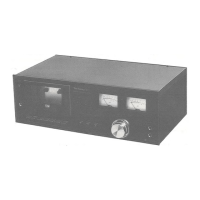
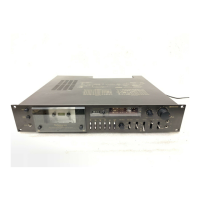
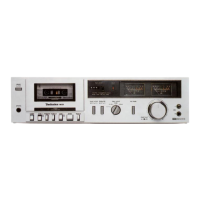
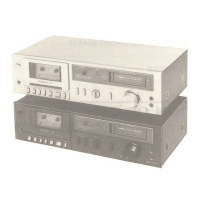
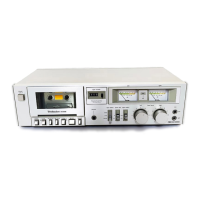
The Technics RS-M5 is a high-quality stereo cassette deck designed for both recording and playback, featuring metal tape compatibility and a full auto-stop mechanism. This service manual provides comprehensive details for its maintenance and repair.
Function Description:
The RS-M5 operates as a 4-track, 2-channel stereo cassette deck, capable of both recording and playing back audio at a standard tape speed of 4.8 cm/s. It incorporates an electronic control DC motor for stable tape transport. A key feature is its compatibility with metal tapes, allowing for a wider frequency response and improved audio fidelity. The deck also includes a full auto-stop mechanism, which automatically halts tape movement at the end of a cassette, preventing tape damage and wear.
For noise reduction, the RS-M5 is equipped with a Dolby NR (Noise Reduction) system, indicated by the "DO DOLBY SYSTEM" logo. This system significantly reduces tape hiss during recording and playback, enhancing the dynamic range of the audio. The front panel features VU meters for visual monitoring of audio levels during recording and playback, ensuring optimal signal levels and preventing distortion.
The deck offers various controls for operation, including dedicated buttons for Play, Record, Rewind, Fast Forward, Stop, and Pause. An Eject button facilitates cassette loading and unloading. Input selection is handled via an "Input selector" switch, allowing users to choose between different audio sources. Microphone jacks are provided for direct microphone input, and an "Input level controls" knob allows for precise adjustment of recording levels. For private listening, a headphone jack is included.
Connectivity options include Line Input and Line Output cords for integration with other audio components, as well as a 5P DIN type Record/Playback connection socket. A "Tape selector" switch allows users to optimize the deck's performance for different tape types (Normal, CrO2, Metal), ensuring accurate recording and playback characteristics for each.
Important Technical Specifications:
- Power Requirement: AC 110/220 V, 50-60 Hz (for All European areas except United Kingdom) or AC 240 V, 50-60 Hz (for United Kingdom).
- Power Consumption: 10 W.
- Motor: Electronic control DC motor.
- Track System: 4-track 2-channel stereo recording and playback.
- Tape Speed: 4.8 cm/s.
- Wow and Flutter: 0.07% (WRMS), ±0.20% (DIN).
- Fast Forward and Rewind Time: Approximately 86 seconds with a C-60 cassette tape.
- Frequency Response:
- Metal tape: 20-17,000 Hz (30-16,000 Hz DIN).
- CrO2 tape: 20-16,000 Hz (30-15,000 Hz DIN).
- Normal tape: 20-15,000 Hz (30-13,000 Hz DIN).
- Signal-to-Noise Ratio:
- Dolby NR in: 66 dB (above 5kHz).
- Dolby NR out: 56 dB (signal level = max. recording level, CrO2 type tape).
- Inputs:
- MIC: Sensitivity 0.25 mV, input impedance 10kΩ (over applicable microphone impedance 400Ω - 10kΩ).
- LINE: Sensitivity 60 mV, input impedance 47kΩ.
- Outputs:
- LINE: Output level 420 mV, output impedance 1.4kΩ or less, load impedance 22kΩ over.
- HEADPHONE: Output level 60 mV, load impedance 8Ω.
- Rec/pb Connection (5P DIN type): Input sensitivity 0.25 mV, impedance 6.0kΩ; output level 420 mV, impedance 5.0kΩ.
- Bias Frequency: 80 kHz.
- Heads: 2-head system;
- 1-MX head for record/playback.
- 1-double-gap ferrite head for erasure.
- Dimensions: 41.0 cm (W) × 14.2 cm (H) × 20.5 cm (D).
- Weight: 4.0 kg.
Usage Features:
The RS-M5 is designed for user-friendly operation. The "Cassette holder" provides easy access for inserting and removing tapes. A "Tape counter and Reset button" helps users keep track of tape position and reset the counter as needed. The "VU meters" offer clear visual feedback on audio levels, crucial for achieving high-quality recordings. The "Recording indication lamp" illuminates when the deck is in record mode, providing a visual cue. The "Dolby noise-reduction switch" allows users to engage or disengage the Dolby NR system based on their preference or the tape's recording. The "Voltage selector" (VOLTAGE SELECTOR) ensures compatibility with different regional power supplies.
Maintenance Features:
The service manual outlines detailed procedures for maintenance and adjustment, essential for keeping the RS-M5 in optimal working condition.
- Disassembly Instructions: Step-by-step instructions with diagrams are provided for removing the bottom cover, front panel, operation button assembly, cassette holder, mechanism, main circuit board, and oscillation circuit board. This facilitates access to internal components for repair and inspection.
- Assembly Instructions: Guidelines for reassembling the deck, including a caution to repair the cassette deck in its upright condition and to lift the recording lever-A when mounting the main circuit board.
- Adjustment Parts Location: A diagram clearly identifies the location of various adjustment parts such as test points (TP1-TP8), variable resistors (VR3, VR4, VR5, VR6, VR301, VR302), and coils (L5, L6).
- Measurement and Adjustment Methods: Comprehensive instructions for critical adjustments:
- Head Azimuth Adjustment: Involves using a test tape (QZZCFM 8kHz) and an oscilloscope/VTVM to adjust the record/playback head angle for maximum output level and equal output across channels. Erase head azimuth adjustment ensures proper tape path and prevents tape curling.
- Tape Speed Accuracy: Measured using a test tape (QZZCWAT 3,000 Hz) and a digital electronic counter, with an acceptable standard value of ±1.5%. Adjustment is performed via a VR on the back of the main case.
- Playback Frequency Response: Measured across various frequencies (63 Hz to 10 kHz) using a test tape (QZZCFM) and VTVM/oscilloscope to ensure the output level is within specified ranges.
- Playback Gain: Measured using a standard recording level test tape (QZZCFM 315Hz) to ensure the output level at LINE OUT is around 0.39 V. VR3 and VR4 are used for adjustment if necessary.
- Bias Leakage: Measured in record mode using a VTVM/oscilloscope, adjusting trap coils L5 and L6 for minimum value.
- Erase Current: Measured at a test point (TP6) in record mode using a VTVM, with a standard value of around 155 mA for metal tapes.
- Bias Current: Measured in record mode for Normal, CrO2, and Metal tape positions, adjusting VR301 and VR302 to achieve standard values (around 400µA for Normal, 550µA for CrO2, and 830µA for Metal).
- Overall Gain: Measured in record/playback mode with a 1 kHz signal to ensure the monitor level at LINE OUT is 0.39 V. VR5 and VR6 are used for adjustment.
- Overall Frequency Response: Detailed charts for Normal, CrO2, and Metal tapes are provided, outlining expected frequency response curves and adjustment procedures for bias current if the response deviates.
- Level Meter Adjustment: Ensures the VU meters accurately display levels within -1dB to +1dB.
- Dolby NR Circuit Adjustment: Confirms the Dolby NR system provides the specified gain (8 ±2.5 dB) at TP7 and TP8.
- Mechanical Specifications: Includes pressure of pressure roller (350±50g), takeup tension (50±15 g-cm), and wow and flutter (less than 0.12% WRMS).
- Exploded Views and Parts Lists: Detailed diagrams and lists for both electrical and mechanical parts, including screws, springs, levers, heads, and circuit boards, are provided for easy identification and replacement of components.
- Wiring Connection Diagram and Schematic Diagram: Essential for tracing electrical paths and understanding the circuit design for troubleshooting.
The Technics RS-M5 is a robust and feature-rich cassette deck, and this service manual ensures that technicians have all the necessary information to maintain its performance and extend its lifespan.

 Need help?
 General

 To Next Page