EasyManua.ls Logo

Technics RS-M5 - Page 8

Technics RS-M5
14 pages
Print Icon
To Next Page IconTo Next Page
To Previous Page IconTo Previous Page
Loading...
|
_
RS-MI5
RS-M5
.
q
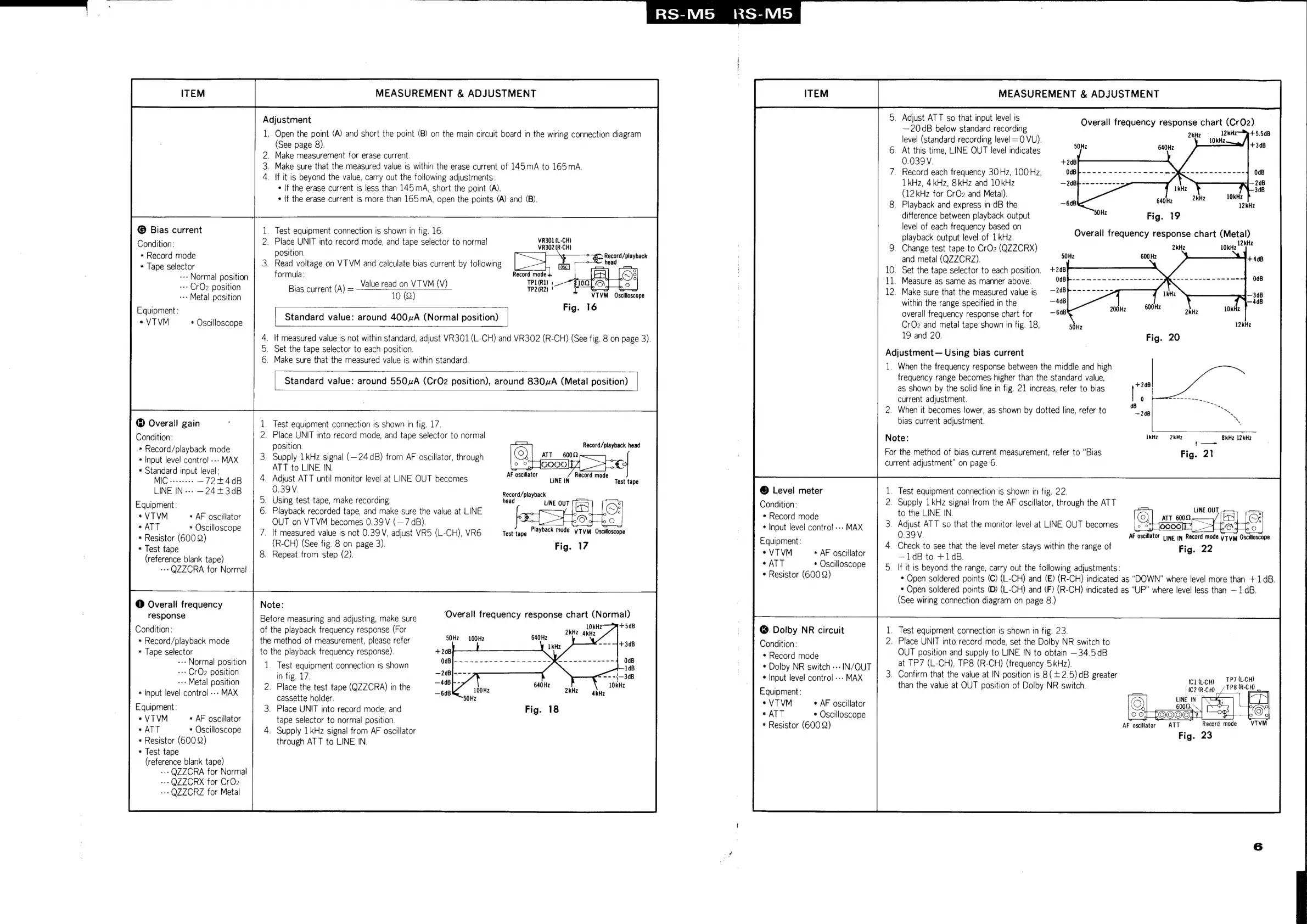
ITEM
MEASUREMENT
&
ADJUSTMENT
ITEM
MEASUREMENT
&
ADJUSTMENT
9.
Adjust
ATT
so
that
input
level
is
—-20dB
below
standard
recording
level
(standard recording
level
=0
VU).
6.
At
this
time,
LINE
OUT
level
indicates
0.039V.
7.
Record
each
frequency
30
Hz,
100
Hz,
1kHz,
4kHz,
8kHz
and
10
kHz
(12kHz
for
CrO2
and
Metal).
8.
Playback
and
express
in
dB
the
difference
between
playback
output
level
of
each
frequency
based
on
playback
output
level
of
1
kHz.
9.
Change
test
tape
to
CrOz
(QZZCRX)
2kHz
10kHz
and
metal
{(QZZCRZ).
a
10.
Set
the
tape
selector
to
each
position.
11.
Measure
as
same
as
manner
above.
12.
Make
sure
that
the
measured
value
is
within
the
range
specified
in
the
overall
frequency
response
chart
for
CrQz2
and
metal
tape
shown
in
fig.
18,
19
and
20.
Adjustment
Using
bias
current
1.
When
the
frequency
response
between
the
middle
and
high
frequency
range
becomes.
higher
than
the
standard
value,
as
shown
by
the
solid
line
in
fig.
21
increas,
refer
to
bias
current
adjustment.
0
2.
When
it
becomes
lower,
as
shown
by
dotted
line,
refer
to
eae
bias
current
adjustment.
Note:
IkHz
For
the
method
of
bias
current
measurement,
refer
to
“Bias
Fig.
21
current
adjustment”
on
page
6.
Adjustment
1.
Open
the
point
(A)
and
short
the
point
(B)
on
the
main
circuit
board
in
the
wiring
connection
diagram
(See
page
8).
2.
Make
measurement
for
erase
current.
3.
Make
sure
that
the
measured
value
is
within
the
erase
current
of
145mA
to
165mA.
4.
{f
it
is
beyond
the
value,
carry
out
the
following
adjustments:
¢
If
the
erase
current
is
less
than
145
mA,
short
the
point
(A).
¢
if
the
erase
current
is
more
than
165mA,
open
the
points
(A)
and
(B).
Overall
frequency
response
chart
(CrO2)
©
Bias
current
Condition:
*
Record
mode
*
Tape
selector
-++
Normal
position
--»
CrO2
position
--+
Metal
position
Equipment:
*
VTVM
*
Oscilloscope
.
Test
equipment
connection
is
shown
in
fig.
16.
2.
Place
UNIT
into
record
mode,
and
tape
selector
to
normal
beet
Overall
frequency
response
chart
(Metal)
12kHz
position.
3.
Read
voltage
on
VTVM
and
calculate
bias
current
by
following
formuia:
Value
read
on
VT
VM
(V)
10
(Q)
Bias
current
(A)
=
Fig.
16
|
Standard
value:
around
400A
(Normal
position)
.
lf
measured
value
is
not
within
standard,
adjust
VR301
(L-CH)
and
VR302
(R-CH)
(See
fig.
8
on
page
3).
.
Set
the
tape
selector
to
each
position.
.
Make
sure
that
the
measured
value
is
within
standard.
Oo
&
Standard
value:
around
550A
(CrO2z
position),
around
830A
(Metal
position)
Overall
gain
Condition:
*
Record/playback
mode
*
Input
level
control
---
MAX
_
Test
equipment
connection
is
shown
in
fig.
17.
2.
Place
UNIT
into
record
mode,
and
tape
selector
to
normal
position.
3.
Supply
1
kHz
signal
(—24dB)
from
AF
oscillator,
through
ATT
to
LINE
IN.
2kHz
S8kHz
12kHz
Record/playback
head
*
Standard
input
level:
ah
MIC
Gaseas
:
.—72+4dB
4.
Adjust
ATT
until
monitor
level
at
LINE
OUT
becomes
Neer
SNE
Test
tape
LINE
IN.--
—24+3dB
0.39
V.
|
Record/playback
©
Level
meter
_
Test
equipment
connection
is
shown
in
fig.
22.
Equioment:
o.
Using
test
tape,
make
recording.
head
Condition:
2.
Supply
1kHz
signal
from
the
AF
oscillator,
through
the
ATT
oe
|
.
6.
Playback
recorded
tape,
and
make
sure
the
value
at
LINE
to
the
LINE
IN.
=~
5
*
VTVM
+
AF
oscil
*
Record
mode
|
6000
au
ee
:
A
eae
OUT
on
VTVM
becomes
0.39V
(—7dB).
eal
pg
oe
+
Input
level
control
«-.
MAX
|
3:
Adjust
ATT
so
that
the
monitor
level
at
LINE
OUT
becomes
Of
ar
eon
[ES]
[CF
*
Resistor
(600
Q)
P
7.
\f
measured
value
is
not
0.39
V,
adjust
VR5
(L-CH),
VR6
Test
tape
|
*YD8CK
Mode
VTVM
0
a
|
0.39V.
AF
oscillator
1yye
jn
Record
mode
v'r
ym
Oscilloscope
»
Test
t
(R-CH)
(See
fig.
8
on
page
3).
Fig.
17
quipment:
.
4.
Check
to
see
that
the
level
meter
stays
within
the
range
of
Fia.
22
iigoe
blank
tape)
8.
Repeat
from
step
(2).
es
ai
gince
~~
TdB
to
+1dB.
.
*
ATT
*
Oscilloscope
|
5
If
it
is
beyond
the
range,
carry
out
the
following
adjustments:
--»
QZ77CRA
for
Normal
*
Resistor
(600)
¢
Open
soldered
points
(C)
(L-CH)
and
(£)
(R-CH)
indicated
as
“DOWN”
where
level
more
than
+1
dB.
*
Open
soldered
points
(D)
(L-CH)
and
(F)
(R-CH)
indicated
as
“UP”
where
level
less
than
—1
dB.
(See
wiring
connection
diagram
on
page
8.)
Note:
Before
measuring
and
adjusting,
make
sure
of
the
playback
frequency
response
(For
the
method
of
measurement,
please
refer
to
the
playback
frequency
response).
+2dB
@
Overall
frequency
response
Condition:
*
Record/playback
mode
*
Tape
selector
-««
Normal
position
‘Overall
frequency
response
chart
(Normal)
@.
Dolby
NR
circuit
Condition:
*
Record
mode
*
Dolby
NR
switch
--»
IN/OUT
.
Test
equipment
connection
is
shown
in
fig.
23.
2.
Place
UNIT
into
record
mode,
set
the
Dolby
NR
switch
to
OUT
position
and
supply
to
LINE
IN
to
obtain
—34.5dB
at
TP7
(L-CH),
TP8
(R-CH)
(frequency
5
kHz).
50Hz
100Hz
1.
Test
equipment
connection
is
shown
+++
CrO2
position
nie
ag:
—248
See
ane
pot
ee
3.
Confirm
that
the
value
at
IN
position
is
8(+2.5)
dB
greater
|
--+
Metal
position
2.
ae
the
test
tape
(QZZCRA)
in
the
—44B
c
ae
=
Ee
er
than
the
value
at
OUT
position
of
Dolby
NR
switch.
re
een
13
raat
:
See
eo
eens
cassette
holder
ae
S0Hz
an
ie
|
LINE
IN.
[>So
Equipment:
3.
Place
UNIT
into
record
mode,
and
Fig.
18
ee
:
a
rs
aC
*VTVM
*
AF
oscillator
tape
selector
to
normal
position.
*
Resistor
(600
Q)
ATT
Record
mode
*
ATT
Oscilloscope
4.
Supply
1
kHz
signal
from
AF
oscillator
Fig.
23
*
Resistor
(600
Q)
through
ATT
to
LINE
IN.
=
*
Test
tape
(reference
blank
tape)
-->
Q7ZCRA
for
Normal
-+»
Q7ZCRX
for
CrOz
--»
QZZCRZ
for
Metal

Related product manuals