Instructions for the installation, use and maintenance of Tecnicomar watermaker
2 Process description and system components identification
The watermaker has four main sections:
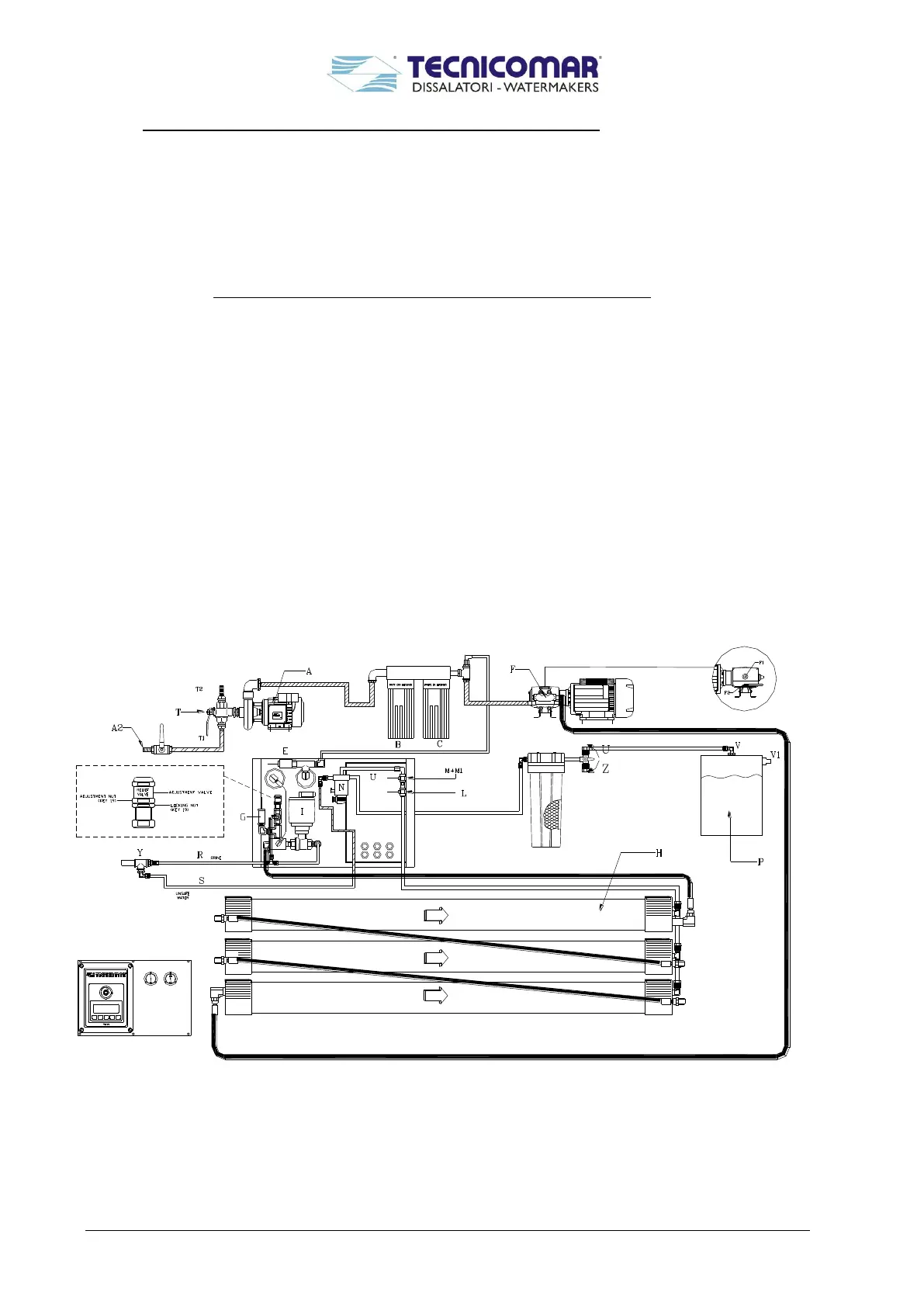
Prefiltration section where salt water, supplied by the booster pump (A), is filtrated passing through the two
prefilters (B and C). Feed water pressure is taken by the low pressure sensor (E) and shown on the display of the
electric box (Lbar);
High pressure section in which sea water is pressurized by the high-pressure pump (F). The high-pressure sensor
(G), electrically connected to the electric box, shuts down the system automatically if the operating pressure exceeds
the preset level. The unit can be equipped with automatic pressure regulator valve (I) or can be run also in manual
mode and the working pressure adjusted manually by the pressure regulator valve (I) located on top of the
motorized valve. The high-pressure tubes and their fittings require periodic (see MAINTENANCE section).
Salt water (BRINE) discharge section. In this section the brine is discharged. The fresh water is also discharged out
of board if it does not have the drinking-water quality. Through the three-way solenoid valve (N), the electric box
automatically switches the water coming from membranes either to the discharge or to the fresh water tank. The
water quality is checked by the salinity sensor (M). The temperature sensor (M1) compensates the reading
according to temperature. The salinity and temperature sensor require periodic maintenance (see MAINTENANCE
section).
Freshwater section. This is the most important section of the system, the section where the physical process of
reverse osmosis takes place. The main components of this section are the semipermeable membranes which separate
sea water in two flows: one with concentrated salts which goes to the discharge (R) and the other with fresh water
(U) which goes to the fresh water tank. The fresh water flow is taken by the flow sensor (L) before reaching the
three-way solenoid valve (N) and shown on the display. The three-way solenoid valve (N) switches the flow,
depending on its salinity, to the discharge or to the tank. The semipermeable membranes are very sensitive
components and require strict observance and care (see PROTECTION AND CARE OF SEMIPERMEABLE
MEMBRANES in Maintenance section).
Flow diagram (in case of supply c/w automatic pressure regulator)-see also attached drawing-


 To Next Page