Page 29
www.theenergydetective.com
Page 29
v.3.3.1
Load Prole
TED Footprints provides the ability to monitor simple changes in kW usage to create Load Prole Events. The
concept of Load Proling is based on TED’s recognition of a ‘footprint’ created when a load is turned on or off.
Theoretically, any electrical load may be proled, however, the more common the load (i.e. 60w light), the more
likely a false-positive will be registered. In other words, you may turn on your computer or TV, or any 60w load,
and Footprints would not be able to discern which was turned on - the light, the computer, or the TV. That being
said, major loads (water heater, HVAC, pool pump, hot tub) are more easily proled because they are less likely to
have similar loads. Please note that the Load Prole feature is only intended to indicate when an appliance might
have possibly been turned on or off, and that many factors may cause an event to be incorrectly registered.
The following is an example of Load Proling a Hot Water Heater
A hot water heater turning on might register a 4.6kW increase over a few seconds. TED Footprints will watch for
a 4.6 kW increase and register an event signaling that the device has been turned on. Once a 4.6kW decrease is
measured, Footprints will log an additional event signaling that the device has been turned off.
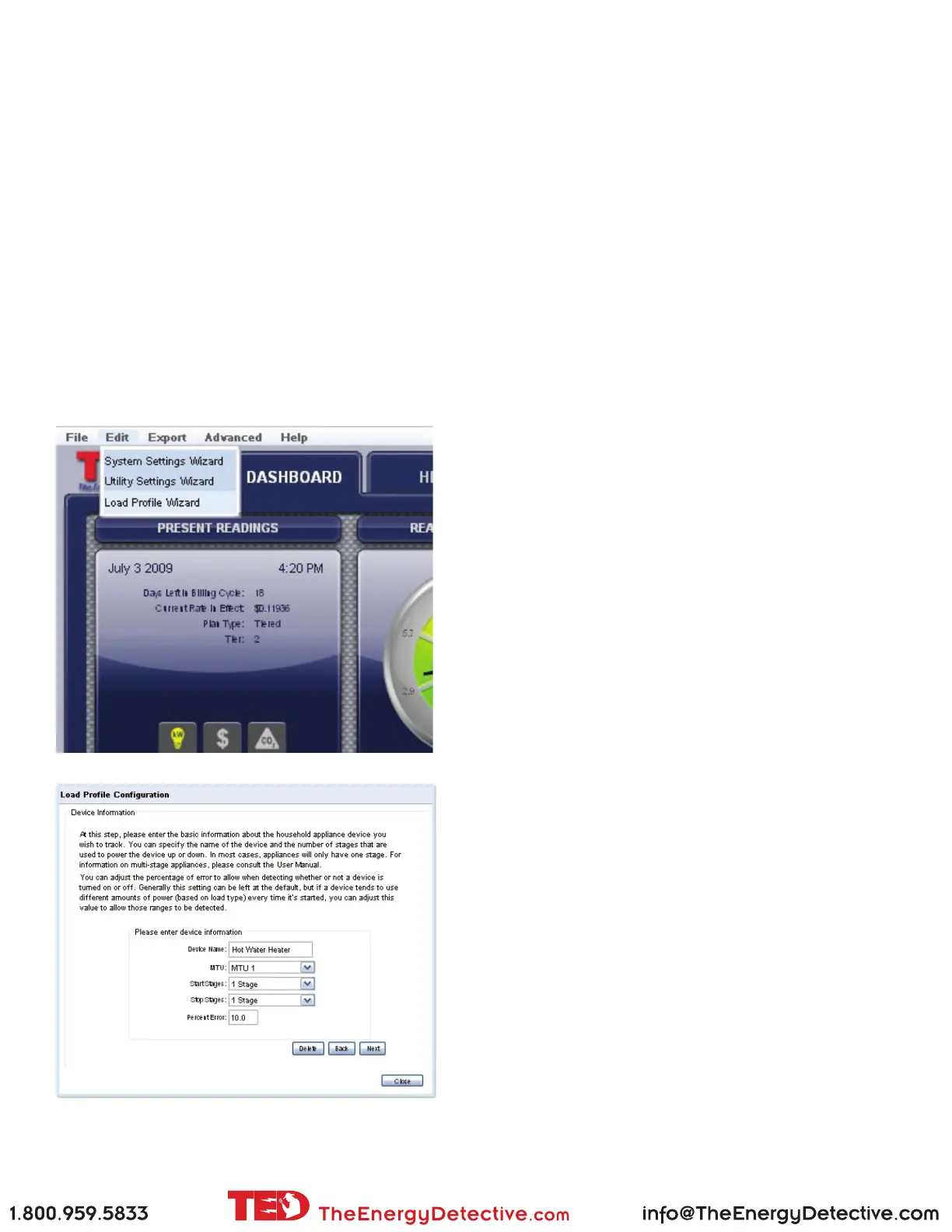
To Add, Edit or Delete a Load Prole Appliance. select
“Load Prole Wizard” under EDIT.
TED Footprints will track up to ve electrical devices.
To ADD a device
The wizard will prompt you for the name of the device.
Appliance Names must be unique. If you attempt to add
a second appliance with the same name as an appliance
that already exists, you will overwrite the settings of the
original appliance.
MTU# allows you to select which MTU the load may
be measured by (in the instance of dual electric panels,
or solar/wind generation). Generally, there will only be
one MTU.
Start Stages - Some electrical devices have multiple-
start stages (i.e. some HVAC systems).
Stop Stages - As with Start Stages, some devices power
down in stages.
Percent Error - This gure can be adjusted as the user
wishes. It will help TED Footprints to avoid false-
positive readings.


 To Next Page
 Loading...