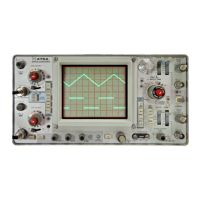
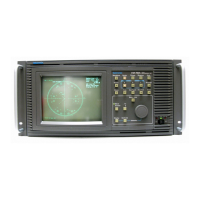
To prepare the rackmount or benchtop version for ad
justment, refer to the Rackmount/Benchtop Versions sec
tion of this manual (Section 6 ).
Remove the cabinet of the 492/492P as follows:
Preparation
1) set the 492/492P on its face or front panel;
2 ) loosen the four screws through the back rubber feet;
3) pull the cover up and off of the 492/492P;
4) place the instrument on the bench and reconnect the
power cord.
1. Check and Adjust Low Voltage Power Supply
this high efficiency power supply uses an internal
oscillator. The frequency of the oscillator is adjusted for
6 6 kHz. This adjustment is normally required only after re
placing oscillator components; therefore, Part 1 of this step
should only be performed after repair. Part 2 is the normal
adjustment and check procedure.
WARNING
The 492/492P uses a high efficiency power supply.
The potential of the primary ground for this supply is
different than chassis or earth ground. An isolation
transformer, with a turns ratio of 1:1 and a 500 VA
minimum rating, should be used between the power
source and the 492/492P power input receptacle. The
transformer must have a three-wire input and output
connector with ground through the input and output.
Stancor GIS21000 is a suitable transformer. A jumper
should also be connected between the primary ground
side to chassis ground (emitter of 02061 and the
ground terminal of the input filter FL301).
If the power supply is separated from the instrument
and operated on the bench, hazardous potentials will
exist within the supply for several seconds after pow
er is disconnected. This is due to the slow discharge
of capacitors C6101 and C6111. A relaxation
oscillator lights DS5112 (next to C6111) when the po
tential exceeds 80 volts.
Part 1
Adjusting the Power Supply Oscillator Frequency
a. Remove the Power Supply module as described in the
Maintenance section. Remove the Power Supply module
cover and disconnect P3045.
Calibration—492/492P Service Vol. 1 (SN B030000 & up)
Adjustm ent Procedure
b. Apply power to the module by plugging the power
cord into the power input plug and connect it to a suitable
power source (115 V ac or 230 V ac, depending on the posi
tion of P1091 on J1091).
c. Use a plastic or insulated tuning tool or equivalent, to
insert between the two power switches to engage these
switches.
d. Connect a test oscilloscope probe with a deflection
sensitivity of 5 V/div and sweep rate of 10 ^s/div to TP6053
(Fig. 3-22). Note the output waveform of the oscillator
U6059. Amplitude should be approximately 10 V.
e. Adjust R6061 (Oscillator Freq Adj) for a waveform pe
riod of 15 ^ (6 6 kHz).
f. Reinstall the power supply module cover, then install
the module on the 492/492P.
Part 2
Check and Adjust Low Voltages
a. Connect a Variac (line voltage regulator) in line with
the 492/492P power input and set the Variac for 117 Vac.
b. Connect a digital voltmeter (DVM) to +15 V test point
(Fig. 3-22B) on the Z-Axis board to monitor the +15 V
supply.
c. Remove the power supply cover screw located below
the 10 MHz IF OUTPUT jack on the rear panel (see Fig. 3-
22A). This will provide access to the +15 V adjustment,
R6028.
d. Insert a narrow bit screwdriver through the screw hole
and engage adjustment R6028. Adjust for +15 V on the
DVM.
e. Vary the input voltage range from 90 to 132 Vac and
note that the +15 V supply remains regulated.
f. Check the other supply voltages at test points indicat
ed in Fig. 3-22B against tolerances listed in Table 3-10.
Table 3-10
POWER SUPPLY VOLTAGE TOLERANCES
Supply
Tolerance
+ 9 V
+ 8.92 V to +10.1 V
-5 V
-4.95 V to -5.05 V
-15 V
-14.84 V to -15.13 V
+ 5 V +4.73 V to +5.23 V
+ 17 V
+ 16.8 V to +18.6 V
+ 100 V
+ 95 V to +105 V
+ 300 V
+ 280 V to +310 V
REV JUN 1983
3-43


 To Next Page
 Loading...