
 Need help?
Do you have a question about the Tektronix P6139A and is the answer not in the manual?
Contact information for technical questions and product support.
Information on extended warranty and calibration programs.
Resources for worldwide service centers and general inquiries.
Precautions to prevent injury and product damage from electrical hazards.
Steps to adjust low-frequency compensation for optimal waveform display.
Instructions for cleaning the probe exterior using mild solutions.
Illustration and description of standard probe accessories.
Detailed electrical specifications for the P6139A probe.
Physical and environmental operating parameters for the probe.
Graph showing input impedance versus frequency.
Graph illustrating voltage derating based on frequency.
List of relevant safety and compliance standards for the probe.
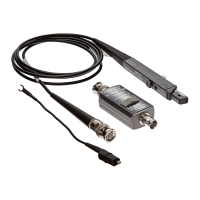
Diagram showing the probe and its standard accessories.
Table listing part numbers for the probe and standard accessories.
Diagram illustrating optional probe accessories.
Table listing part numbers for optional accessories.
Index of manufacturers with their contact and address information.
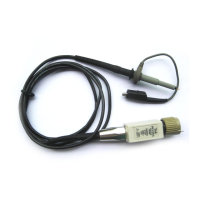
The Tektronix P6139A is a 10X passive probe designed for use with Tektronix TDS 3000 and TDS 500 Series digitizing oscilloscopes. It serves as a crucial interface between the circuit under test and the oscilloscope, allowing for accurate measurement of electrical signals. The probe's 10X attenuation factor reduces the signal amplitude by a factor of ten, which is beneficial when measuring higher voltages that might otherwise exceed the oscilloscope's input range. This passive design means the probe does not require external power, simplifying its operation and making it a reliable tool for various measurement tasks.
A key feature of the P6139A is its compact size and compatibility with the Tektronix family of compact (3.5 mm) probe accessories. This ensures versatility and ease of integration into existing test setups. The probe comes with a 1.3-meter cable, providing ample reach for connecting to different points in a circuit.
One of the essential aspects of using the P6139A probe is proper compensation. Due to variations in the input characteristics of different oscilloscopes, the probe's low-frequency compensation may need adjustment. This adjustment is critical to ensure accurate waveform representation, particularly for square waves. If the displayed square wave shows significant differences between its leading and trailing edges, it indicates that compensation is required. The process involves connecting the probe to the oscilloscope's calibration signal, adjusting the oscilloscope to display a meaningful waveform (often using an AUTOSET function), and then fine-tuning a trimmer located in the probe's compensation box until a perfectly flat-top square wave is achieved on the display. This ensures that the probe accurately transmits the signal without introducing distortions.
For safety and optimal performance, several usage features are highlighted. Users are warned against touching the metallic portions of the probe head when it is connected to a voltage source to avoid electric shock. It is also crucial to connect and disconnect the probe properly, meaning probes or test leads should not be connected or disconnected while they are attached to a voltage source. Observing all terminal ratings is paramount to prevent fire or shock hazards, and users should consult the product manual for detailed ratings information before making any connections. The common terminal of the probe is at ground potential, and it should never be connected to elevated voltages. Furthermore, no potential exceeding the maximum rating of any terminal, including the common terminal, should be applied.
The P6139A is designed for operation in specific environmental conditions. It should not be operated in wet or damp conditions, nor in an explosive atmosphere. If any damage to the product is suspected, it should be inspected by qualified service personnel before further use. These precautions are in place to ensure both user safety and the longevity of the device.
Maintenance of the P6139A probe primarily involves cleaning. To remove accumulated dirt from the probe's exterior, a soft cloth dampened with a mild detergent and water solution or isopropyl alcohol can be used. It is important to avoid using solvents such as benzene, toluene, xylene, or acetone, as these can damage the probe materials. Abrasive cleaners should also be avoided. Keeping the product surfaces clean and dry is a general recommendation for maintaining the probe.
The probe comes with a range of standard accessories that enhance its functionality and ease of use. A retractable hook tip allows for hands-free measurements by connecting the probe tip to wires and component leads. For a secure connection, the hook tip should be firmly pushed and twisted onto the probe tip. An adjustment tool is provided specifically for adjusting the probe compensation, accessible through an opening in the compensation box. Color marker bands are included to help users color-code the probe to the oscilloscope input, which is particularly useful when multiple probes are in use. These bands can be clipped around the strain relief of the probe head and the matching band on the strain relief of the probe output.
For specialized grounding needs, the P6139A includes an SMT KlipChip™ and ground lead, which connect the probe ground to small or hard-to-reach ground reference points. A low-inductance ground, consisting of a ground collar and short lead, connects the probe ground to a reference close to the signal source, minimizing aberrations on high-frequency signals caused by the inductance of a longer ground lead. A standard ground lead with an insulated alligator clip is also provided for general ground connections. A guard is integrated into the probe design to keep fingers away from the probe tip, offering protection against electric shock. This guard is a critical safety feature, and users are explicitly warned to keep their fingers behind it when using the probe.
In summary, the Tektronix P6139A is a versatile and essential 10X passive probe for digitizing oscilloscopes, offering reliable signal acquisition with careful attention to compensation and safety protocols. Its design and accompanying accessories facilitate accurate measurements across a range of applications, while clear instructions for usage and maintenance ensure its continued performance and user safety.
 General
| Type | Passive Voltage Probe |
|---|---|
| Bandwidth | 500 MHz |
| Input Impedance | 10 MΩ |
| Attenuation Ratio | 10:1 |
| Maximum Input Voltage Category | CAT II |
| Rise Time | 700 ps |
| Input Capacitance Accuracy | ±0.5 pF |
| Cable Length | 1.3 m |
| Connector Type | BNC |
| Input Capacitance | 8 pF |
| Maximum Input Voltage | 300 V (DC + AC Peak) |


 To Next Page