11
Temco VF36RN/RNH/RP
78586
When installing this fireplace at an elevation above
2,000 feet, it may be necessary to decrease the input
rating by changing the existing burner orifice to a
smaller size. Input should be reduced four percent
(4%) for each 1,000 feet above sea level, unless the
heating value of the gas has been reduced, in which
case this general rule will not apply. To identify the
proper orifice size, check with the local gas utility.
Consult your local gas utility for assistance in determin-
ing the proper orifice for your location.
Gas Pressure Check
The gas inlet pressure specified in Table 1 is the
pressure where the field-installed gas line connects to
the gas control. This is measured at the inlet test port
on the gas valve in the appliance. Ensure that pressure
is as shown in Table 1.
The manifold pressure is controlled by a regulator built
into the gas control and should be checked at the
pressure test points located between the flame adjust-
ment knob and the control knob at the front of the
Table 1
Gas Inlet Pressure Natural Propane
Max. 14.0” w.c. 14.0” w.c.
Normal 7.0” w.c. 11.0” w.c.
Min.* 4.5” w.c. 11.0” w.c.
Regulator Pressure 3.5” w.c. 10.0” w.c.
*Minimum inlet supply pressure for the purpose of input adjustment.
valve. The pressure connections accept 1/4” I.D. hose
or tubing.
The pressure should be checked with the appliance
burning on high (highest setting) and all other gas
appliances turned on. One must then read the manom-
eter and if pressures are not as specified in Table 1,
then the inlet pressure must be adjusted.
After measuring the pressure, tighten the screw in the
pressure test port and check for leaks. Replace the
control box cover and the two screws.
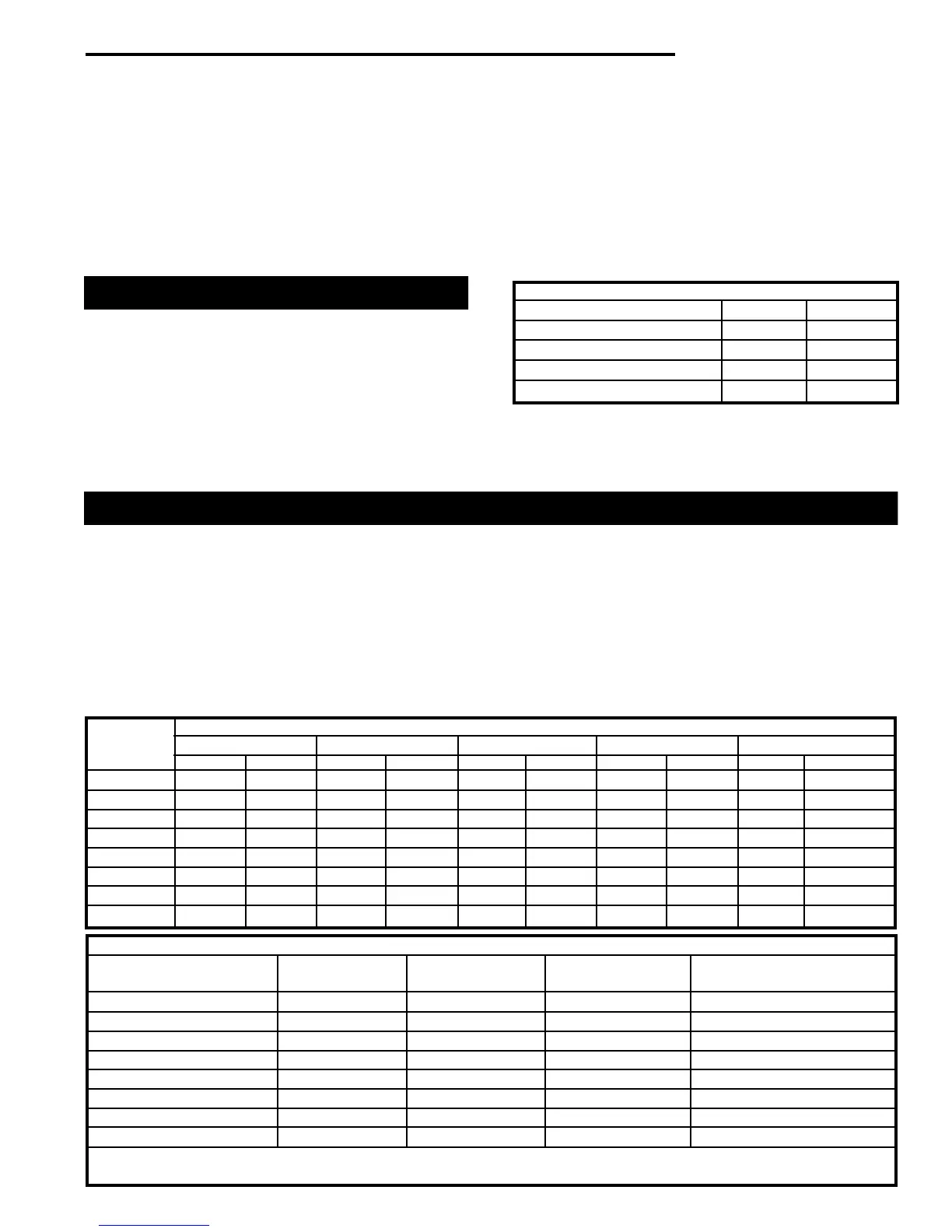
NOTE: To determine the size of the branch gas line from the main gas line to the fireplace, enter the tables below (for iron
pipe or copper tubing) using the distance from the gas meter or second stage regulator to the furthest appliance on the
gas system. Select a pipe or tube diameter which has enough capacity to meet the maximum input requirement of the
fireplace. Regardless, do not use less than 1/2" diameter for the branch line. For any distances required longer than
shown in these tables, refer to the National Fuel Gas Code.
NOTE: There may be a local gas utility requirement specifying a minimum diameter for gas piping. All units require a 1/2 inch pipe
connection at the gas valve.
Gas Line Pipe Sizing
CAPACITY OF PIPING
Cubic Feet per Hour based on 0.3" w.c. Pressure Drop
Specific Gravity for Natural Gas - 0.6 (1000 BTU/Cubic Foot)
Specific Gravity for Propane Gas - 1.6 (2550 BTU/Cubic Foot)
Length Nominal Inches for Iron Pipe Sizes (1,000s BTU/hr)
of 1/2” D 3/4” D 1” D 1¹⁄₄” D 1¹⁄₂” D
Pipe Natural Propane Natural Propane Natural Propane Natural Propane Natural Propane
20’ 92 143 190 296 350 546 730 1135 1100 1711
30’ 73 115 152 237 285 444 590 918 890 1385
40’ 63 97 130 202 245 380 500 778 760 1183
50’ 56 87 115 179 215 334 440 683 670 1043
60’ 50 79 105 163 196 304 400 622 610 949
70’ 46 71 96 151 180 280 370 576 560 872
90’ 40 61 84 130 160 250 320 497 490 763
100’ 38 59 79 122 150 235 305 474 460 717
Outside Diameter Copper Tubing, Type L (1,000s BTU/hr)
Tubing Length 1/2” 5/8” 3/4” 7/8”
Feet 0.43 0.545 0.666 0.785
10 110 206 348 536
20 76 141 239 368
30 61 114 192 296
40 52 97 164 256
50 46 86 146 224
60 42 78 132 203
80 36 67 113 174
100 32 59 100 154
WARNING: Use only internally tinned copper tubing. If correct copper tubing is not used, tubing can deteriorate and
develop gas leaks.
CAUTION: If the appliance’s operating pressures
are not checked and adjusted, improper combus-
tion may result in soot being produced.


 To Next Page