EasyManua.ls Logo

Ten-Tec JUPITER - Page 32

Ten-Tec JUPITER
92 pages
Print Icon
To Next Page IconTo Next Page
To Previous Page IconTo Previous Page
Loading...
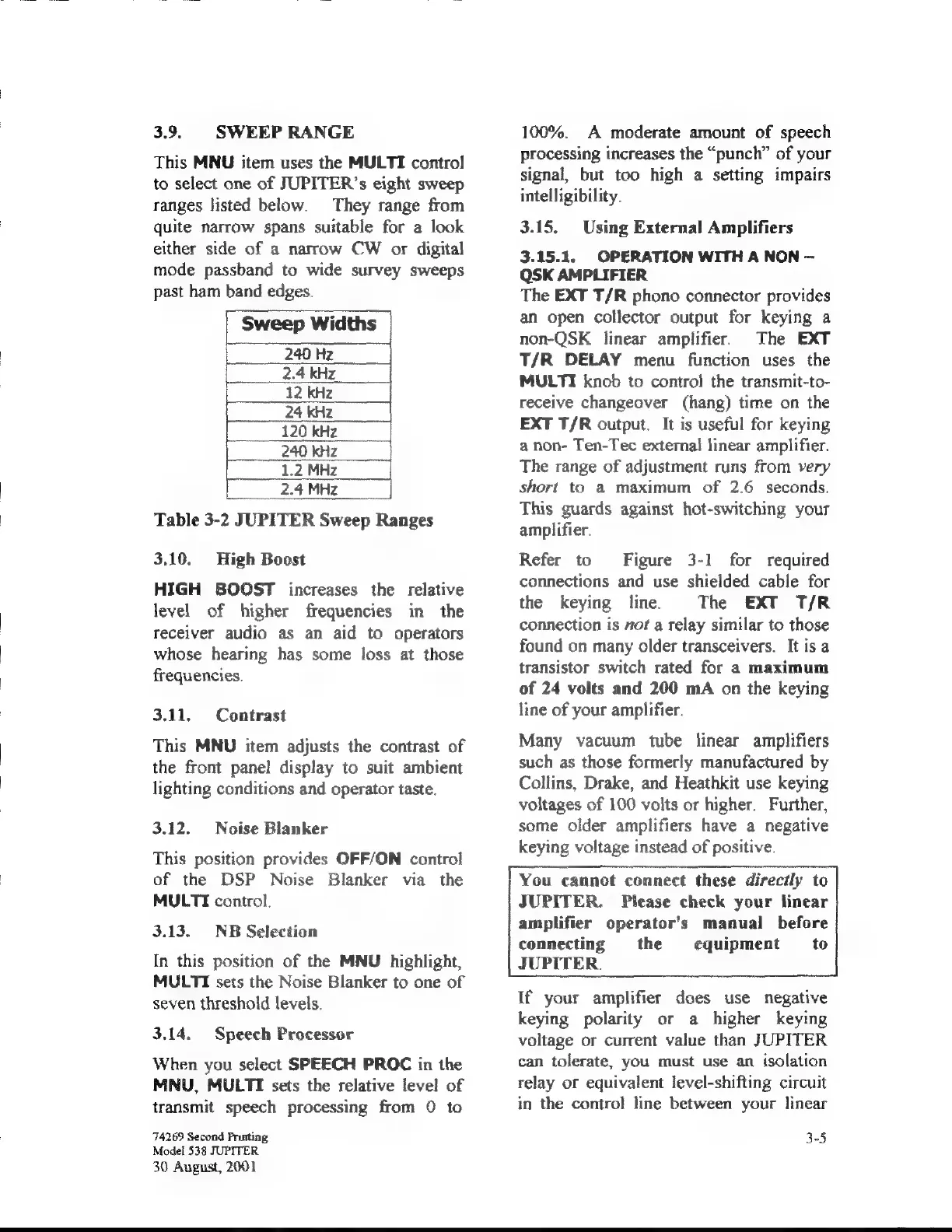
3.9.
SWEEP
RANGE
This
MNU
item
uses
the
MULTI
control
to
select
one
of
JUPITER”
s
eight
sweep
ranges
listed
below.
They
range
from
quite
narrow
spans
suitable
for
a
look
either
side
of
a
narrow
CW
or
digital
mode
passband
to
wide
survey
sweeps
past
ham
band
edges.
Sweep
Widths
240
Hz
2.4
kHz
12
kHz
Table
3-2
JUPITER
Sweep
Ranges
3.10.
High
Boost
HIGH
BOOST
increases
the
relative
level
of
higher
frequencies
in
the
receiver
audio
as
an
aid
to
operators
whose
hearing
has
some
loss
at
those
frequencies.
3.11.
Contrast
This
MNU
item
adjusts
the
contrast
of
the
front
panel
display
to
suit
ambient
lighting
conditions
and
operator
taste,
3.12.
Noise
Blanker
This
position
provides
OFF/ON
control
of
the
DSP
Noise
Blanker
via
the
MULTI
control.
3.13.
NB
Selection
In
this
position
of
the
MNU
highlight,
MULTI
sets
the
Noise
Blanker
to
one
of
seven
threshold
levels.
3.14.
Speech
Processor
When
you
select
SPEECH
PROC
in
the
MNU,
MULTI
sets
the
relative
level
of
transmit
speech
processing
from
0
to
74269
Second
Printing
Model
538
JUPITER
30
August,
2001
100%.
A
moderate
amount
of
speech
processing
increases
the
“punch”
of
your
signal,
but
too
high
a
setting
impairs
intelligibility.
3.15.
Using
External
Amplifiers
3.15.1.
OPERATION
WITH
A
МОМ
QSK
AMPLIFIER
The
EXY
T/R
phono
connector
provides
an
open
collector
output
for
keying
а
non-QSK
linear
amplifier
Тһе
EXT
T/R
DELAY
menu
function
uses
the
MULTI
knob
to
control
the
transmit-to-
receive
changeover
(hang)
time
on
the
EXT
T/R
output.
It
is
useful
for
keying
а
non-
Ten-Tec
external
linear
amplifier.
The
range
of
adjustment
runs
from
very
short
to
a
maximum
of
2.6
seconds.
This
guards
against
hot-switching
your
amplifier.
Refer
to
Figure
3-1
for
required
connections
and
use
shielded
cable
for
the
keying
line.
The
EXT
T/R
connection
is
по!
a
relay
similar
to
those
found
on
many
older
transceivers.
It
is
a
transistor
switch
rated
for
a
maximum
of
24
volts
and
200
mA
оп
the
keying
line
of
your
amplifier.
Many
vacuum
tube
linear
amplifiers
such
as
those
formerly
manufactured
by
Collins,
Drake,
and
Heathkit
use
keying
voltages
of
100
volts
or
higher.
Further,
some
older
amplifiers
have
a
negative
keying
voltage
instead
of
positive.
You
cannot
connect
these
directly
to
JUPITER.
Please
check
your
linear
amplifier
operator's
manual
before
connecting
the
equipment
to
JUPITER.
ТЕ
your
amplifier
does
use
negative
keying
polarity
or
а
higher
keying
voltage
or
current
value
than
JUPITER
can
tolerate,
you
must
use
an
isolation
relay
or
equivalent
level-shifting
circuit
in
the
control
line
between
your
linear
3-5

Related product manuals