EasyManua.ls Logo

Ten-Tec JUPITER - Page 79

Ten-Tec JUPITER
92 pages
Print Icon
To Next Page IconTo Next Page
To Previous Page IconTo Previous Page
Loading...
5.
THEORY
ОЕ
OPERATION
This
chapter
introduces
interested
users
to
a
brief
explanation
of
what
goes
on
behind
JUPITER's
front
panel
5.1,
Product
Composition
JUPITER's
basic
design
derives
from
the
Ten-Tec
Model
550,
but
a
number
of
changes
were
necessary
to
replace
PEGASUS'
personal
computer
functions
with
front
panel
controls.
Apart
from
the
software,
physical,
and
cosmetic
changes,
Ten-Tec
engineers
designed
several
new
electronic
circuit
board
subassemblies
to
transform
PEGASUS
to
JUPITER.
Model
538
comprises
the
following
electronic
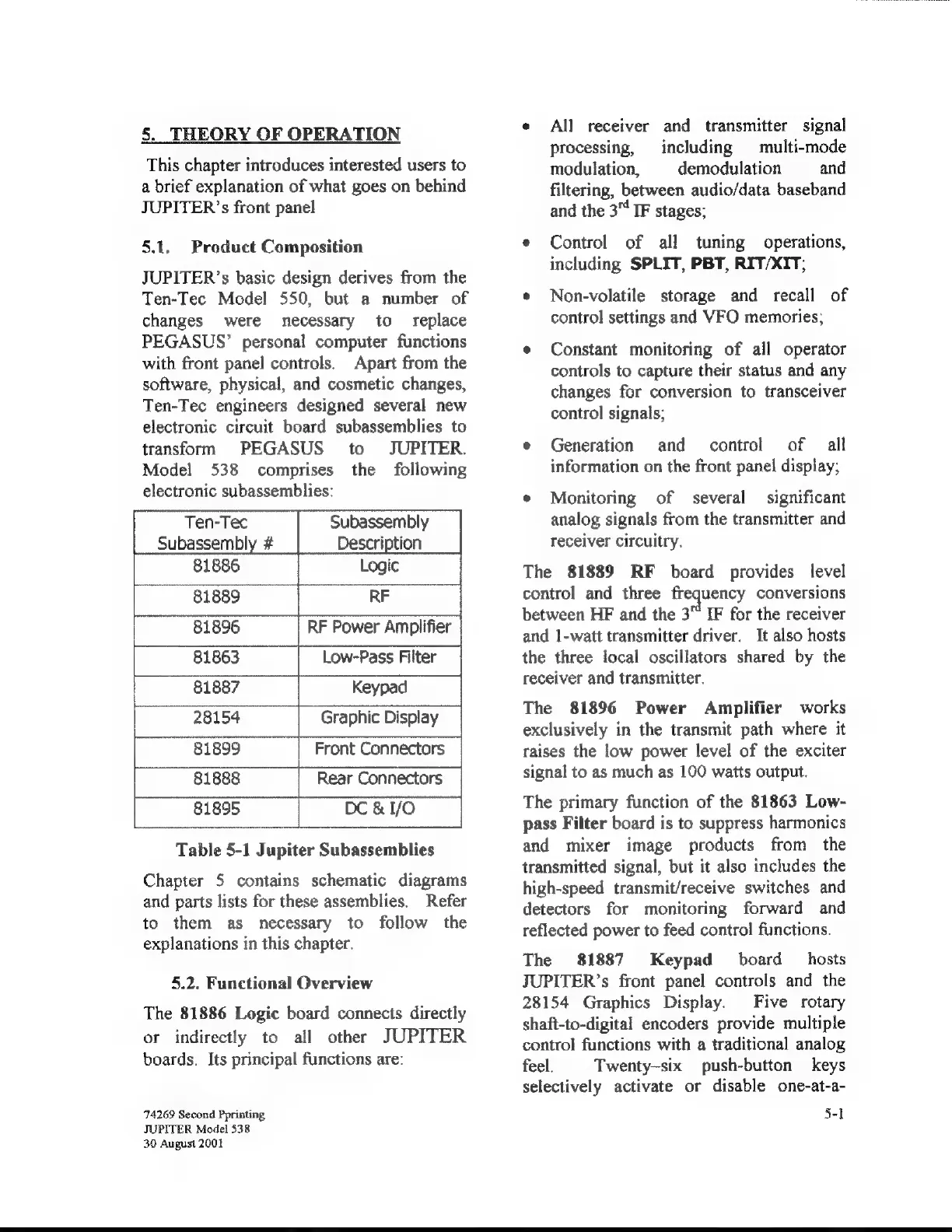
subassemblies:
Subassembly
Description
Logic
RF
RF
Power
Amplifier
Low-Pass
Filter
|
Graphic
Display
81899
Front
Connectors
Rear
Connectors
Table
5-1
Jupiter
Subassemblies
Chapter
5
contains
schematic
diagrams
and
parts
lists
for
these
assemblies.
Refer
to
them
as
necessary
to
follow
the
explanations
in
this
chapter.
5.2.
Functional
Overview
The
81886
Logic
board
connects
directly
or
indirectly
to
all
other
JUPITER
boards.
Its
principal
functions
are:
74269
Second
Pprinting
JUPITER
Model
538
30
August
2001
e
All
receiver
and
transmitter
signal
processing,
including
multi-mode
modulation,
demodulation
and
filtering,
between
audio/data
baseband
and
the
3"
IF
stages;
e
Control
of
all
tuning
operations,
including
SPLIT,
PBT,
RIT/XIT;
в
Non-volatile
storage
and
recall
of
control
settings
and
VFO
memories,
e
Constant
monitoring
of
all
operator
controls
to
capture
their
status
and
any
changes
for
conversion
to
transceiver
control
signals;
e
Generation
and
control
of
all
information
on
the
front
panel
display;
e
Monitoring
of
several
significant
analog
signals
from
the
transmitter
and
receiver
circuitry.
The
81889
RF
board
provides
level
control
and
three
frequency
conversions
between
HF
and
the
3"
IF
for
the
receiver
and
1-watt
transmitter
driver.
It
also
hosts
the
three
local
oscillators
shared
by
the
receiver
and
transmitter.
The
81896
Power
Amplifier
works
exclusively
in
the
transmit
path
where
it
raises
the
low
power
level
of
the
exciter
signal
to
as
much
as
100
watts
output.
The
primary
function
of
the
81863
Low-
pass
Filter
board
is
to
suppress
harmonics
and
mixer
image
products
from
the
transmitted
signal,
but
it
also
includes
the
high-speed
transmit/receive
switches
and
detectors
for
monitoring
forward
and
reflected
power
to
feed
control
functions.
The
81887
Keypad
board
hosts
JUPITER's
front
panel
controls
and
the
28154
Graphics
Display.
Five
rotary
shaft-to-digital
encoders
provide
multiple
control
functions
with
a
traditional
analog
feel.
Twenty-six
push-button
keys
selectively
activate
or
disable
one-at-a-
5-1

Related product manuals