
 Need help?
Do you have a question about the Texas Instruments bq27220 and is the answer not in the manual?
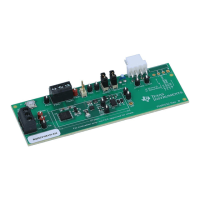
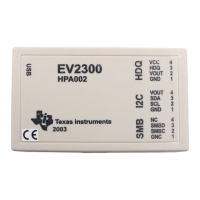
The bq27220EVM-744 Evaluation Module (EVM) is a comprehensive system designed for evaluating the bq27220 gas gauge. This EVM includes a bq27220 circuit module and an external current sense resistor, providing a complete platform for testing and configuration. To operate the EVM, it requires a separate EV2300 or EV2400 PC interface board, a PC USB cable, and PC software running on Microsoft® Windows®.
The primary function of the bq27220 circuit module is to monitor and predict the capacity of a system-side or removable battery pack fuel-gauge solution. When connected to the EV2300 or EV2400 interface, users can interact with the bq27220 device through the bqStudio software. This interaction allows for reading data registers, programming the chipset for various configurations, logging cycling data for in-depth analysis, and evaluating the overall functionality under different charge and discharge conditions.
The EVM offers several features to facilitate evaluation and configuration. It provides a complete evaluation system for the bq27220 CEDV (Compensated End-of-Discharge Voltage) gas gauge, ensuring a thorough assessment of its performance. The populated circuit module allows for quick setup, minimizing the time required to begin evaluation. The personal computer (PC) software and interface board simplify the evaluation process, offering a user-friendly environment. Additionally, the software includes data logging capabilities, which are crucial for detailed system analysis.
To get started, the bq27220EVM Quick Start Guide outlines the necessary steps. Users need the bq27220 circuit module, an EV2300 or EV2400 communications interface adapter, a USB cable, a computer with Windows XP or higher, internet access to download bqStudio software, and a DC power supply capable of supplying 4.5 V and 2 A (with constant current and constant voltage capability being desirable).
Software installation involves downloading the latest bqStudio version from the Texas Instruments website. It's important to ensure the EV2300 or EV2400 is not connected to the PC during installation. After copying the installation package to a temporary directory, users can run the bqStudio installer and follow the on-screen instructions. Once the software is installed, the EV2300 or EV2400 should be connected to the PC via USB. If using an EV2300, specific USB drivers may need to be installed manually by pointing to the TIUSBWin2K-XP-1 and TIUSBWin2K-XP-2 subdirectories. For the EV2400, the driver typically installs with the software. Troubleshooting unexpected dialog boxes may require logging in as an administrator and allowing the installation of unsigned drivers, especially on Windows 7.
The EVM connections are straightforward. The bq27220 circuit module connects directly to the battery pack (PACK+/PACK-), charger and load (LOAD+/LOAD-), I2C communication port (SDA, SCL, VSS), signal outputs (SOC_INT, SDQ, BAT_GD), and an external power connection (EXT). The circuit module then connects to the EV2300 or EV2400 interface board using wire leads for SDA, SCL, and VSS. Jumpers J9 and J10 on the bq27220EVM should be shorted for EV2300 connections and left open for EV2400.
Once set up, the bqStudio software can be launched. The DashBoard, Registers, and Commands windows should open by default. Users can update data in the Registers and Data Memory windows by clicking the Scan (continuous scan) or Refresh (single time scan) buttons. The logging function, enabled by clicking Start Log, records selected Data Registers. The default logging interval is 4000 milliseconds, which can be adjusted in the Preferences to 1000 milliseconds, though logging faster than 1 second is unnecessary as the gauge updates at that rate.
Configuring the bq27220 involves using the Data Memory window to adjust programmable options. It's crucial to ensure these settings match the battery pack and application for optimal performance. Users can read all data from the non-volatile flash memory by clicking Read All. To update parameters, select a parameter, enter the new value, and press Enter. Entire configurations can be imported or exported using *.gg.csv files.
Calibration is a critical maintenance step to ensure accurate value reporting from the bq27220EVM. This process is performed in the Calibration window of bqStudio. Calibration involves several steps:
For advanced configuration, the bq27220 supports CEDV (Compensated End-of-Discharge Voltage) parameters. Texas Instruments provides an online gauging parameter calculator (GPC) tool (www.ti.com/tool/GPCCEDV) to evaluate the bq27220. After programming design parameters, the EVM is used to collect experimental data necessary for calculating the CEDV coefficients. This process requires bqStudio software, the bq27220EVM-744, and a power supply capable of sourcing/sinking current (e.g., a gauge development kit, Keithley sourcemeter, or a regular DC power supply and electronic load). Detailed instructions for CEDV coefficients data collection and GPC tool configuration can be found in the "Simple Guide to CEDV Data Collection for Gauging Parameter Calculator (GPC)" (SLUUB45).
 General
| Type | Battery Fuel Gauge |
|---|---|
| Communication Interface | I2C |
| Operating Voltage | 2.5V to 4.5V |
| Operating Temperature | -40°C to +85°C |
| Battery Chemistry | Li-ion, Li-polymer |
| Accuracy | 1% |
| Cell Count | 1 |



 To Next Page