EasyManua.ls Logo

Thermal Care TSE - User Manual

Thermal Care TSE
52 pages
Print Icon
To Next Page IconTo Next Page
Loading...

Table of Contents

Question and Answer IconNeed help?

Do you have a question about the Thermal Care TSE and is the answer not in the manual?

Overview

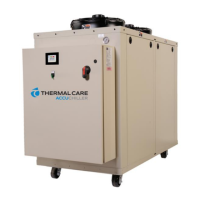
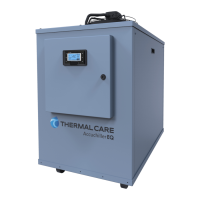
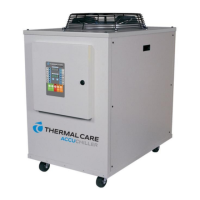
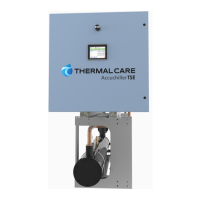
The document describes the THERMAL CARE Accuchiller TSE Central Chiller, a refrigeration system designed to provide cooling water to a coolant. This manual serves as a comprehensive guide for installation, operation, and maintenance of the equipment, emphasizing the importance of qualified personnel for all procedures to prevent poor performance or equipment damage.

Function Description:

The Accuchiller TSE Central Chiller utilizes a refrigeration circuit to cool water for various industrial processes. It is available in different configurations, including models with integral water-cooled condensers and those designed for use with remote air-cooled condensers. The chiller's control system, managed by a Programmable Logic Controller (PLC) and a color touch-screen Human Machine Interface (HMI), allows for precise control and monitoring of the refrigeration process. Key functions include managing compressor staging, electronic expansion valve (EEV) control, pump control, and discharge control to maintain optimal operating conditions and energy efficiency. The system can be integrated into common process fluid supply and return piping systems, with options for field-installed fluid-temperature and flow sensors for enhanced control in multi-chiller setups.

Important Technical Specifications:

The chiller uses hydrofluorocarbon (HFC) R-410A as a chemical refrigerant, contained within ASME coded vessels. Refrigerant piping design is critical, with total distances between the chiller and air-cooled condenser not exceeding 200 actual feet or 300 equivalent feet. Liquid line risers are limited to 15 feet in height from the condenser liquid line connection, and discharge line risers cannot exceed an elevation difference greater than 100 actual feet without a minimum of 2% efficiency decrease. Proper pipe sizing, as detailed in tables for various ton circuits (10, 15, 20, 25, 30, 40, 50, 60, 80, 100, 120 tons), is essential for satisfactory performance. The nominal water-cooled condenser is designed for 85°F condenser cooling water supply, with a typical 10°F rise resulting in 95°F exiting water. It requires a condenser water pump providing at least 25 psi or a flow rate of 3 gpm per ton of chiller capacity. The equipment is designed to operate within a sound pressure level of 70 dBA at 1 meter distance and 1 meter elevation. The control system includes two levels of security: "User" (password 9999) and "Supervisor" (password 7720).

Usage Features:

The HMI provides an intuitive interface for system operation. Users can navigate through various menus for system overview, alarms, diagnostics, security, inputs/outputs, and user setup.

  • System Overview: Displays a synopsis of the chiller system, including CKT Demand, Status Messaging, Setpoint, and Alarm status.
  • Starting and Stopping: Dedicated screens allow for easy initiation and cessation of chiller operation.
  • Alarms: Provides a listing of active and prior alarm history, with options to silence and reset alarms. Warning Glycol screens appear if the chiller setpoint goes below 45°F, requiring antifreeze.
  • Diagnostics: Offers detailed information on various system components, including pumps, chiller tank, process, hardware, and import/export data.
  • Security: Password-protected menus allow for managing user accounts, changing passwords, and controlling access to sensitive operating parameters.
  • Inputs/Outputs: Displays real-time status of temperature, pressure, analog, and digital inputs and outputs, aiding in monitoring and troubleshooting.
  • User Setup: Allows customization of various parameters, including alarm settings, hot gas bypass, EEV control, compressor staging, stage order, discharge control, dynamic lift, serial communications (Modbus RTU), temperature retransmit, IP address, and display units.
  • Trending: Graphical representation of core operating parameters like setpoint temperature, evaporator fluid out, process supply and return temperature, and hot gas bypass valve resisters for system analysis.
  • Full Screen View: A simple, large-font display of the process supply temperature for quick reference.

Maintenance Features:

The manual outlines a comprehensive preventive maintenance schedule to ensure optimal performance and extended equipment life.

  • Weekly Maintenance:
    • Check process temperature against setpoint (should be within 5°F).
  • Monthly Maintenance:
    • Check integral chiller and/or process pump discharge pressures.
    • Check suction and discharge refrigerant pressure at the compressor.
    • Inspect refrigerant sight glass for air bubbles or moisture.
    • Check compressor oil level in the sight glass.
    • Clean the Y strainer between the return connection and the evaporator inlet.
    • Visually inspect and clean the flow sensor tip.
    • Shut off power, check electrical connections for loose or frayed wires.
    • Verify main power supply and ground connection.
    • Check amp draws to each compressor leg.
    • Check system superheat (10-15°F) and sub-cooling (10-20°F).
  • Bi-Annual (Every 6 Months) Maintenance:
    • Perform all monthly checks.
    • Check for visible mechanical damage to the compressor.
    • Check for excessive vibration from rotating equipment.
    • Inspect power cables for signs of hot spots/discoloration.
    • Ensure all communication cables are secure and tight.
    • Verify all electrical modules are secure.
    • Check system refrigerant charge.
    • Check compressor crankcase heater operation.
  • Annual Maintenance:
    • Perform all bi-annual checks.
    • Check chilled water condition for algae and particulate fouling; backflush the evaporator.
    • (TSEW Models) Check condenser water for algae, scale, and particulate fouling; rod out and backflush tubes; chemical clean if necessary.
    • (TSER Models) Check air coils of remote condensers for dirt and debris; blow out contaminants with compressed air.
    • Perform compressor oil analysis to determine moisture content and acid level.
  • Operator Interface Cleaning: Use a clean sponge or soft cloth with mild soap/detergent, rinse with clean water, and dry with a chamois or moist cellulose sponge. Avoid abrasive cleaners or solvents.

The manual also includes a troubleshooting guide for common issues like compressor not starting, low/high refrigerant pressure, freezestat problems, insufficient cooling, and erratic temperature control. It emphasizes the importance of proper water chemistry and glycol solutions to prevent corrosion, scale, fouling, and biological contamination, providing detailed requirements for fill water chemistry.

Thermal Care TSE Specifications

General IconGeneral
BrandThermal Care
ModelTSE
CategoryChiller
LanguageEnglish

Related product manuals