
 Need help?
Do you have a question about the Thermo Scientific HM340E and is the answer not in the manual?
General safety guidelines for operating the microtome, including warnings and precautions.
Safety precautions and guidelines for handling chemicals used with the microtome.
Information regarding waste disposal and compliance with environmental directives.
Details on the product warranty and conditions for its validity.
Statement on the instrument's compliance with electromagnetic compatibility standards.
Specifies the device's purpose and applications in diagnostic procedures.
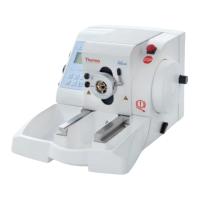
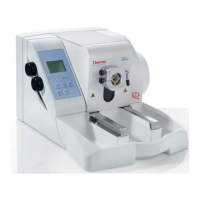
Provides an overview of the microtome's features, design, and capabilities.
Lists all accessories included with the microtome as standard.
Details optional accessories available for purchase to enhance microtome functionality.
Presents detailed technical specifications, performance parameters, and operating conditions.
Step-by-step guide for unpacking, positioning, and initial setup of the microtome.
Procedure for connecting the operating panel and powering on the instrument for the first time.
Overview of the microtome's control panel, its layout, and key functions.
Explanation of the display elements and the function of various keys on the operating panel.
Information displayed during the cutting process, including section count and thickness.
Instructions on how to set precise section and trimming thicknesses for sectioning.
Details on the microtome's cutting mechanism and the specimen retraction function.
How to use the motorized coarse feed system for specimen positioning and movement.
Enables manual sectioning in rocking mode; instructions to start and stop the function.
Overview of different adapters for securing specimen clamps to the microtome.
Adapter for direct, non-orienting fastening of specimen clamps.
Adapter allowing specimen alignment with the knife/blade.
Methods and accessories for securely clamping specimens for sectioning.
Description of the universal clamp for quick cassette changes.
Details on the adjustable clamp for various cassette sizes.
Clamp designed for rectangular and square paraffin and plastic blocks.
Accessories for clamping round specimens or providing V-shaped support.
Information on different carriers for holding knives and blades.
Details on the ER model for disposable blades, including blade insertion.
Procedure for adjusting the blade's clearance angle for optimal cutting.
Details on the E model for disposable blades, including blade insertion.
Specific information and instructions for Knife Carrier C, including knife insertion.
Description of the waste tray and its integrated arm rest feature.
Information about the large field magnifier accessory, including its specifications.
Instructions for mounting the large field magnifier onto the microtome.
Key points and guidelines for performing effective sectioning with the microtome.
Requirements for knife/blade sharpness, cleanliness, and condition for optimal sectioning.
Procedure for adjusting the knife's cutting angle to achieve desired section quality.
Tips and procedures to prevent common errors during microtome operation.
Identifies common problems, their causes, and recommended solutions.
Daily cleaning procedures and recommendations for maintaining the microtome.
General maintenance practices and recommendations for instrument upkeep.
Recommendation for yearly maintenance by a trained service technician.
Information on service contracts for ensuring optimal instrument condition.
Procedures for replacing components, specifically focusing on fuses.
Step-by-step guide for safely replacing the instrument's power fuses.
Procedures and precautions for returning the instrument for service or maintenance.
Steps to safely take the microtome out of operation, including temporary storage.
Guidelines for environmentally responsible disposal of the instrument at end-of-life.
 General
| Type | Microtome |
|---|---|
| Trimming Thickness Setting | 1 µm increments |
| Vertical Specimen Stroke | 60 mm |
| Specimen Retraction | Automatic |
| Power Supply | 100-240 VAC, 50/60 Hz |
| Operating Temperature Range | 10°C to 35°C |
| Operating Humidity Range | 20% to 80% non-condensing |


 To Next Page