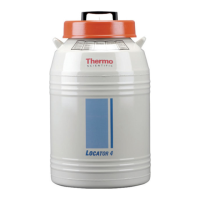
The Thermo Scientific LOCATOR® & LOCATOR Plus are cryobiological storage vessels designed for the long-term preservation of biological samples in liquid nitrogen. These units are accompanied by a Liquid Nitrogen Level Monitor (Type CN50900) to ensure safe and efficient operation.
Function Description:
The LOCATOR and LOCATOR Plus vessels utilize a vacuum-insulated design to maintain extremely low temperatures, specifically -196°C, for cryopreservation. This design is crucial for keeping nitrogen in a liquid form and preventing rapid evaporation. The vessels are intended for storing samples in either the liquid phase (submerged in liquid nitrogen) or the vapor phase (slightly above the liquid nitrogen level).
The Liquid Nitrogen Level Monitor (Type CN50900) is an accessory that continuously monitors the liquid nitrogen level inside the vessel using ultrasonic sound waves. This non-physical probe method prevents increased liquid nitrogen consumption often associated with conventional probes. The monitor provides both visual (5-segment LED display) and audible alarms to alert users to low liquid nitrogen levels or rapid drops in level, which could indicate a vacuum failure. A microprocessor controls the display and alarm functions, ensuring continuous and reliable monitoring.
Important Technical Specifications:
The manual provides detailed specifications for various LOCATOR and LOCATOR Plus models, including:
- Height (Including lid): Ranges from 27.5" (69.85 cm) for LOCATOR JR. to 40" (101.6 cm) for LOCATOR 4 Plus, LOCATOR 8 Plus, and LOCATOR JR. Plus. The level monitor adds 1 inch to these heights, and a transportation cart adds 4 inches.
- Diameter: All models have a diameter of 22" (55.8 cm) or 26" (55.8 cm) for LOCATOR 6 Plus.
- Vessel Volume: Ranges from 50L (LOCATOR JR.) to 165L (LOCATOR 6 Plus).
- LN2 Capacity, Liquid Phase Storage: Ranges from 40L (LOCATOR JR.) to 134L (LOCATOR 6 Plus).
- Vapor Phase LN2 Capacity: Ranges from 20L (LOCATOR JR.) to 39L (LOCATOR 6 Plus).
- Static LN2 Evaporation Rate - L/Day: Ranges from 0.40 L/day (LOCATOR 8) to 0.80 L/day (LOCATOR 4 Plus, LOCATOR 6 Plus, LOCATOR JR. Plus).
- Liquid Phase Capacity (Ampules):
- Using Nalgene cryoboxes with 9x9 ampule configuration: Ranges from 1296 ampules (LOCATOR JR.) to 4860 ampules (LOCATOR 6 Plus).
- Using Nalgene System 100 cryoboxes with 10x10 ampule configuration: Ranges from 1600 ampules (LOCATOR JR.) to 6000 ampules (LOCATOR 6 Plus).
- Vapor Phase Capacity (Ampules):
- Using Nalgene cryoboxes with 9x9 ampule configuration: Ranges from 972 ampules (LOCATOR JR.) to 3888 ampules (LOCATOR 6 Plus).
- Using Nalgene System 100 cryoboxes with 10x10 ampule configuration: Ranges from 1200 ampules (LOCATOR JR.) to 4800 ampules (LOCATOR 6 Plus).
- Environmental Conditions:
- Operating: 17°C - 27°C; 20% to 80% relative humidity, non-condensing. Installation Category II, Pollution Degree 2. Altitude limit: 2,000 meters.
- Storage: -25°C to 65°C; 10% to 85% relative humidity.
- Intended for indoor use only.
- Liquid Nitrogen Level Monitor: Operates on 15Vdc (+/- 10%) 0.2 amps, 3.0 Watts.
- Alarm Contact Specifications (Photomos type relay):
- Contact Form: Type 1 form B
- Load Voltage Maximum: 24 Vdc Max
- Load Current Maximum: 120 mA
- Typical On Resistance: Maximum 26 Ω
Usage Features:
- Safety Attire: Always wear proper safety attire (face shield, cryogenic gloves, cryogenic apron) when handling liquid nitrogen or related equipment.
- Filling Instructions:
- For warm vessels, add a small amount (5-10 liters) of liquid nitrogen and allow it to sit for at least 2 hours before adding more. This minimizes stress from sudden temperature changes.
- Never overfill; the liquid nitrogen level should remain below the tops of the racks. Overfilling can crack the neck and lead to vacuum failure.
- Allow for displacement when inserting racks and boxes.
- Measuring Liquid Nitrogen Quantity: Use a wooden yardstick to measure the liquid nitrogen level. Never use a hollow tube or plastic dipstick. The frost line indicates the level. The Level Monitor provides continuous measurement.
- Storing Samples in Vapor Phase: Remove the bottom-most cryoboxes from each rack. Fill the vessel with liquid nitrogen to a height corresponding to the removed cryoboxes. A level monitor is highly recommended for vapor phase storage due to lower liquid nitrogen levels.
- Rack Insertion/Removal: Insert and remove racks slowly and vertically to avoid contact with the neck tube area, which can cause premature vacuum failure.
- Vacuum Port: Do not tamper with or remove the vacuum port (covered by a black plastic cap) or spill liquid nitrogen on it, as this will void the warranty and can cause vacuum failure.
- Upright Position: Always keep the liquid nitrogen vessel in an upright position.
- Transportation: LOCATOR vessels are not designed for transport. For cryogenic transport, consider Arctic Express Dry Shippers.
- Level Monitor Operation:
- After placing the cover with the monitor on the vessel and plugging it in, allow approximately 15 minutes for the system to equilibrate and provide an accurate reading.
- If the vessel is new, allow at least 1 day for the liquid nitrogen to equilibrate before plugging in the monitor to avoid false alarms.
- Press the "Reset" button after placing the unit on the vessel; the green LED on the switch should be "OFF."
- Audible and Visual Alarms (Level Monitor):
- "LOW LEVEL" light flashes when 2" of liquid nitrogen remains.
- Audible alarm sounds intermittently when 1" of liquid nitrogen remains.
- Continuous audible alarm and all 5 LED segments lit indicate no liquid nitrogen or a rapid drop (1/2" per hour or more), signaling an emergency or vacuum failure.
- Safety Feature (Level Monitor): A "RESET" switch lights and an audible alarm sounds intermittently if the user does not reset the monitor after removing the vessel cover. The microprocessor must be reset each time the cover is removed. If not reset, an audible alarm will sound after five minutes, prompting deactivation of reset/hold mode and cover replacement.
- Remote Alarm Connection: The Level Monitor can be connected to a remote alarm system, providing alerts even when the laboratory is unoccupied. The alarm contacts are activated simultaneously with the monitor's audible alarm. The contact can be configured as normally open or normally closed via a jumper on the circuit board.
Maintenance Features:
- Regular Monitoring: Monitor liquid nitrogen consumption regularly (every 1-2 days) to anticipate subtle changes and react to potential problems.
- Periodic Testing: Consider having the vessel tested by the manufacturer or a qualified cryovessel service technician every 7-10 years, regardless of apparent problems, to ensure sample safety against sudden vacuum failure.
- Cleaning: Wipe exterior surfaces with a lightly dampened cloth containing mild soap solution.
- Level Monitor Troubleshooting:
- Intermittent alarm/incorrect reading: Caused by ice or frost buildup on the transducer. Solution: Remove the monitor, place it in a room for 20 minutes to allow moisture to drain, then replace it on the unit and press "Reset."
- Measuring "Full" after removing samples/replacing lid: Caused by fog in the neck area of the vessel. Solution: The fog will dissipate after about 15 minutes, after which the monitor will take an accurate reading.
- Replacement Parts: A comprehensive list of replacement parts is provided, including covers, corks, glue, transducers, PC boards, display boards, LEDs, and power supplies.
- Ordering Procedures: Refer to the Specification Plate for model, serial, and series numbers when ordering parts or requesting service. Contact the Thermo Scientific dealer or Customer Service Department for assistance. A Return Materials Authorization (RMA) number is required for all returned materials.

 Need help?
 General


 To Next Page