33
3. Tires and Wheel Nuts
Inspect tires for wear or damage. Check and inflate tires to
correct pressure:
10.00 x 16.5 ...........40 - 45 PSI (276 - 310 kPa)
Tires can be inflated to 50 PSI (345 kPa) when operating
on hard, flat surfaces.
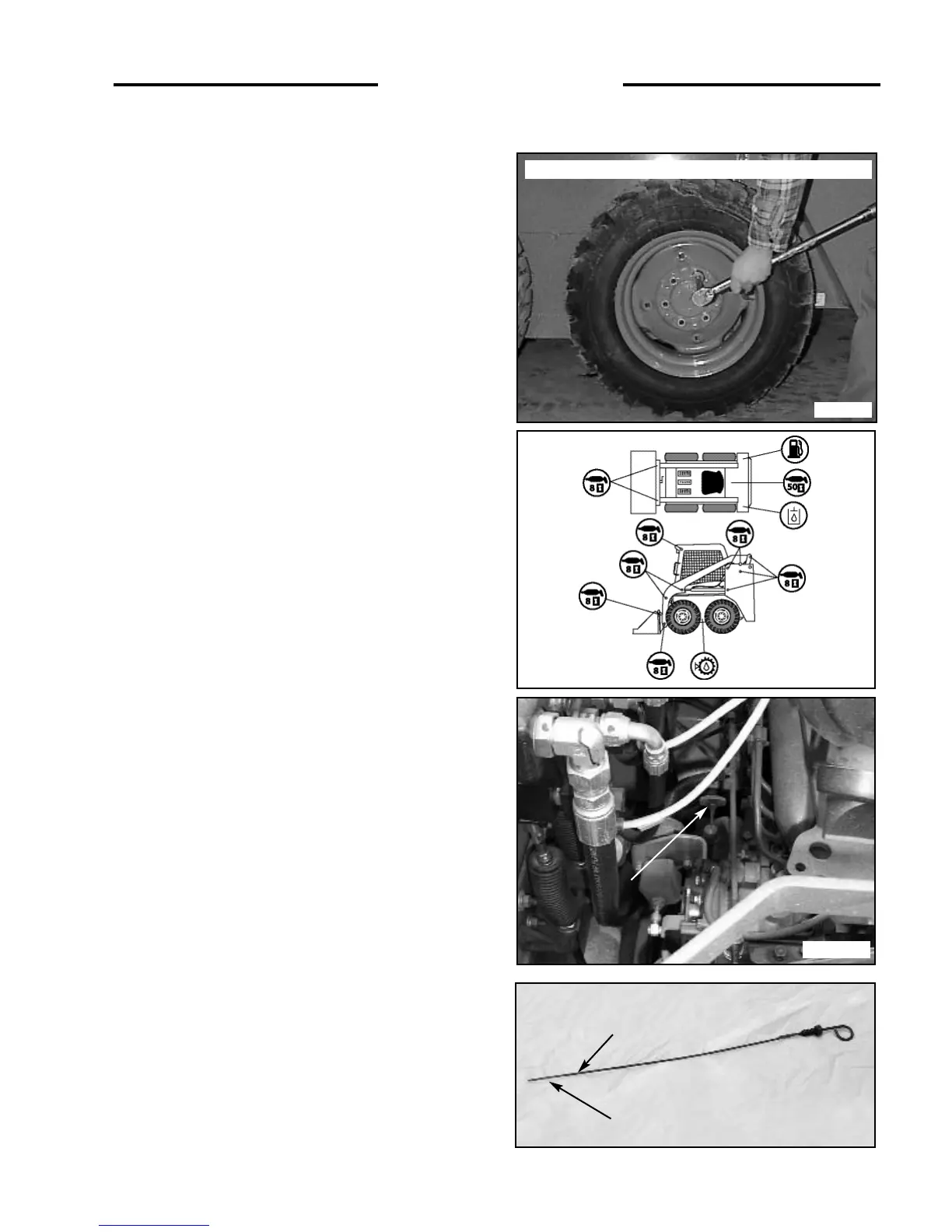
To prevent shearing of the wheel studs and rim damage
check wheel nuts for proper torque 100 -110 lbs. ft. (136 -
149 Nm) daily (Fig. 4.3C). After changing a rim, Check
wheel nuts hourly, until the reading stabilizes.
4. Safety Equipment
Check all safety equipment for proper operation and
condition - seat belt, lift arm supports, seat bar, steering
neutral lock, parking brake, quick tach lock, shields,
safety treads and lift arm lock down. Lubricate all
linkages, springs and pivot points with a silicone based
lubricant. Repair or replace if necessary.
5. Decals
Check the condition of all safety and instruction decals.
Replace any damaged or missing decals. Refer to Section
5.3 for decal description and locations.
6. Lubrication
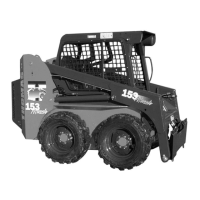
There are sixteen (16) grease fittings located in the loader
that require lubrication every eight hours. Lubricate with
a good quality multi-purpose lithium based grease. Apply
grease until excess shows. Refer to the service schedule
for complete service details. (See Fig. 4.3D). The sixteen
(16) lubrication points are:
Rear Lift Arm Pivots (2)
Lift Cylinder Bushings (4)
Bucket Cylinder Bushings (4)
Lift Arm Supports (2)
Quick Tach Pivot and Lock Pins (4)
7. Engine Oil Level
Check the oil before engine start up. If the engine has been
running let it cool for at least 5 minutes to allow the oil to
drain back to the oil pan.
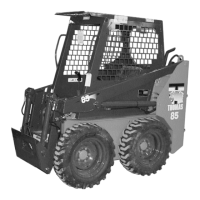
To check the oil level, check with the loader on level
ground, open the rear door and remove the dipstick (Fig.
4.3E).
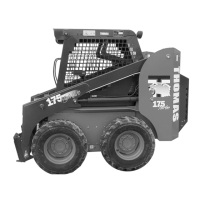
Keep the oil level between the full and low mark on the
dipstick (Fig. 4.3F). Do not fill above the full mark. Use
API Classification CF oil.
4. MAINTENANCE
C3956
Fig. 4.3D
Torque Wheel Nuts 100 - 110 lbs. ft. (136 - 149 Nm)
Fig. 4.3C
C3415
Fig. 4.3E
Dipstick
Location
C3414
Fig. 4.3F
FULL
LOW



 To Next Page