Need help?
Do you have a question about the THORLABS PDB210A and is the answer not in the manual?
Lists available PDB2xx Series models and their specifications.
Lists all items included in the PDB2xx Series package for each model.
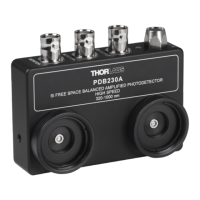
Describes the PDB230A's operating elements, which are identical across the PDB2xx Series.
Explains the function of the balanced photodetector and its components.
Details the free-space optical input ports and compatible accessories for beam alignment.
Describes the three BNC output connectors (MONITOR +, MONITOR -, RF OUTPUT).
Explains the mounting options using tapped holes and compatible accessories.
Describes the features and benefits of AC-coupled versions for modulated signals.
Explains Common Mode Rejection Ratio (CMRR) and how frequency response is measured.
Provides recommendations for achieving optimal common mode suppression and reducing noise.
Presents detailed technical specifications for PDB220A2, PDB210A, and PDB210C models.
Provides explanations and definitions for the technical specifications listed in the manual.
Displays performance plots, including responsivity and frequency response, for the PDB210A.
Displays performance plots for responsivity, frequency response, and spectral noise for the PDB210C.
Displays performance plots for responsivity, frequency response, and spectral noise for the PDB220A2.
Displays performance plots for responsivity, frequency response, and spectral noise for the PDB230A.
Displays performance plots for responsivity, frequency response, and spectral noise for the PDB230C.
Provides physical dimensions and mounting thread information for the PDB2xx Series.
Shows the EU Declaration of Conformity for the PDB2*, PDB4*, PDB5* models.
Important safety precautions and guidelines for operating the device safely.
Instructions for returning the device for servicing, emphasizing proper packaging.
Lists the manufacturer and EU importer addresses and contact details.
Outlines the 24-month warranty period and provides links to terms and conditions.
States copyright information and limits liability for document content.
Lists global contact information for Thorlabs sales and technical support.
The Thorlabs PDB2xx Series of Amplified Balanced Photodetectors are designed for optical measurement applications, offering a robust solution for detecting the difference between two optical input signals. These devices integrate two well-matched photodiodes with an ultra-low noise, high-speed transimpedance amplifier to generate an output voltage (RF OUTPUT) proportional to the difference in photocurrents. Additionally, they feature two fast monitor outputs (MONITOR+ and MONITOR-) to measure individual optical input power levels and low-frequency modulated signals on each detector separately.
The core function of the PDB2xx Series is to provide a balanced detection scheme, effectively suppressing common mode noise and allowing for precise measurements of differential optical signals. This is particularly useful in dual-beam setups where one optical path is for measurement and the other for an invariant reference. By balancing the optical power levels and path lengths, the devices can achieve significant common mode noise reduction, often exceeding 35 dB over their specified frequency range. The RF OUTPUT provides the primary differential signal, while the MONITOR outputs offer insights into the individual input power levels, aiding in alignment and balancing procedures. The PDB2xx Series can operate in both balanced mode (both inputs illuminated) and single detector mode, with the RF OUTPUT polarity depending on the input used in single detector mode.
The PDB2xx Series includes several models with varying specifications to suit different application needs:
All models share a photo diode damage threshold of 20 mW. Electrical outputs are BNC, with 100 Ω impedance for PDB210x/PDB220A2 and 50 Ω for PDB230x. Operating temperature range is 0-40 °C. The devices are powered by an included ±12 V @ 250 mA linear power supply.
 General
| Brand | THORLABS |
|---|---|
| Model | PDB210A |
| Category | Security Sensors |
| Language | English |

 To Next Page