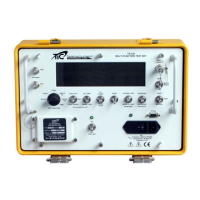
User Manual SDR-OMNI Avionics Test Set
Page 36 6 June 2023 Revision B
5.1.2 Direct Connect or TAP-OMNI Antenna Coupler Testing
Before beginning any ATC Transponder test, the SDR-OMNI needs to know which connection port will be used.
For Direct Connect testing OR testing with the TAP-OMNI antenna coupler, select the Direct T/R port
(Figure 5-2, 1) setting.
Direct Connect Testing
1. Connect the transponder to the Direct T/R TNC connector using the TIC-supplied 3 meter (10 foot) direct
connect cable (Figure 2-15). It may be necessary to use one of the supplied RF adapters to make the
connection (see Paragraph 2.2.16).
2. Make sure the Cable Length (Figure 5-2, 2) and Cable Loss (3) (marked on the cable) are correct; if
not, enter the correct values. If an RF adapter is used, add 1 dB per adapter to the Cable Loss value.
TAP-OMNI Antenna Coupler Testing
1. Check the Using TAP-OMNI Coupler checkbox (4).
2. Connect the 10 meter (33 foot) direct connect cable (Figure 2-15) from the SDR-OMNI to the TAP-OMNI
coupler (Figure 2-14). Attach the coupler to the desired antenna of the transponder system under test.
3. Verify the Cable Length (Figure 5-2, 2) and Cable Loss (3) (marked on the cable) are correct; if not,
enter the correct values. The Coupler Loss value of 0.9 dB (5) is added to the Cable Loss to compute
accurate power and sensitivity readings.
4. Select Close (6).
5.1.3 Over-the-Air (OTA) Testing with L-Band Directional Antenna
1. Connect the L-Band Directional Antenna (Figure 2-4) to the ANT-A Antenna A connector (see Paragraph 3.2)
in the top of the unit.
2. Select Antenna A in the Port field (Figure 5-3, 1).
3. Using Antenna Cable (2): Check this box only if an extension cable is inserted between the SDR-OMNI and
the L-Band Directional Antenna. If this box is checked, the operator will be asked to enter the cable length
and the cable loss.
4. Antenna Distance to UUT (3): Enter the distance from the SDR-OMNI antenna to the UUT antenna.
NOTE: Over-the-Air Testing with L-Band Directional Antenna
Position the SDR-OMNI so that it has an unobstructed line-of-sight to the
aircraft antenna to be tested. If testing a dual transponder installation, make
sure that the other transponder is OFF or in STANDBY so that it does not
reply.
The use of the TAP-OMNI antenna coupler is highly recommended to
minimize the possibility of receiving multipath reflections from hangar walls
and doors and other structures and to obtain the most accurate power and
MTL sensitivity measurements.
When testing Diversity transponders, the TAP-OMNI coupler will minimize the
reception of squitters from the non-tested antenna. If testing a Diversity
transponder over-the-air using the directional antenna, ensure that that the
non-tested antenna is not visible from the test set location – either by locating
the test set under (or over) the wing, or under or above the fuselage.


 To Next Page
 Loading...